
Reviewed · ANCIENT CORINTH TOURS
Biblical Corinth Taste Faith & History with wine & Oil Tasting
Corinth smells like wine and old stone. This half day of Corinth Canal, Paul-linked ancient sites, and the high fortress of Acrocorinth is a rare mix of faith, engineering, and big views.
I love the door-to-door pickup and the calm ride in a luxury mini-van with Wi-Fi, A/C, and bottled water. I also like how the route threads together the story, from the canal idea (2,000 years old) to the places tied to Saint Paul and the letters to the Corinthians.
One possible drawback: the main site area at Ancient Corinth can close unexpectedly for filming or safety, so your best plan is to be flexible if you are going on a day when closures are possible.
In This Review
- Key highlights worth planning for
- A private Athens ride to Corinth in about five hours
- Corinth Canal and the 19th-century waterway with a 2,000-year dream
- The Diolkos, the ancient ship track that beat the long way around
- Isthmia, the Isthmian Games, and Saint Paul in the background
- Isthmia Museum, Kechreon glass, and the kinds of objects that make faith visible
- Ancient Corinth, from Paul’s letters to the scale of a major Greek city
- Archaeological Museum of Corinth and what the site layout teaches
- Temple of Apollo, early Doric columns and the power of structure
- Free time for lunch and shopping, plus a useful habit
- Acrocorinth, the Upper Corinth fortress and the view that ties it all together
- Price and value: what $190.46 covers and what costs extra
- Wine and oil tasting options, and how to decide
- Who this tour fits best
- Should you book this Corinth Taste Faith and History tour?
- FAQ
- How long is the Corinth tour from Athens?
- Is pickup and drop-off included?
- Is it a bus tour?
- Are entrance fees included in the price?
- Are wine and oil tastings included?
- Do I need a licensed tour guide?
- What happens if weather is bad?
Key highlights worth planning for
- Small group, truly private: up to 7 people, in a luxury sedan or mini-van, not a bus crush.
- Paul-focused stops around the Isthmian region and Ancient Corinth, connected to First and Second Corinthians.
- Engineering history on full display with the Corinth Canal and the ancient Diolkos ship track.
- Acrocorinth fortress views from Upper Corinth, positioned like a last-defense command post.
- Museum time that most tours skip, including finds from Isthmia such as glass from Kechreon and votive offerings.
- Optional tastings available (wine and oil), so you can match the day to your budget and appetite.
A private Athens ride to Corinth in about five hours
This is a small-group outing run in a modern, first-class private vehicle. Your driver collects you from your Athens hotel, Airbnb, or the port, and then brings you back to the same spot afterward. If you are traveling solo or with one other person, you typically ride in a sedan. With up to 7 people, it shifts to a mini-van.
The practical value here is simple: you save time and hassle. You are not juggling bus schedules, taxis, or figuring out how to get from one ancient zone to the next. You also get a driver who explains what you are seeing in English, with plenty of room for questions as the day moves along.
In reviews, the standout theme is that the driving part is not just transportation. Guides like Panos are singled out for being attentive, and Periklis is praised for history lessons that show up during the ride, not only at the stops. That matters because Corinth is not just one “pretty ruin.” It is a whole system of places, roads, ports, and viewpoints.
More trails following Paul through Greece:
- Biblical Tour Letters ToThe Corinthians St Paul’s Footsteps 6Hour
★ 5.0 · 1,065 reviews - Private Biblical Tour Ancient Corinth & Isthmus Canal from Athens
★ 5.0 · 762 reviews - Private Tour of Apostle Paul’s Footsteps in Ancient Corinth
★ 5.0 · 275 reviews - Paul”s Footsteps Ancient Corinth Biblical Tour
★ 5.0 · 184 reviews
Corinth Canal and the 19th-century waterway with a 2,000-year dream
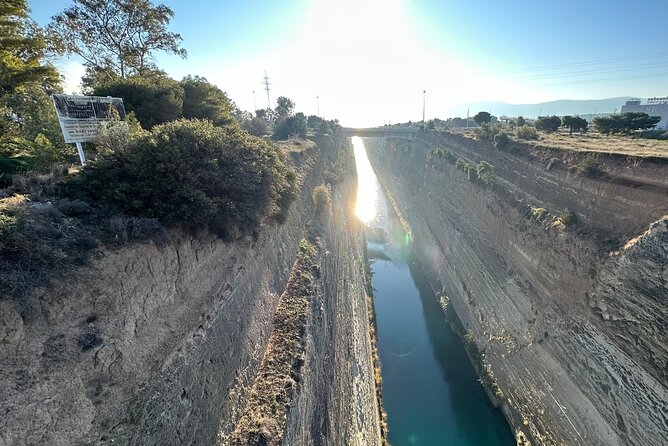
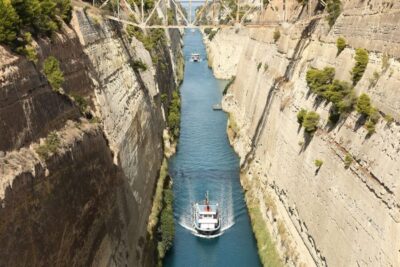
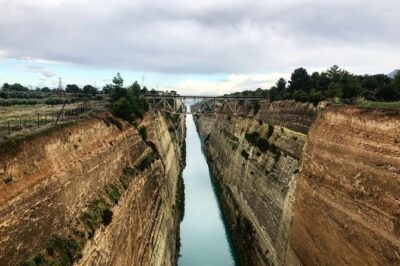
The day often starts with the Corinth Canal area, a narrow waterway that cuts across the isthmus. Its job today is to connect the Gulf of Corinth with the Saronic Gulf, effectively separating the Greek mainland from the Peloponnese like a shortcut.
What makes this stop more interesting than it sounds is the backstory. Before the canal was built, ships had to go around the Peloponnese peninsula. That meant an extra 185 nautical miles, basically adding time and risk to every passage.
The canal itself was executed in the late 19th century, but the idea is much older. It ties to the tyrant Periander around 602 BC, who is believed to be the first to imagine the canal dig. Since ancient engineers did not have the tools to make it happen, Corinthans pursued the faster overland transport solution instead, which leads you directly to the Diolkos.
Quick tip: wear shoes you can walk in comfortably for photos. Canal viewpoints can be windy, and you may want to pause for a slow look before the next stop.
The Diolkos, the ancient ship track that beat the long way around
Right near the canal is the Diolkos, an ancient paved trackway built to move vessels overland across the Isthmus of Corinth. This was the “skip the dangerous loop” plan, long before the modern canal existed.
Here are the key details to listen for from your driver:
- It operated from around 600 BC into the middle of the 1st century AD.
- The length was roughly 6 km to 8.5 km, depending on how it is measured in different references.
- Ships could be transferred using wheeled platforms, reducing travel time and avoiding the long circumnavigation.
There is also a cultural clue about how well-known it was. A phrase attributed to Aristophanes uses the idea “as fast as a Corinthian,” referencing the Diolkos reputation for speed. It is a fun moment because it connects logistics to everyday language.
And when you stand near it, you start to see why Corinth mattered. It was not only about temples and myths. It was a crossroads economy with real routes.
Isthmia, the Isthmian Games, and Saint Paul in the background
Next up is Isthmia, tied to the ancient Isthmian Games. This was described as the second most important sports competition after the Olympic Games. The significance is not just athletic. It puts Isthmia on the map as a major gathering place for people from across the ancient world.
What gives this stop the “Taste Faith” angle is the Saint Paul connection. The tour framing highlights Paul’s presence in the Isthmian region and links it to the New Testament references about his presence at the games. It also notes that Paul worked as a tent maker for visitors and athletes, described here as his role during the games.
You should think of this stop as a change of pace from archaeology. You are stepping into a place that made room for both celebration and visiting, which helps you understand why messages and letters could spread across communities.
If you like religious history, this part gives you context. If you prefer pure ruins, treat it as the human-scale bridge between the games and Corinth’s urban sites later on.
Isthmia Museum, Kechreon glass, and the kinds of objects that make faith visible
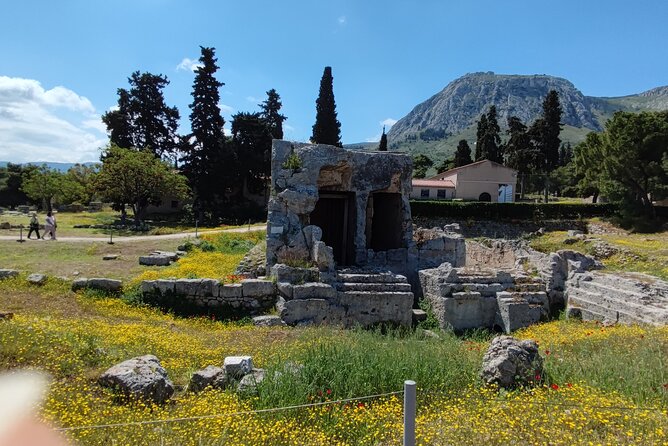
After the Isthmia area, time at the Archaeological Museum of Isthmia is a big plus. Many half-day tours skip museum time, or they rush it. Here you get a focused look.
Some of the specific finds highlighted in the museum include:
- An Archaic marble pediment dated to the end of the 7th century BC, placed at the entrance of the first Temple of Poseidon.
- Glazing of Kechreon, colored glass found submerged on the floor of the Temple of Isis on the south pier of the harbor. These pieces are described as harbor scenes, exotic landscapes, animals and plants, and figures like philosophers.
- An Imperial statue in the type of Zeus from the mid 2nd century BC.
- An Epinician stele with a portrait of the Corinthian musician Lefkios Cornelius from around 150 AD.
- Animal figurines including a golden bull described as a vow to the sanctuary.
- Commercial amphorae and various votive offerings, plus items connected to Mycenaean and Roman cemeteries.
Even if you do not read every label, you can still get a lot from the range. This is where Corinth stops being just a Greek-word name on a map. You see what people carried, feared, celebrated, and promised.
Plan for extra value: if you are traveling with older family members or you just want a slower pace, the museum time can feel like a decompression stop after walking outdoors.
Other visits to ancient Corinth:
- From Athens: Ancient Corinth Day Trip with Canal & VR Guide★ 4.6 · 1,073 reviews
- Athens: Ancient Corinth & Nafplio Full Day Trip with Swim★ 4.8 · 531 reviews
- Athens: Corinth Canal, Mycenae & Nafplio Premium Guided Tour★ 4.7 · 322 reviews
- Athens: Corinth Canal, Mycenae and Nafplio Day Tour★ 4.3 · 252 reviews
Ancient Corinth, from Paul’s letters to the scale of a major Greek city
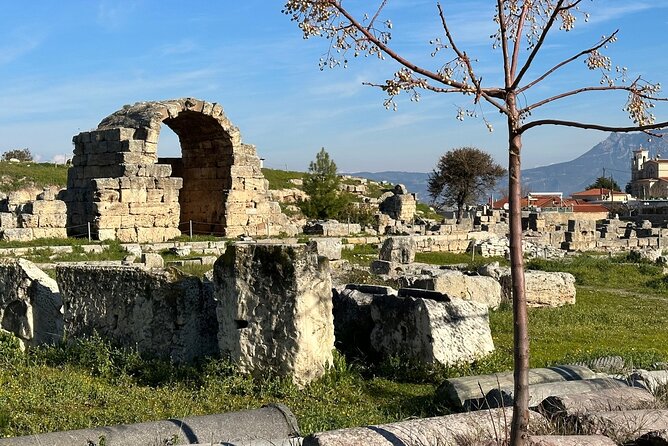
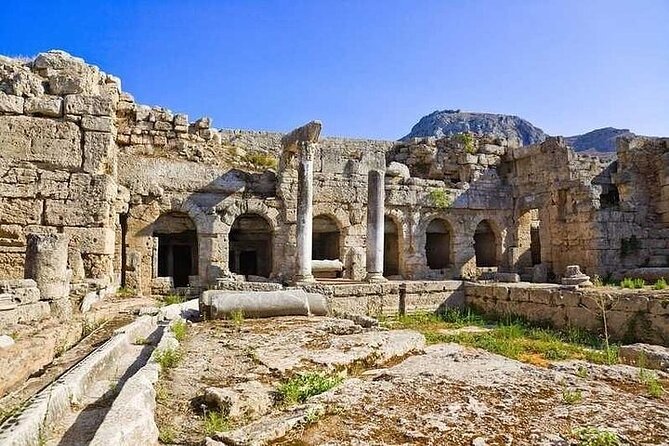
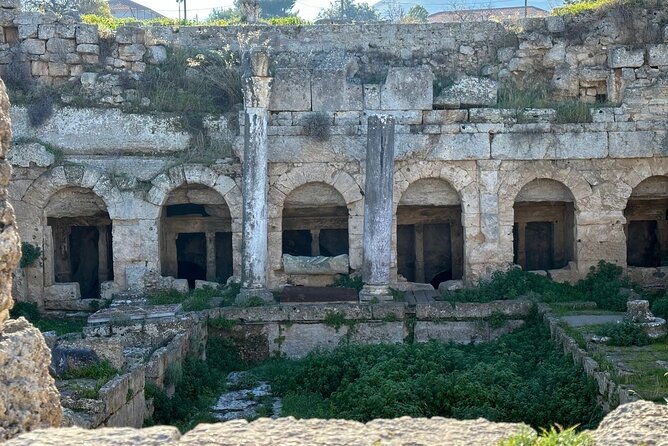
The heart of the day is Ancient Corinth, also called Archaia Korinthos. This is where you walk among the remains of a city that was massive by ancient standards. The tour description notes a population of about 90,000 in 400 BC, which gives you a sense of why Corinth was a heavyweight in Greek life.
Corinth was a city-state on the Isthmus, halfway between Athens and Sparta in the broader geography of power. That position mattered for trade and for movement of people, including visitors heading through the Peloponnese.
The religious connection is front and center:
- Corinth is known in Christianity for the two letters attributed to Saint Paul, First and Second Corinthians.
- The Acts of the Apostles also places Paul in Corinth as part of his missionary travel.
- Pausanias’ Description of Greece devotes space to Corinth too.
On the ground, the experience becomes about imagining the flow of everyday life. Where would travelers have entered? Where would merchants have gathered? Why would someone write to a community there?
Important: this is also the part most likely to throw a wrench in the plan. There is an explicit caution from the tour operator’s side that Ancient Corinth can be closed due to filming of director Nolan’s new film, The Odyssey, and safety reasons. If your date is flexible, consider building in a “Plan B” for Corinth day trips.
Archaeological Museum of Corinth and what the site layout teaches
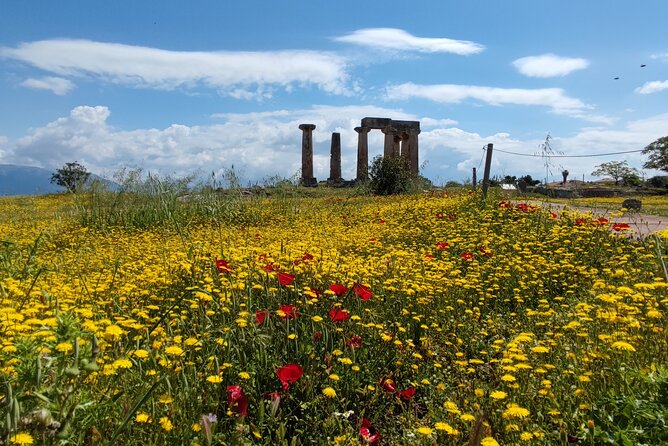
Once you are in the Ancient Corinth area, the Archaeological Museum of Corinth is a smart follow-up. This museum was constructed between 1931 and 1932 to display finds from recent excavations. It sits within the archaeological site itself.
What I like about this stop is how it keeps your attention on the ground plan of the city. The tour materials call out major site features such as:
- Hadgimoustafa spring
- Lechaion Road
- The Basilica
- Fountain of Peirene
- Stoa
- Agora
- Odien
That sounds like a list, but it helps you build a mental model. Corinth was not only monumental structures. It was water systems, roads, gathering places, and administrative space.
If you want a “big picture” day that still stays practical, the museum and site walk together work better than chasing individual ruins with no connections.
Temple of Apollo, early Doric columns and the power of structure
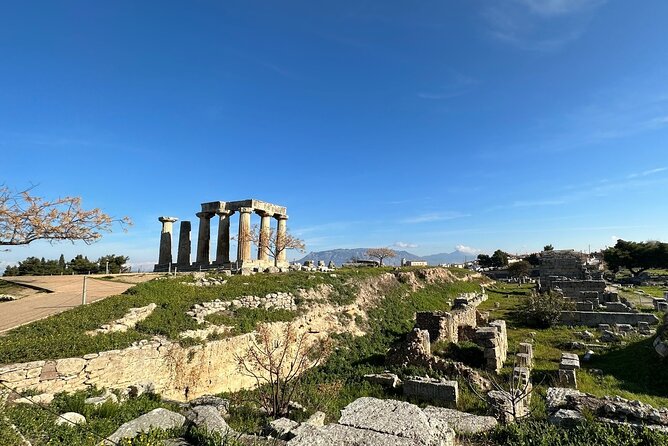
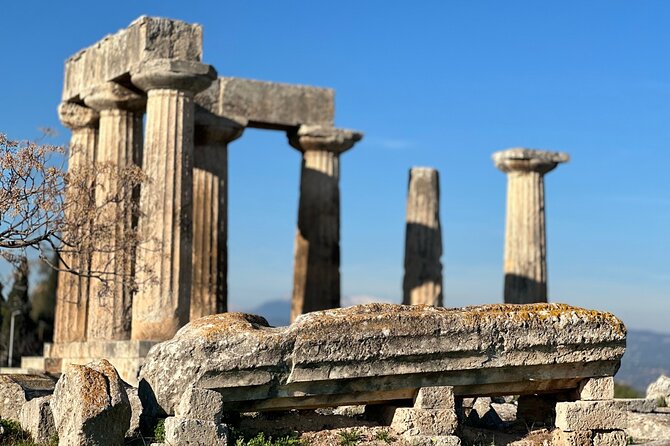
Next is the Temple of Apollo, constructed around 550 BC. The tour description points out it as one of the earliest Doric temples in the Peloponnese and on the Greek mainland, with monolithic columns described as rare in the ancient world.
Why this matters for your visit: temples like this were not just worship spaces. They signaled presence, wealth, and order in a place that competed for trade and attention. When you look at these columns, you are seeing the “language” of authority used in stone.
This stop is shorter by design, which keeps the pacing realistic. You get enough time to appreciate structure and materials, then move upward to the fortress.
Free time for lunch and shopping, plus a useful habit
There is scheduled free time for lunch and shopping in the Ancient Corinth area. You will not be forced into a set restaurant, which is handy because you can match your meal to your energy level and crowd patterns.
I also recommend using your driver for this part, not only for driving. In feedback, drivers often suggest a lunch spot, and they can usually point you toward places that are convenient after you leave the ruins.
A small habit that helps in Corinth: bring water and take short breaks before you head into the higher walk at Acrocorinth. The day can feel longer than you expect once you add museum time.
Acrocorinth, the Upper Corinth fortress and the view that ties it all together
Acrocorinth is the acropolis area, often described as a monolithic rock overlooking the ancient city. It has a secure water supply, and the fortress nature is clear once you see how it commands the isthmus.
The tour frames Acrocorinth as repeatedly used as a last line of defense in southern Greece because it controlled access into the Peloponnese peninsula. That strategic idea becomes obvious when you stand there and imagine the land routes.
The time at Acrocorinth is set for about 30 minutes, which can be perfect if you plan your movement. Go for the viewpoint first, then decide how much you want to explore based on energy and the weather.
This is also where the entire day makes sense. Canal engineering, ship transport, trade position, games and crowds, and Paul’s community all connect through the simple geography of who could pass and who had to wait.
Price and value: what $190.46 covers and what costs extra
The tour price is listed at about $190.46 per person, and the experience focuses on private transportation plus a curated half-day route. You also get:
- English-speaking driver with history context
- Pickup and drop-off from Athens hotel, Airbnb, or port
- Modern vehicle with Wi-Fi, A/C, and bottled water
- Small group limits, including luxury sedan or mini-van for the right headcount
What is not included is equally important for value planning:
- Entrance fees for attractions are listed as about €15 per person for sites, plus a specific €15 archaeological site fee is also stated.
- A licensed tour guide is optional and can be an extra €140 per person (depending on availability).
- Lunch costs are not included.
- Optional tastings cost extra: oil tasting finger food at €80 per person, and wine tasting at €15 per person.
So is $190.46 worth it? It can be, especially if you value:
- Private pickup and drop-off
- A driver who narrates the day during the ride
- The ability to adjust timing around photo stops and breaks
If you are traveling with more people and can share the mini-van cost, it tends to improve value quickly. If you are going solo, the price still can work because you are not competing for space like on a bus.
Wine and oil tasting options, and how to decide
The experience name includes wine and oil tasting, but the tastings are listed as add-ons rather than included baseline items.
Here is how to think about it:
- Wine tasting at €15 per person sounds like a low-cost way to add a local flavor to a history-heavy day.
- Oil tasting finger food at €80 per person is a bigger spend. It can be worth it if you are genuinely interested in Greek olive oil culture and want an organized tasting moment rather than just eating somewhere random.
My practical suggestion: decide based on the rest of your day in Greece. If you already have a separate wine experience planned, focus on the oil tasting only if it fits your interests. If this is your only tasting slot, the wine add-on is the easiest entry point.
Either way, do not forget you still have walking time in archaeological areas. Eat early enough that you do not feel rushed, and keep water handy.
Who this tour fits best
This works especially well for you if:
- You want Corinth plus Acrocorinth without wrestling public transport.
- You care about the link between Saint Paul, Corinth, and the New Testament setting.
- You enjoy “engineering meets mythology,” because the canal and Diolkos stops are not treated like filler.
- You want museum time, including finds from Kechreon glass and votive offerings.
It may feel less ideal if you expect a relaxed, slow sightseeing day with no museum and no walking. This is structured, and you will move from canal to ruins to fortress. It is not a sit-down on a terrace all day.
Should you book this Corinth Taste Faith and History tour?
If your dates are flexible and you can accept that Ancient Corinth might close for filming or safety, I think this tour is a strong pick. The combination of private transport, Paul-related context, and the extra museum time makes it more than a simple ruin checklist.
Book it if you like the idea of connecting stories across places, from the canal’s shipping shortcut roots to the fortress viewpoint that explains why Corinth mattered. Consider the wine tasting add-on if you want one easy cultural stop. If olive oil tasting is a priority, plan for the higher oil tasting fee and treat it as the day’s food centerpiece.
If you want, tell me your travel month and whether you are going solo or with a couple. I can help you think through entrance fee expectations and which add-on makes the most sense for your budget.
FAQ
How long is the Corinth tour from Athens?
It runs for about 5 hours (approx.).
Is pickup and drop-off included?
Yes. Pickup and drop-off are offered from Athens Hotel, Airbnb residence, or the Port, and the tour ends back at the meeting point.
Is it a bus tour?
No. It is described as a small group tour with only your group participating, using a luxury sedan for 1 to 3 people or a comfortable mini-van for 4 to 7 people.
Are entrance fees included in the price?
No. Entrance fees for attractions are not included, with €15 per person listed, and the archaeological site admission is also listed as not included.
Are wine and oil tastings included?
They are listed as optional add-ons. Oil tasting finger food is listed at €80 per person and wine tasting at €15 per person.
Do I need a licensed tour guide?
An English-speaking tour driver is included, described as well-versed in Greek history. A licensed tour guide is optional and costs extra, listed as €140 per person depending on availability.
What happens if weather is bad?
The tour requires good weather. If it is canceled due to poor weather, you will be offered a different date or a full refund.
Greek Wine Poured Near Athens
- Athens: Classic Cooking Class with Market Visit and Wine
★ 5.0 · 1,101 reviews - Athens: Food Market Visit and Cooking Class with Wine
★ 4.9 · 1,087 reviews - Best rated Acropolis Wine Tasting
★ 5.0 · 568 reviews - PREMIUM Semi-Private Athens Afternoon Food Tour & Wine Tasting
★ 5.0 · 363 reviews
Tavernas, Ouzeri and Counters
- Greek Food Walking Tour in Athens
★ 5.0 · 4,740 reviews - Athens: Street Food Tasting Tour
★ 4.9 · 3,343 reviews - Athens: Guided Greek Food Walking Tour with Tastings
★ 4.9 · 2,859 reviews - Small Group Greek Traditional Food Tour in Athens 20+ Tastings
★ 5.0 · 1,759 reviews
Latest from under the Acropolis




Ancient Corinth Tours, compared.
Ancient Corinth Day Trip with Canal & VR Guide
Read our review →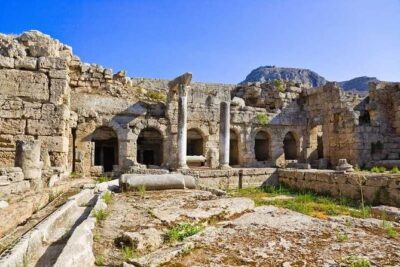
Biblical Tour Letters ToThe Corinthians St Paul’s Footsteps 6Hour
Read our review →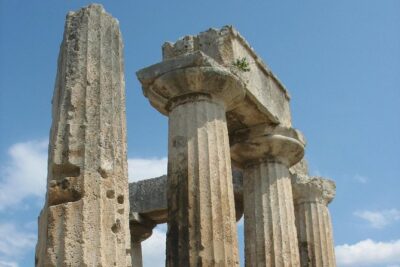
Private Biblical Tour Ancient Corinth & Isthmus Canal from Athens
Read our review →
Corinth Canal, Mycenae & Nafplio Premium Guided Tour
Read our review →
Private Tour of Apostle Paul’s Footsteps in Ancient Corinth
Read our review →
Corinth Half-Day Trip from Athens with Entrance Tickets
Read our review →Browse the lists this tour appears in