
Reviewed · WALKING TOURS
Athens Walking Private Tour – Licensed Tour Guide
One afternoon, Athens in full focus. This private walking tour lines up the Acropolis Museum first, then the Acropolis sights, with a licensed guide who can turn marble, myths, and politics into something you actually remember. If you’re lucky enough to get a guide like Natalia, you get fluent English, big enthusiasm, and smart routing that helps avoid wasting time stuck in the crowd.
I love the way the route gives you context before you climb. You see how artifacts were found and displayed at the museum, then you walk the sacred hill and connect those objects to the buildings you’re standing in front of. I also like the ending, Plaka’s cozy lanes and Monastiraki’s lively square, because it lets you shift from history to real Athens street life.
One thing to consider: you need moderate physical fitness. It is a walking day with time on ancient surfaces and uphill parts, and you will not have hours to browse shops like you would on a full free day.
In This Review
- Key highlights to know before you go
- Starting at the Acropolis Museum, not the ticket line
- Climbing the Acropolis with Propylaea and the Parthenon in sequence
- Beyond the Parthenon: Erechtheum, sacred spots, and the sacred hill feel
- Theatre views you can feel, Odeon of Herodes Atticus included
- Plaka’s cobblestones and a Greek-island vibe, even in the middle of the city
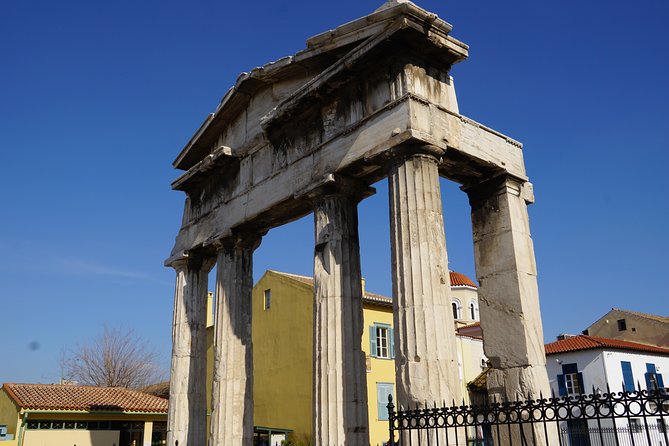
- Monastiraki’s square energy, Hadrian’s Library ruins, and market browsing
- Private tour benefits, plus whisper headsets for real-world crowds
- Price and value: what $395.69 per person buys you
- Practical timing tips for a smooth 2:00 pm start
- Should you book this Athens private walking tour?
- FAQ
- How long is the Athens Walking Private Tour?
- What is the starting point and start time?
- Is pickup offered?
- Does this tour end near public transportation?
- Is this a private tour?
- What language is the tour in?
- Are entrance fees included?
- Are whisper headsets provided?
- Is transportation to and from attractions included?
- What is the cancellation policy?
Key highlights to know before you go
- Acropolis Museum first, so the ruins make sense right away
- Plexiglass floor views that reveal buried neighborhood remains under the museum
- Acropolis highlights in a single route, including Propylaea and the Athena Nike area
- Theatre stops with real dates, like the Odeon of Herodes Atticus completed in 161 AD
- Plaka and Monastiraki as a practical add-on, with cobblestones, cafes, and market chaos
- Private group pace, plus whisper headsets when you have over 10 people
Starting at the Acropolis Museum, not the ticket line
The best trick on this tour is the order. You begin at the Acropolis Museum rather than starting with the hilltop scramble. That matters because the museum gives you a way to read the Acropolis like a story, not just a postcard.
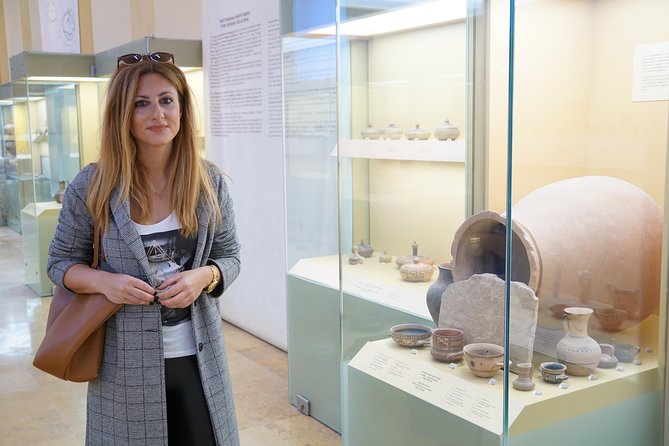
Inside, you’re looking at a modernist setting that still feels tied to what lies beneath it. One of the coolest built-in moments is the plexiglass floor section where you can look down at the remains of an ancient Athenian neighborhood that were uncovered during excavations. It is one of those quiet, wow-then-keep-walking moments that makes the area feel alive, not frozen behind ropes.
The museum collection focuses heavily on the Acropolis in the 5th century BCE, described as the peak of Greek artistic achievement. You’ll see artifacts from different periods too, but the point is clear: this is where Athens explains its own skyline. If you’ve ever felt like the Acropolis was just too big and too famous to understand, this start helps.
Even better, the tour’s timing gives you a solid block of museum time. That means you can actually look, not just sprint through rooms. And if your guide is strong, you’ll connect what you’re seeing with what you’re about to climb toward.
More of Plaka and Monastiraki on foot:
- Acropolis and Parthenon Guided Walking Tour
★ 5.0 · 4,755 reviews - Greek Food Walking Tour in Athens
★ 5.0 · 4,740 reviews - Athens: Guided Greek Food Walking Tour with Tastings
★ 4.9 · 2,859 reviews - Acropolis monuments & Parthenon Walking Tour with Optional Acropolis Museum
★ 5.0 · 2,678 reviews
Climbing the Acropolis with Propylaea and the Parthenon in sequence
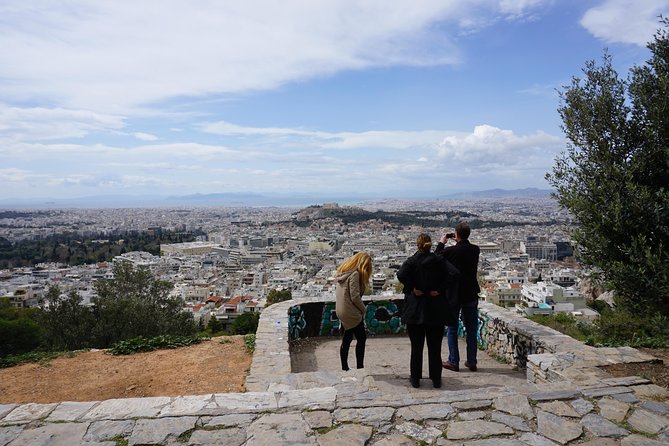
After the museum, the tour shifts to the hilltop core of Athens. This is where you want a guide, because the Acropolis is not one monument. It’s a whole sacred complex, built, expanded, and repurposed over time.
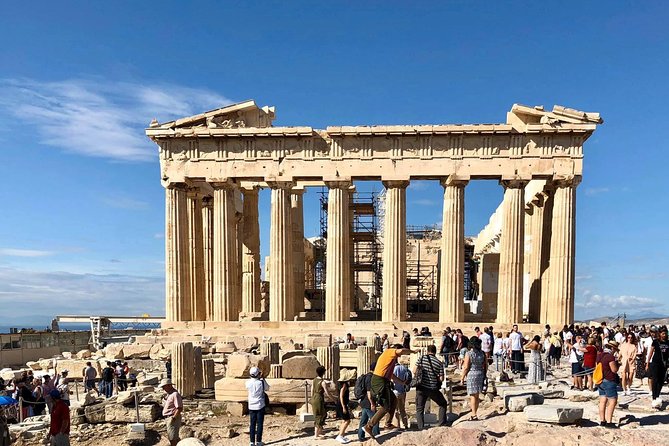
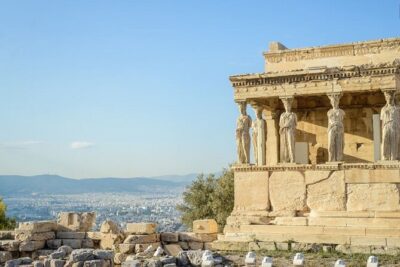
You start with the Acropolis itself and get time to take in the major landmarks in one pass. Among the highlights are the Odeon of Herodes Atticus, the Temple of Athena Nike, the monumental gateway known as Propylaea, the Erechtheum, and of course the Parthenon.
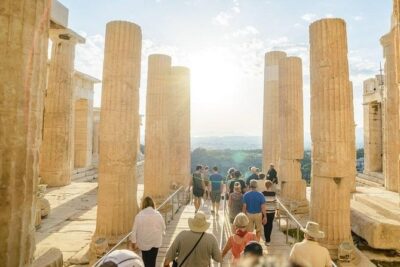
Propylaea is a big deal, and your guide should help you see why. It is the monumental entrance into the sacred area dedicated to Athena, built with Pentelic marble by the architect Mnesicles. The description of its design as avant-garde hints at something important: this is not just functional architecture. It is public theater, telling visitors where they stand and who they worship.
Near Propylaea, you’ll also be directed toward the Ionian temple of Apteros Nike. It sits on a rampart protecting the main entrance area, and it connects to the Temple dedicated to the goddess Athena Nike, sometimes described with the nickname Wingless Victory. Even if you do not memorize every detail, you’ll start spotting how different structures relate to processions, entrances, and sacred space.
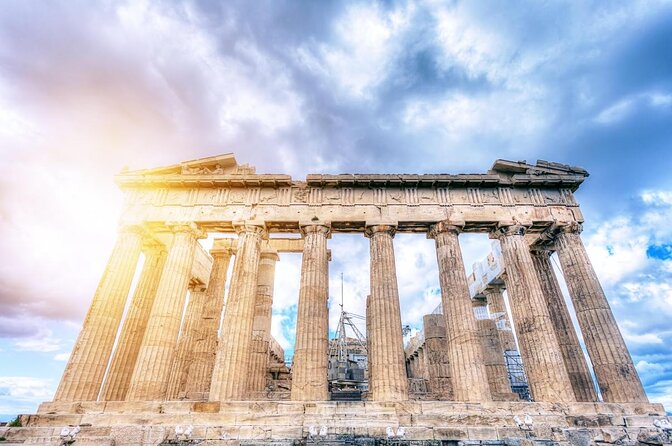
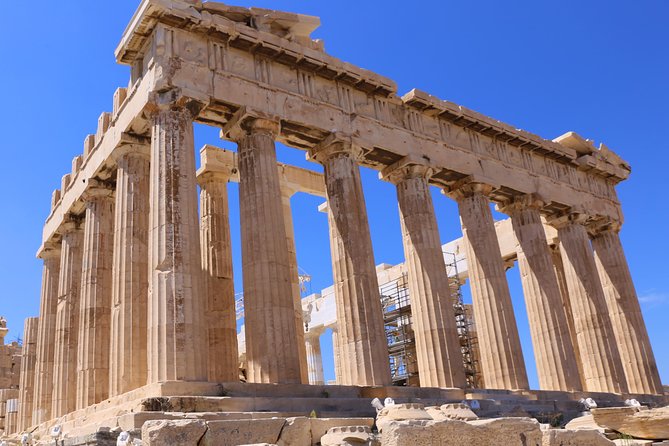
You get a focused stop at the Parthenon too. The stop is short compared to the museum time, so treat it as a chance to get the big picture: position, scale, and the feeling of how that building dominates the skyline.
Beyond the Parthenon: Erechtheum, sacred spots, and the sacred hill feel
A private tour pays off on the Acropolis because you’re not just walking the highlights. You’re learning how the complex is organized and why certain points matter.
As you move through the central areas, you should hear about the Erechtheum. This is one of those temple names that can sound like trivia until someone explains its place in the broader story of Athena and the sacred landscape of Athens.
You also get pointed attention to a spot described as the Temple of Poseidon and Athena, framed as the most sacred place in ancient Athens. I cannot verify how every guide interprets that phrasing on the ground, but I can tell you this type of stop is useful. You’re not only looking at monuments, you’re being told where meaning was assigned, and that changes how you experience ruins.
Then there are the “supporting cast” monuments that make the hill feel real. You’ll stand near structures that connect religious life to civic life, plus defensive and ceremonial elements that shaped how the Acropolis functioned.
If you’re the type who likes to understand what you’re seeing rather than just take photos, this part is where the tour feels like it has a point. The guide’s job is to help you connect the dots quickly before your legs decide to quit.
Theatre views you can feel, Odeon of Herodes Atticus included
Two theatre-related stops help you see the Acropolis area as a cultural hub, not just a temple hill.
First is the Theatre of Dionysus Elefthereus. You’ll hear it described as one of the world’s earliest theatres, built at the foot of the Athenian Acropolis. Even if you already know that the Greeks invented theatre in some form, seeing it in context makes it more tangible. You realize how tied performance was to civic identity, and how religion and public life overlapped.
Then comes the Odeon of Herodes Atticus. This is a Roman stone theatre structure on the southwest slope. It was completed in 161 AD, then renovated in 1950. Those dates matter because they remind you that this hill kept being used and reworked long after the classical period. Athens is layered, and this stop gives you one more layer.
The payoff here is perspective. When you stand where crowds once gathered, the scale stops being theoretical. You can almost picture how voices carried, even if today you are hearing your guide through headsets and your own footsteps.
Plaka’s cobblestones and a Greek-island vibe, even in the middle of the city

From the Acropolis, the tour drops you into Plaka, the classic walking neighborhood with a village feel. Think narrow cobblestone lanes, small shops with jewelry, clothes, and local ceramics, plus sidewalk cafes and family-run tavernas that stay open late.
This is the section where you stop treating Athens like a museum and start treating it like a place people actually live in. You get about 20 minutes here, which is enough time to slow down, grab a quick drink, and browse a few storefronts without turning the tour into a shopping marathon.
One detail worth noticing as you wander: nearby Anafiotika, with its whitewashed homes, can feel like a Greek island tucked into the city. Even in a short stop, you’ll likely spot that vibe.
A possible drawback: because Plaka time is limited, you might want to bookmark a couple streets to revisit later. If you love photos and people-watching, this neighborhood can easily swallow extra hours if you let it.
A handful more Athens outings to compare
- Best of Athens Half Day Private Tour★ 5.0 · 3,714 reviews
- Athens Full Day Private Tour★ 5.0 · 2,903 reviews
- Athens Airport Private Arrival Transfer with Meet & Greet★ 4.5 · 1,495 reviews
- Athens Airport to Athens Hotels Private Arrival Transfer★ 5.0 · 947 reviews
Monastiraki’s square energy, Hadrian’s Library ruins, and market browsing
Monastiraki is where Athens gets loud in the best way. It is known for landmark anchors such as the ruins of Hadrian’s Library, the Ancient Agora, and the rebuilt Stoa of Attalos with a museum displaying Athenian artifacts.
You also get a sense of how everyday Athens works, not just how it looked in antiquity. The Monastiraki Flea Market area is a jumble of shops selling artisanal soaps, handmade sandals, and souvenir T-shirts. This is not subtle. It is fun if you like a bit of chaos.
The tour gives you about 20 minutes here too, ending in Monastiraki Square near a metro station. That ending choice is practical. You can keep going by metro or grab dinner nearby without needing to plan transport at the end of a long walk.
If you want a quieter, more contemplative pace, Monastiraki might feel like a switch from ruins to retail too fast. On the other hand, if you want your history day to end with a lively street scene, this is a smart closer.
Private tour benefits, plus whisper headsets for real-world crowds
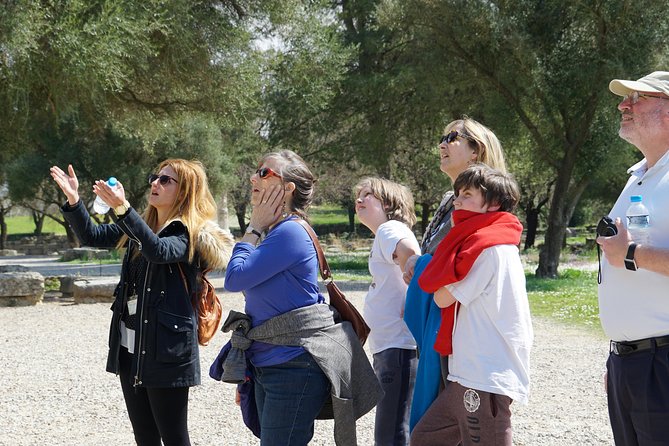
This is a private tour, meaning it’s just your group. That matters for a city like Athens, where crowd flow can change by the minute.
You also have whisper headsets when the group is over 10 people. That’s not glamorous, but it is crucial. On the Acropolis, you need to hear directions and context, and you need to do it without craning your neck toward a tour leader while dodging other visitors.
Pickup is offered, and the pickup time can be adjusted upon request. The default meeting point is Coco-Mat Athens BCFalirou 5, Athina 117 42, Greece, and the tour starts at 2:00 pm. Since it ends in Monastiraki, you get a logical loop: hill to museum to neighborhoods.
If your guide is skilled at moving people between sights, you should feel fewer minutes lost to confusion. One of the standout themes tied to guides like Natalia is routing that helps reduce waiting around at entry points and crowded areas. That difference can be the whole day, especially when you only have a half-day window.
Price and value: what $395.69 per person buys you
At $395.69 per person, this is not a bargain-basement option. You’re paying for guide time, a private group experience, and entrance coverage for the Acropolis and Acropolis Museum.
So what is the value angle?
- You’re getting expert interpretation for the big ticket sights, not just walking them.
- You’re getting entrance fees included for the two most expensive and logistically annoying stops.
- You’re getting a route that compresses a lot of Athens into five hours without making you feel like you missed the point.
If you’re the kind of traveler who would otherwise hire guides separately for museum time and hill time, this can be a cost-effective way to get one coherent plan. If you only want casual strolling and do not care about explanations, the price will feel steep. But if you want the Acropolis to click, the guide-driven value is real.
There are also group discounts mentioned, which can improve the math if you’re traveling with others and can keep the group size in a good range.
Practical timing tips for a smooth 2:00 pm start
Starting at 2:00 pm is a smart slot for many people. It gives you late lunch time, and you avoid an all-day schedule that can wear you down in the heat.
Still, build your expectations around the fact that this is a walking tour with scheduled stops. You spend about 1 hour 30 minutes at the Acropolis highlights, around 1 hour at the museum, and then shorter neighborhood transitions at Plaka and Monastiraki.
What that means for you:
- Treat Acropolis time as the main event. Wear comfortable shoes you trust.
- Use the museum time to ask questions and look slowly at the artifacts. That context will make your later photos more meaningful.
- Do quick browsing in Plaka and Monastiraki, then plan to return on your own if something grabs you.
Also, moderate physical fitness is required. If you have mobility limitations, you may find the hill and uneven stone surfaces challenging. A private format can help, but it cannot remove the basics of walking where you need to walk.
Should you book this Athens private walking tour?
Book it if you want a focused half-day that actually explains what you’re seeing. This is ideal for first-time visitors who want their bearings fast, plus anyone who has limited time and still wants the Acropolis Museum and Acropolis highlights without piecing the day together on your own.
I would skip it if you want a slow, open-ended afternoon with lots of free wandering and long shopping detours. The stops are timed, and Plaka and Monastiraki are designed as charming add-ons, not full neighborhood days.
One last check: if you’re sensitive to crowds, go with the mindset that guide routing matters. The best version of this tour is when your guide can keep things moving and help you stay oriented through busy areas. If that sounds like your kind of day, you’ll likely leave Athens feeling like you understood the skyline, not just photographed it.
FAQ
How long is the Athens Walking Private Tour?
It runs for about 5 hours.
What is the starting point and start time?
The tour starts at Coco-Mat Athens BCFalirou 5, Athina 117 42, Greece, and the start time is 2:00 pm.
Is pickup offered?
Yes, pickup is offered and the pickup time is adjustable upon your request.
Does this tour end near public transportation?
Yes. It ends at Monastiraki Square where a Metro Station is.
Is this a private tour?
Yes. It’s private, so only your group participates.
What language is the tour in?
The tour is offered in English.
Are entrance fees included?
Yes, entrance fees are included for the Acropolis and the Acropolis Museum.
Are whisper headsets provided?
Whisper headsets are provided for groups of over 10 people.
Is transportation to and from attractions included?
No. Transportation to or from attractions is not included.
What is the cancellation policy?
The experience is non-refundable and cannot be changed for any reason. If you cancel or ask for an amendment, the amount you paid will not be refunded.
Latest from under the Acropolis






Walking Tours, compared.
Acropolis and Parthenon Guided Walking Tour
Read our review →

Acropolis monuments & Parthenon Walking Tour with Optional Acropolis Museum
Read our review →
Athens Acropolis and Parthenon Walking Tour
Read our review →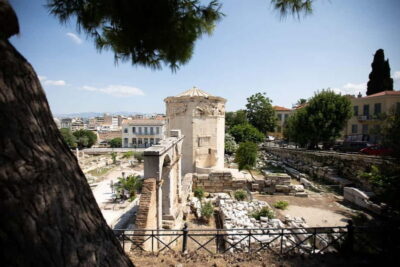
Acropolis, Parthenon & Athens Old City Heritage Walking Tour
Read our review →
Athens Authentic Greek Food Walking Tour (Small Group)
Read our review →
Browse the lists this tour appears in