
Reviewed · ACROPOLIS HILL TOURS
Athens Acropolis and Parthenon Walking Tour
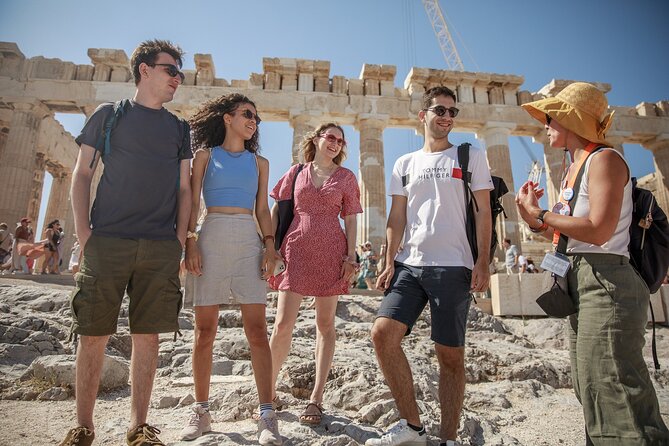
One hill, a lot of world-changing sites. This Acropolis and Parthenon walking tour turns the big, famous ruins into a clear route, with a licensed guide and earsets so you can actually follow along. I especially loved how the guide connects each stop to everyday Greek life, and I liked getting the Athens map plus a guide magazine to keep exploring after the tour. One drawback to plan for: it is a real uphill climb over uneven stone, so comfortable shoes and moderate fitness matter.
You start at the base of the Acropolis at a yogurt bar near Dionysiou Areopagitou, then you walk up through classic landmarks, including the Propylaea gateway and the Theatre of Dionysus. If you choose the option with admission, you also get help skipping the ticket-office lines (if selected), which is a big deal when security lines can run long. Best part: the tour is short enough to fit even on tight itineraries, but it still hits the highest-impact monuments like the Parthenon and Erechtheion with the Caryatid Porch.
In This Review
- Key highlights you will feel immediately
- Meeting at the yogurt bar, then earsets up the hill
- Price and logistics: what you are paying for (and what to double-check)
- The walk up the Acropolis: comfort tips that actually matter
- Stop-by-stop: the monuments that make this tour worth 2 hours
- Acropolis grounds: first impressions that set the theme
- Theatre of Dionysus: where drama began
- Temple of Asclepios: medicine, calm, and a break in the theme
- Odeon of Herodes Atticus: ancient theater, still used
- Philopappos Hill: a viewpoint break you will appreciate
- Temple of Athena Nike: victory and the southwest edge
- Propylaea: the grand entrance gateway
- Erechtheion: the Caryatid Porch and temple duality
- Parthenon: the main scene
- What the best guides do: clear explanations and good pacing
- Weather, security, and staying on schedule without stress
- Who this 2-hour Acropolis and Parthenon tour is best for
- Should you book this Acropolis and Parthenon walking tour?
- FAQ
- Is the entrance ticket to the Acropolis included?
- Where does the tour start?
- How long is the tour?
- Will I be able to hear the guide?
- Is this tour okay for people who are less mobile?
- Are baby strollers allowed on the Acropolis?
Key highlights you will feel immediately
- Earsets for clearer listening on a crowded, windy site, not just from far away.
- A tight 2-hour route that hits the Parthenon and the main Acropolis highlights without dragging.
- Real monument-by-monument context, from drama at the Theatre of Dionysus to worship at the Erechtheion.
- Athens guide magazine and map included, so you can steer your next day’s wandering.
- Small group size up to 24, which helps the guide manage stops and photo breaks.
- Optional entrance ticket upgrade, with line-skipping included when you select that version.
Meeting at the yogurt bar, then earsets up the hill
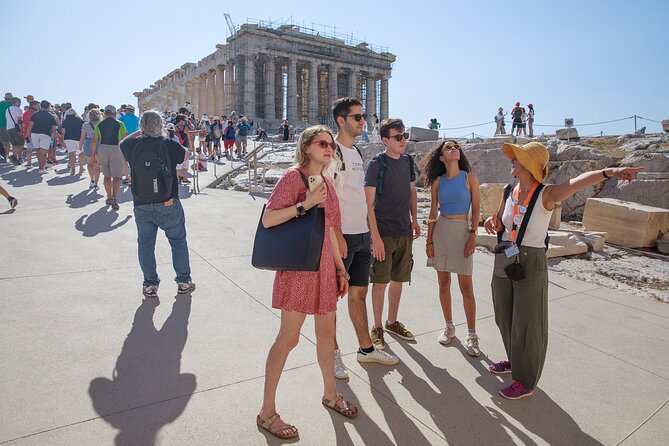
The tour meets at LUKUMAΔΕΣ, Dionysiou Areopagitou 3, near the base of the Acropolis. You go at your chosen time, meet your guide and group, then head upward together. In many group tours, the first minutes feel chaotic. Here, the start is organized, and once you get the earsets, the whole experience becomes easier to follow.
Earsets are a big part of why this tour works in real-world crowds. You do not have to crane your neck to hear the guide or constantly ask people nearby what was said. You also get better context as you move, because your guide can point out details while you are standing in the right spot.
Do not ignore the practical side. There is airport-style security at the Acropolis, and peak-season waits can run 30+ minutes. Your tour time is strict too. Entry times are tied to the schedule, and the tour cannot wait for latecomers, so build a little buffer.
Other routes up the hill and around the Parthenon:
- Athens: Acropolis & up to 5 Archaeological Sites Combo Pass
★ 4.2 · 13,904 reviews - Athens: Acropolis, Parthenon & Acropolis Museum Guided Tour
★ 4.8 · 9,316 reviews - The Acropolis, Parthenon & Acropolis Museum Guided Tour
★ 4.7 · 8,493 reviews - Acropolis: Premium Acropolis and Parthenon Guided Tour
★ 4.8 · 5,208 reviews
Price and logistics: what you are paying for (and what to double-check)
At $41.12 per person for a tour listed at about 2 hours, the value is not just the walking. You are paying for a licensed guide, the earsets, and the planning help that keeps you from wandering up the wrong paths or missing what matters.
You also have two common versions:
- If you select the option with an admission ticket, you get ticket-office line skipping for the Acropolis (and Museum, if that is part of your selected package).
- If you select the option without the entrance ticket, the provided details indicate two possible handling methods: you may be asked to pay cash at the start, or you may receive a separate email with a ticket purchase link that you must complete within the stated window.
Because these two instructions both appear in the information you were given, the smart move is to check your booking confirmation for your exact entrance-ticket method before tour day. Either way, the tour requires a valid entrance ticket to join.
One more logistics point that affects your enjoyment: this is not a sit-down museum tour. You will be walking on uneven ground and you cannot use a stroller on the archaeological site. If you are planning to travel with a baby, the info here recommends using a baby pouch instead.
The walk up the Acropolis: comfort tips that actually matter
The route is short in total time, but it includes a serious climb. Review feedback and the on-site reality line up: you will spend time going uphill and standing on slopes, and the ground can feel unstable underfoot.
To keep it comfortable:
- Wear comfortable shoes with good grip.
- Plan for heat or shade changes, and bring sun-screen and a hat if the forecast looks bright.
- Bring a bottle of water.
- If it is hot, expect breaks to feel valuable, not optional.
Also note a tour-site reality: once you are inside, there are no toilets once in the site, so it pays to use facilities before you enter.
Wind can affect listening too. Some people reported that earsets occasionally cut in and out, and very windy conditions can make it harder to hear the guide clearly. Usually, earsets help a lot, so treat that as a normal heads-up, not a deal-breaker.
Stop-by-stop: the monuments that make this tour worth 2 hours
This tour moves through a sequence of major Acropolis landmarks, with short stops designed to keep the big picture in your head. The guide also keeps you oriented, which is half the battle at the Acropolis. Without help, it is easy to stare at stone and miss the story.
Acropolis grounds: first impressions that set the theme
The first stop is on the Acropolis, and this is where your guide frames what you are about to see. You get a tour-style overview that makes the rest of the walk make sense: what was built here, who it was built for, and why it matters.
You also get that helpful “move with purpose” feeling. Instead of wandering, you learn which monuments connect to each other. For short itineraries, this matters more than you might think.
More of Plaka and Monastiraki on foot:
- Acropolis and Parthenon Guided Walking Tour★ 5.0 · 4,755 reviews
- Greek Food Walking Tour in Athens★ 5.0 · 4,740 reviews
- Athens: Guided Greek Food Walking Tour with Tastings★ 4.9 · 2,859 reviews
- Acropolis monuments & Parthenon Walking Tour with Optional Acropolis Museum★ 5.0 · 2,678 reviews
Theatre of Dionysus: where drama began
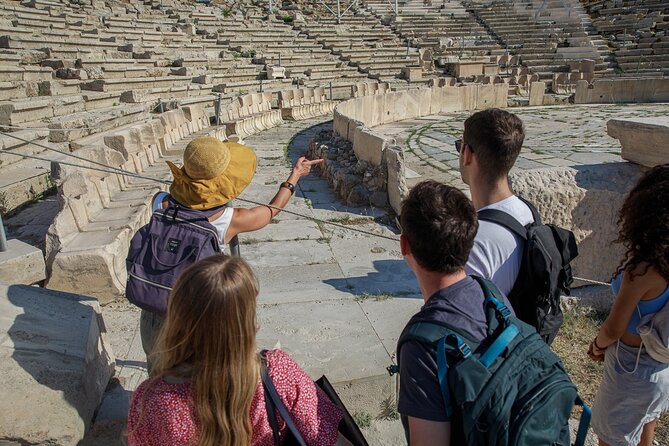
Next comes the Theatre of Dionysus, described as the birthplace of theater. This is one of those stops where the story makes the stones feel alive. Your guide connects the site to Aeschylus, Sophocles, and Euripides, and helps you picture ancient Athenians watching drama in the very landscape you are standing in.
Even if you only know a little Greek mythology or theatre history, the guide explanation helps you see why this site is not just another ruin. It is part of the foundation of Western storytelling.
Temple of Asclepios: medicine, calm, and a break in the theme
Then you step toward the Temple of Asclepios, a sanctuary dedicated to Asclepius, the god associated with medicine. This stop shifts the tone. It is a quieter concept than politics and monuments, and it gives you a mental breather from the big-name spectacle.
The value here is balance. Even in a short tour, mixing worship, art, and everyday human needs (like healing) makes the Acropolis feel more like a lived-in city rather than a static landmark.
Odeon of Herodes Atticus: ancient theater, still used
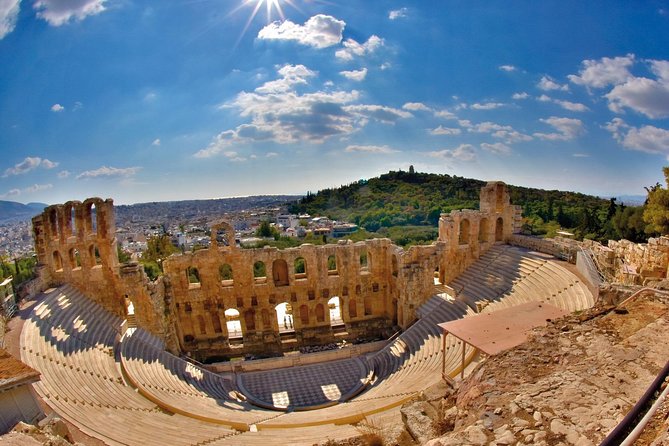
The Odeon of Herodes Atticus is next. This stone theater was constructed in 161 AD, and it continues to host performances. The guide helps you see the bridge between then and now, so you are not just reading about history in a textbook tone.
Photo-wise, it is a great moment to pause. It also helps you understand the Acropolis as a cultural stage, not only a religious complex.
Philopappos Hill: a viewpoint break you will appreciate
There is a stop at Philopappos Hill, also called the Hill of the Muses, with a monument to Philopappos. This is a short pause with big payoff: city views and a moment to reset your eyes after a run of monuments.
This stop matters because it gives you perspective. The Acropolis is easier to understand when you can see how it sits above Athens.
Temple of Athena Nike: victory and the southwest edge
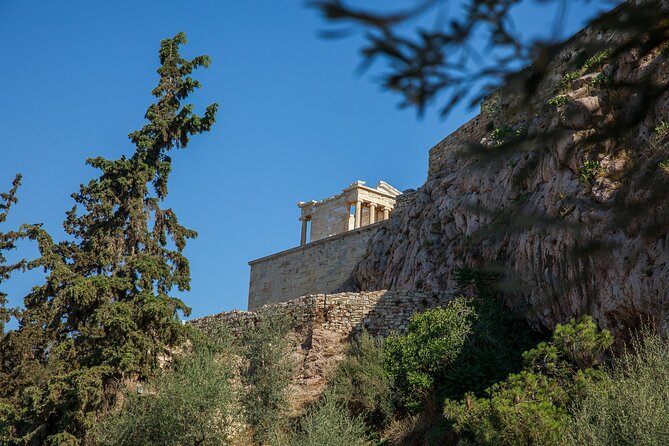
Next is the Temple of Athena Nike, on a bastion at the southwestern edge of the Acropolis. The guide connects it to Athena as the goddess of victory and points you toward the panoramic feeling that comes with its position.
This is also a useful “geometry” stop. The way the site sits helps you start imagining sightlines and the logic of the hilltop plan.
Propylaea: the grand entrance gateway
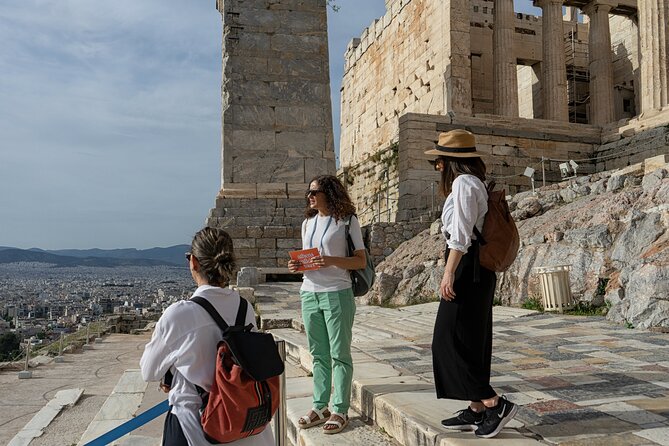
The Propylaea is the marble gateway into the Acropolis. Your guide explains it as a monumental entrance designed by Mnesikles. Even if you are not an architecture nerd, the guide framing helps you notice how the gateway creates anticipation as you move deeper.
It is the kind of stop where a good guide changes the experience from, I walked through a big arch, to I understand why it was built that way.
Erechtheion: the Caryatid Porch and temple duality
Then comes the Erechtheion, associated with Athena and Poseidon, and famous for the Caryatid Porch with six sculpted female figures supporting the structure. This is a highlight for many people for a reason: the statues give the temple a human scale, and the architectural detail keeps your eyes busy while your guide explains the meaning.
If you have been wondering why ancient Greeks cared so much about both function and form, this stop gives you a clear answer.
Parthenon: the main scene
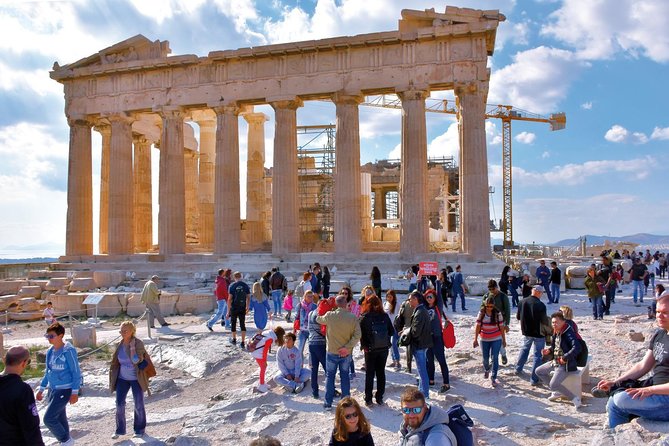
Finally, you reach the Parthenon, the tour’s biggest finale. Your guide explains it as a masterpiece dedicated to Athena Parthenos and the pinnacle of classical architectural and cultural achievement.
This stop is where a guided route really earns its keep. You are not just staring at the most famous temple in Greece. You are standing with the right context about what it represented and why Athenians treated it like a statement about their identity.
The Parthenon is also the place where time feels short. That is why the tour’s pacing matters: you get a meaningful window without feeling like you are rushing the second you arrive.
What the best guides do: clear explanations and good pacing
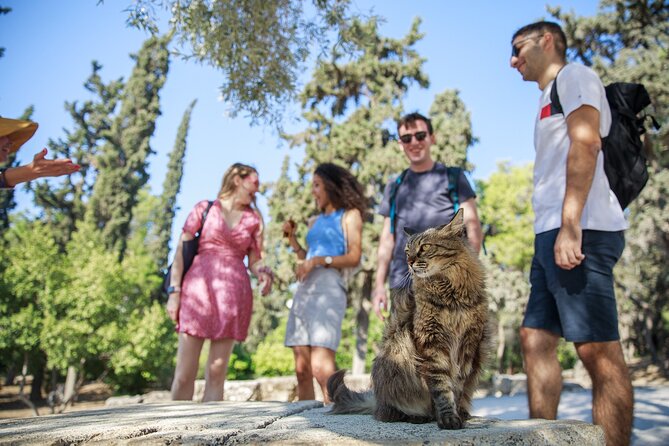
One reason this tour receives so many strong ratings is the way guides teach. Across the names shared in the experience, you can see different personalities while staying consistent on one thing: people feel heard.
You might get storytelling energy like guides such as Elena, who is praised for bringing mythology to life. Or you might meet a guide like Alexia, credited with being attentive and proactive, including keeping people comfortable when possible. Other names that show up in the experience details include Andrea, Dora, Victor, Phillipa, Hermes, and Annie, each praised for clear, organized explanations and answering questions from the group.
The practical benefit for you is simple. When the guide has a good rhythm, you spend more time looking at the right thing, and less time guessing.
Weather, security, and staying on schedule without stress
Acropolis plans have one enemy: time pressure. Entry times are strict, and you should expect security checks. Peak season can mean waits of 30+ minutes, so your best strategy is not to treat your tour start as flexible.
Weather also matters. The experience info says it requires good weather, and if it is canceled due to poor conditions, you will be offered a different date or a full refund.
If it is rainy, the group can still continue in many cases, and guides often work to keep you out of harsh weather when possible. Just remember that wet stone plus uphill walking means you should go slowly and watch your footing.
Who this 2-hour Acropolis and Parthenon tour is best for
This tour fits best if you want the biggest hits without spending half a day on logistics. It is ideal for first-timers who feel overwhelmed by the Acropolis alone. It is also a smart pick if you want a guide to connect the dots, especially for places like the Theatre of Dionysus, where the setting matters as much as the story.
You will especially enjoy it if:
- You like hearing explanations while you are standing at the monument.
- You prefer a structured route over free-form wandering.
- You want the Parthenon with context, not just a quick look.
It may be less ideal if:
- You struggle with uphill walking over uneven surfaces.
- You rely on exact audio clarity in windy conditions, since hearing issues can happen when the weather turns or equipment acts up.
- You need a stroller on site, since baby strollers are not allowed at the archaeological site.
Should you book this Acropolis and Parthenon walking tour?
Yes, I would book it if your goal is to get oriented fast and leave with more than photos. The short 2-hour format, earsets, and the focused set of stops make it a strong value at $41.12. The extra perk is what you get after the tour, the Athens map and guide magazine, which helps you keep exploring on your own with better direction.
You should think twice only if mobility is a challenge for you. The climb, uneven ground, and lack of toilets inside the site are the main factors that can make the experience feel tougher than it needs to be.
If you are ready for an active but manageable walk, this is a practical way to understand why the Acropolis matters, and to stand at the Parthenon knowing what you are looking at.
FAQ
Is the entrance ticket to the Acropolis included?
It depends on which option you booked. The entrance fee is not included unless you selected the option that includes the admission ticket, and you may also have line-skipping if that option is selected.
Where does the tour start?
The meeting point is at LUKUMAΔΕΣ, Dionysiou Areopagitou 3, Athina 117 42, Greece.
How long is the tour?
The duration is about 2 hours.
Will I be able to hear the guide?
Yes. The tour includes earsets to help you hear the licensed guide clearly during the walk.
Is this tour okay for people who are less mobile?
The tour is described as requiring moderate physical fitness level, and it includes uphill walking and uneven ground. Comfortable shoes are recommended.
Are baby strollers allowed on the Acropolis?
No. Baby strollers are not allowed on the Acropolis archaeological site, and there is no cloakroom at the side entrance used for entry.
Latest from under the Acropolis


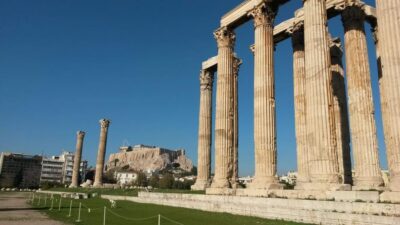




Acropolis Hill Tours, compared.
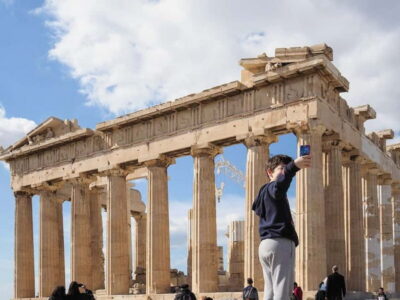
Acropolis & up to 5 Archaeological Sites Combo Pass
Read our review →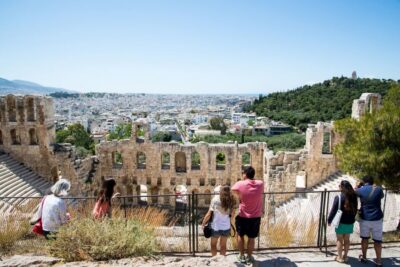
Acropolis, Parthenon & Acropolis Museum Guided Tour
Read our review →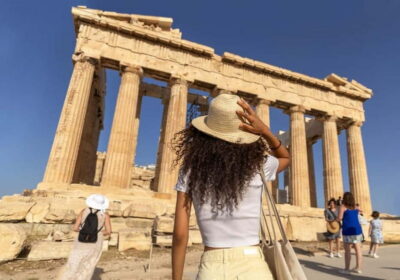
The Acropolis, Parthenon & Acropolis Museum Guided Tour
Read our review →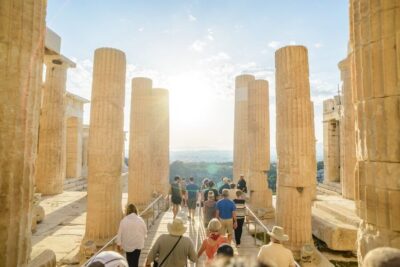
Acropolis: Premium Acropolis and Parthenon Guided Tour
Read our review →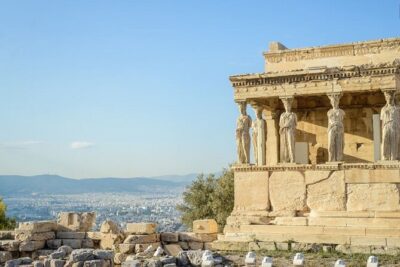
Acropolis and Parthenon Guided Walking Tour
Read our review →Acropolis, Parthenon & Acropolis Museum Guided Tour
Read our review →

Athens Scenic Electric Bike Tour with optional Acropolis visit
Read our review →Browse the lists this tour appears in