
Reviewed · WALKING TOURS
Athens Social and Political Walk
Athens politics walks right up to you. This 2.5-hour Athens Social and Political Walk uses documentary-style analysis and interactive street exploration to connect modern Greek life with centuries of political change.
I really like how the guide takes an explicitly social and political angle, not just government buildings and dates. You also get a built-in slideshow with photos and extra context tied to what you discuss on the walk.
One drawback to consider: this is a theory-and-timeline style experience. If you want mostly archaeology and mythology, you may find the focus on politics, economy, and society a bit heavy.
In This Review
- Quick hits before you go
- A Political Scientist Turns Athens Streets Into a Timeline
- From Maximos Mansion to the Presidential Palace: Power in Plain Sight
- National Garden and Hellenic Parliament: Politics Meets Everyday Athens
- National Historical Museum Stop: How the Past Presses Into the Present
- Korai 4 Memorial Site 1941-1944: The Stakes Behind the Theory
- Panepistimiou and the Metsovio Polytechnic: Youth, Education, and Protest
- The Two Stops That Let the Story Breathe
- Religion, Language, Europe, and the Economy: What the Walk Actually Teaches
- Price and Value for a 2.5-Hour Athens Walk
- Who Should Book This Tour, and Who Might Skip It
- Should You Book the Athens Social and Political Walk?
- FAQ
- How long is the Athens Social and Political Walk?
- How much does the tour cost?
- What languages are the live guides?
- Where does the tour start and where does it finish?
- Is the tour wheelchair accessible?
- What is included in the experience?
- Can I cancel and get a refund?
Quick hits before you go

- A political scientist at the lead who explains modern Greece with clear political cause-and-effect
- Unbiased framing of social and political shifts, from independence-era Greece to today
- Street-based storytelling, where major civic sites become chapters in the same argument
- Theme-driven stops, linking religion, language, Europe, and the economy to real places
- A slideshow with photos and extra info to help everything stick after the walk
- Small-group feel, so you get time for questions and conversation
A Political Scientist Turns Athens Streets Into a Timeline
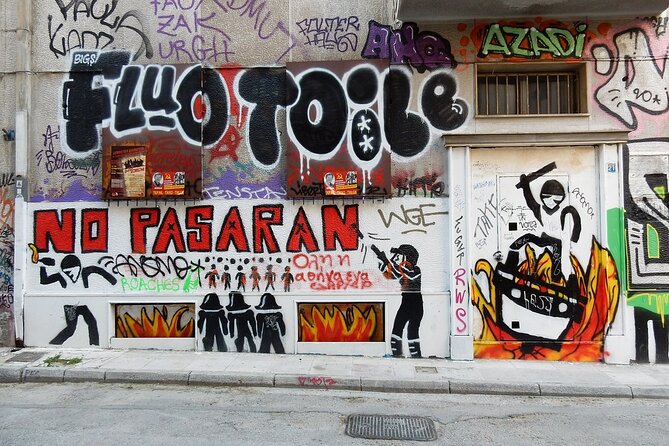
Athens has a way of making politics feel personal. On this walk, you do not just read about the system, you see it written into street corners, official buildings, memorials, and the institutions that shape daily life.
The tone is documentary-like: the guide builds a clear storyline and then points you to the physical evidence as you move. It helps that the guide is a political scientist, and the best sessions bring that mix of clarity and good humor. You are not left with vague impressions, you leave with a framework you can actually use.
I especially like that the walk is designed around interpretation. The big question is blunt, but it is the right one for the post-2008 world: how did the cradle of democracy become the Europe problem story? Along the way, you are encouraged to form your own opinions, not memorize a single line.
More of Plaka and Monastiraki on foot:
- Acropolis and Parthenon Guided Walking Tour
★ 5.0 · 4,755 reviews - Greek Food Walking Tour in Athens
★ 5.0 · 4,740 reviews - Athens: Guided Greek Food Walking Tour with Tastings
★ 4.9 · 2,859 reviews - Acropolis monuments & Parthenon Walking Tour with Optional Acropolis Museum
★ 5.0 · 2,678 reviews
From Maximos Mansion to the Presidential Palace: Power in Plain Sight
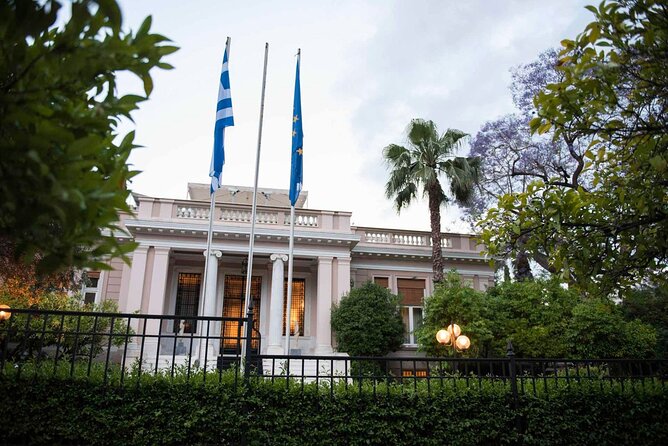
You start near Maximos Mansion, a key stop for anyone trying to understand how Greek governance feels from the inside. Even before the deeper context arrives, the location signals authority. This is where the modern state’s machinery shows up in brick, gates, and the visual language of control.
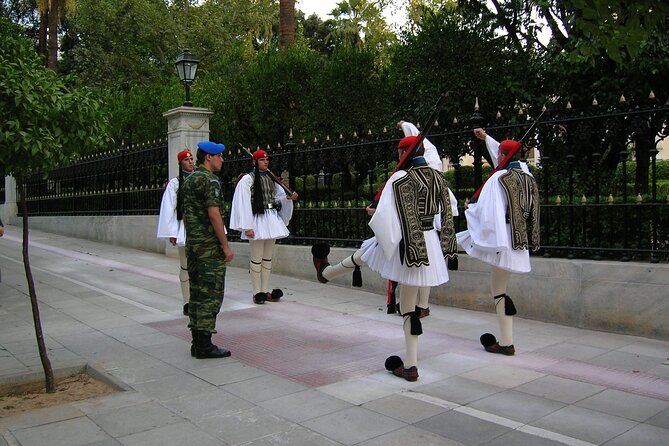
From there, you move toward the Presidential Palace. The point of this stretch is not pageantry. It is contrast: how Greek political identity has been negotiated over time, and how institutions evolved as the country moved through wars, regime changes, and political realignments.
What you should watch for is the guide’s way of connecting the dots. The buildings are not just landmarks. They become anchors for topics like the state after independence, political tension, and how social expectations and political power influence each other.
National Garden and Hellenic Parliament: Politics Meets Everyday Athens
Next comes a calmer zone that still carries political weight: the National Garden area. This stop helps you feel the pacing of the city. Right when you might expect only harsh politics, the route shifts into a different rhythm, reminding you that governance is not separate from daily routines.
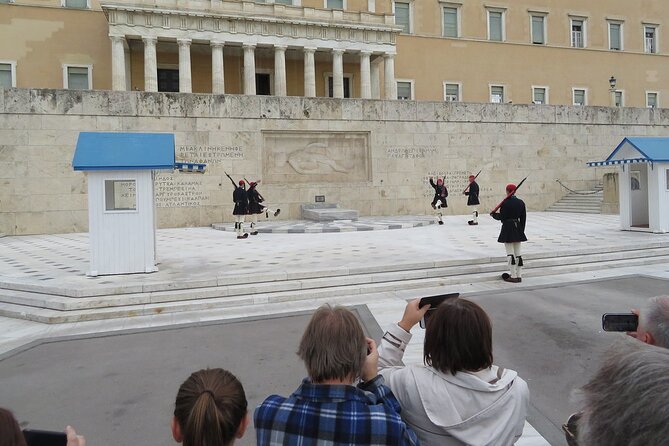
Then you reach the Hellenic Parliament. This is one of the most important visual chapters because it lets the guide talk about modern party politics and how public life shapes policy. The conversation tends to land on what people argue about, not just who holds office.
If you like understanding politics as lived experience, this is where the walk clicks. The guide frames political shifts as something that affects ordinary life: jobs, public trust, institutions, and how people talk about Europe and the economy.
Practical note: this part of the route is made for walking, so plan for comfortable shoes and steady pace. If your energy is limited, you will still be able to follow because the narration is structured around stops, not long stretches of silence.
National Historical Museum Stop: How the Past Presses Into the Present
You then move to the National Historical Museum area. This stop is about continuity. Greece’s past is not treated like a museum label. It is used as a living reference point for modern debates, from national identity to international relationships.
The guide’s approach often connects major historical phases to specific themes: independence-era developments, later upheavals, and the political arguments that grew from them. You also hear how religion and language factor into identity and social organization.
Why this matters for you: it prevents the common Athens mistake of treating history as a separate sightseeing lane. Instead, you learn how the modern Greek story gets explained through older tensions and older choices, even when the issues feel brand-new.
If you are not a politics person, do not worry. The narration is built to keep complex topics understandable. You end up with a mental map you can carry through the rest of your trip.
Korai 4 Memorial Site 1941-1944: The Stakes Behind the Theory
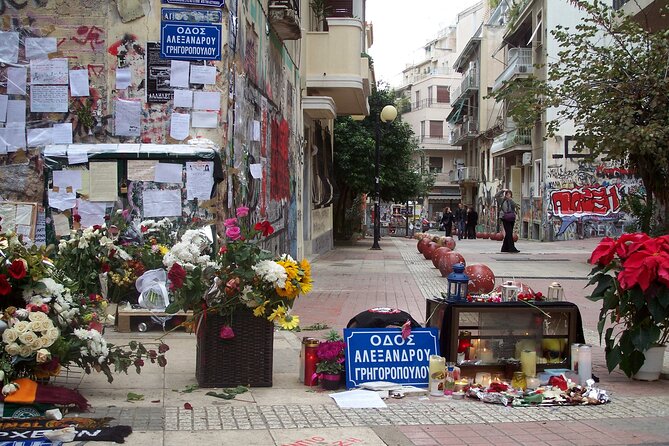
At Korai 4, the tone shifts into memory and consequence. This memorial site, marked for 1941 to 1944, is a place where political conflict is not abstract. You get reminded that politics lands on real people and real risk.
The guide uses this stop to connect broader narratives like occupation-era turmoil and resistance to the bigger themes of social order and political legitimacy. Even if you did not come to Athens seeking wartime context, this is a strong reminder that today’s institutions were shaped by earlier trauma and earlier choices.
It also balances the walk’s earlier focus on power. After Parliament and government buildings, Korai 4 gives you the human gravity beneath the system. You start to understand why civic arguments can feel so intense in Greece, and why certain historical moments still matter in modern debates.
Same hours, spent a different way in Athens:
- Athens: Acropolis & up to 5 Archaeological Sites Combo Pass★ 4.2 · 13,904 reviews
- Athens: Acropolis, Parthenon & Acropolis Museum Guided Tour★ 4.8 · 9,316 reviews
- The Acropolis, Parthenon & Acropolis Museum Guided Tour★ 4.7 · 8,493 reviews
- Athens: Cape Sounion & Poseidon Temple Sunset Half-Day Trip★ 4.8 · 8,241 reviews
Panepistimiou and the Metsovio Polytechnic: Youth, Education, and Protest
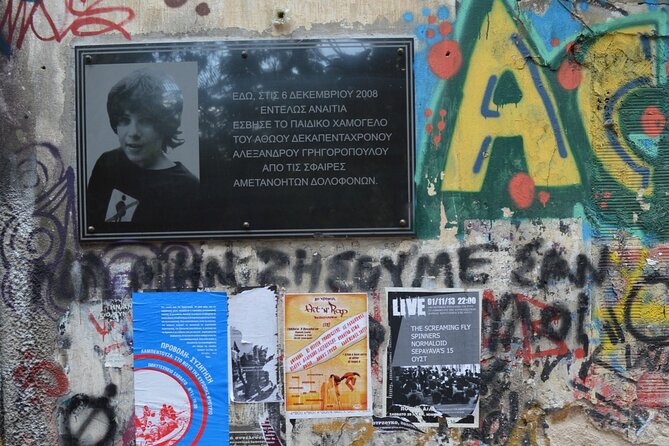
Then you head along Panepistimiou, one of the city’s major educational and institutional corridors. This part of the route is where the walk starts talking about youth, public action, and how ideas travel through schools and universities.
The National Metsovio Polytechnic stop continues that theme. This is where you learn to connect education with political pressure, especially when the country faces economic strain and social change. The guide links these institutions to episodes of student activism and the political shockwaves that follow.
This section is a favorite for people who want the walk to explain more than government structure. It shows how politics is debated, organized, and expressed by citizens, not just by officials.
And for your planning: because this is still a walking tour, this is where you might feel the 2.5-hour duration. The good news is the narration stays tight, and the stops give you natural breaks from the walking.
The Two Stops That Let the Story Breathe
There are also two route moments that are less about major institutions and more about what happens between them. These stops function like pauses in a documentary, places where the guide can widen the lens.
You use these breaks to absorb the bigger themes. Religion and language, the role of Europe in Greek public debate, and shifts in economic thinking are easier to hold when the walking rhythm slows down for a moment. You also get a sense of how everyday Athens exists in the same frame as formal power.
If you like context, do not rush these segments. They are the connective tissue that makes the final argument feel coherent.
Religion, Language, Europe, and the Economy: What the Walk Actually Teaches
The tour’s central strength is its theme stitching. The guide does not treat modern Greece as a single political storyline. Instead, you hear how multiple forces overlap.
Here are the main themes that tend to come up as you move from stop to stop:
- Religion as part of public identity and social organization
- Language as a cultural boundary and a marker of belonging
- Europe as a source of both opportunity and political conflict
- The economy as the pressure system behind many arguments since the financial crisis
The way it is explained matters. You are not just told what happened. You are shown why people in Greece argue the way they do, and how the global story after 2008 changed the local story.
If you are visiting Greece for the first time, this kind of framing helps you decode street conversations, news headlines, and casual opinions you might hear. If you are returning, it gives you a fresh way to interpret familiar spaces.
And yes, the guide answers questions. That is important, because politics gets personal fast. You get a chance to ask what you are really wondering, then you get an answer grounded in the broader storyline.
Price and Value for a 2.5-Hour Athens Walk
The price is $47 per person for a 2.5-hour experience. That is not a museum-ticket bargain, but it is solid value for what you get: a structured political narrative plus a slideshow with photos and extra info.
You are paying for translation, not just distance. The walk turns a confusing topic like Greece’s recent political shifts into an understandable story anchored to real places. It also saves you time. Instead of stitching together your own understanding from books and scattered articles, you get one guided framework delivered in a single afternoon block.
If you are short on time in Athens, this is a practical choice. A 2.5-hour walk is long enough to build momentum and short enough to still let you see other sights the same day.
Who gets the best value?
- People who want a political and social lens, not only archaeology
- First-time visitors who want context before they wander on their own
- Anyone curious about how the 2008 financial crisis changed Europe’s political story, with Greece as the case study
- Readers who prefer explanations with humor and direct answers, not dry lectures
Who Should Book This Tour, and Who Might Skip It
Book it if you want Athens to make sense beyond monuments. This is for you if you like the idea of walking through power, memory, education, and civic institutions and having someone connect them into one argument.
Skip it if your main goal is purely visual sightseeing. You will still see important sites, but the emphasis is on politics and society. This walk is not meant to replace a museum day or a classics-focused tour.
Also, languages matter. The live guide is offered in Spanish and English. If you need another language, you may want to choose a different option.
Should You Book the Athens Social and Political Walk?
Yes, with one key condition: you should go in ready to think. Bring curiosity, not just a checklist. If you do, you will come away with a clearer sense of why modern Greece is discussed the way it is, and why people in Greece talk about identity, Europe, and the economy with such intensity.
I would also recommend this as an early decision in your trip. The framing helps everything else you see fall into place later, especially if you plan to read headlines, visit memorial sites, or spend time in neighborhoods where politics shows up in everyday conversation.
If you want a guided political story that stays street-level and human, this is a strong pick for Athens.
FAQ
How long is the Athens Social and Political Walk?
It lasts 2.5 hours.
How much does the tour cost?
The price is $47 per person.
What languages are the live guides?
The tour is guided live in Spanish and English.
Where does the tour start and where does it finish?
It starts at Athens Social and Political Walk – Planetwonk and finishes at 28is Oktovriou 42, Athina 106 82, Greece.
Is the tour wheelchair accessible?
Yes, it is wheelchair accessible.
What is included in the experience?
You get a slideshow with photos and extra info on the issues discussed during the experience.
Can I cancel and get a refund?
Yes. You can cancel up to 24 hours in advance for a full refund.
Latest from under the Acropolis

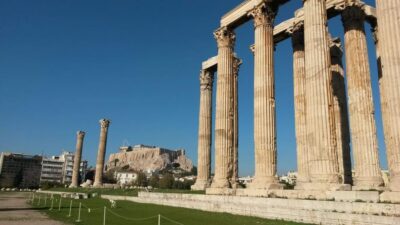




Walking Tours, compared.
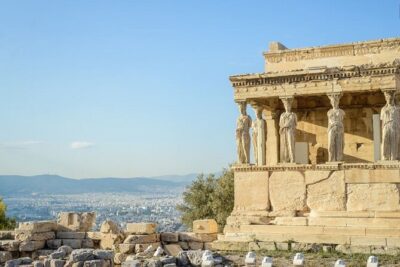
Acropolis and Parthenon Guided Walking Tour
Read our review →

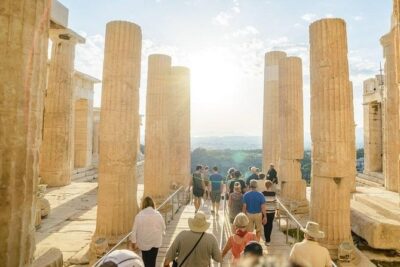
Acropolis monuments & Parthenon Walking Tour with Optional Acropolis Museum
Read our review →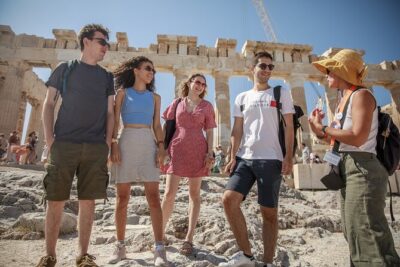
Athens Acropolis and Parthenon Walking Tour
Read our review →
Acropolis, Parthenon & Athens Old City Heritage Walking Tour
Read our review →
Athens Authentic Greek Food Walking Tour (Small Group)
Read our review →
Browse the lists this tour appears in