
Reviewed · ANCIENT CORINTH TOURS
The original Christian tour on Paul’s footsteps in Athens and ancient Corinth
Paul’s footsteps turn a history lesson into a day. This private Athens and Corinth route links the Acropolis to the story of Saint Paul preaching near the Areopagus, with a driver who gets you there smoothly.
I really like the small-group feel, up to 3 people, and the practical plan that packs major sights into a single 8-hour outing. The best part is how clearly the day is structured, so you get context at each stop, not just sightseeing.
One consideration: this is driver-led for the movement between sites, and you may spend time exploring some places on your own since the driver is not licensed to accompany you inside archaeological sites. If you want someone walking you through the details inside museums and ruins, you may need an added licensed guide.
In This Review
- Key things that make this tour feel worth it
- Athens pickup, then a coastal warm-up to the real highlights
- Areopagus and the Paul connection you can actually locate
- Acropolis gate to Parthenon, built for meaning, not just photos
- Temple of Athena Nike and what the carvings try to tell you
- Erechtheion and the Caryatids, including the controversy
- Ancient Agora: 5,000 years of the same idea, in the same space
- Drive to Peloponnese, then Corinth Canal for the geography of trade
- Ancient Corinth visit: where commerce and early Christian-era conversations meet
- Lunch in Corinth, but keep expectations realistic
- Driver-led guidance vs licensed guides inside the sites
- Price and value: what $445 per group really buys you
- Who this suits best (and who should consider a different style)
- Booking call: should you book this Paul’s footsteps Athens and Corinth day?
- FAQ
- How many people are included in this private tour?
- Is hotel pickup and drop-off included?
- What language is the tour offered in?
- Are entrance fees included for the archaeological sites?
- Is lunch included in the price?
- Do I need a separate licensed guide to go inside sites?
- Are admission tickets required in advance?
- What should I wear and how active is the day?
Key things that make this tour feel worth it
- Private vehicle and hotel or cruise pickup, so you are not wasting time on transfers
- Acropolis stop sequence (Areopagus, Propylaea, Parthenon, Erechtheion) timed for a focused religious history day
- Saint Paul context at the Areopagus, with a bronze plaque marker you can see at the foot of the rock
- Corinth Canal and Saronic Gulf drive, which breaks the day up with big scenery and geography
- Flexible lunch time in Ancient Corinth, with free time for food at your own cost
- English-speaking driver experience, often praised for clear explanations before each drop-off
Athens pickup, then a coastal warm-up to the real highlights
The day starts with pickup from your hotel in Athens or from the cruise ship pier in Piraeus. From there, you drive along the coastal road of the Saronic Gulf. It is a smart start. You ease into Athens, you see the city from a distance, and you avoid that first-stress moment of figuring out where to be and when.
The tour is priced per group, not per person, for up to 3. That matters because you are paying for a private vehicle with pickup and drop-off, plus an English-speaking professional driver who explains what you are looking at. For many travelers, it ends up being cheaper than piecing together separate transfers and a guided walking tour.
Other visits to ancient Corinth:
- From Athens: Ancient Corinth Day Trip with Canal & VR Guide
★ 4.6 · 1,073 reviews - Biblical Tour Letters ToThe Corinthians St Paul’s Footsteps 6Hour
★ 5.0 · 1,065 reviews - Private Biblical Tour Ancient Corinth & Isthmus Canal from Athens
★ 5.0 · 762 reviews - Athens: Ancient Corinth & Nafplio Full Day Trip with Swim
★ 4.8 · 531 reviews
Areopagus and the Paul connection you can actually locate
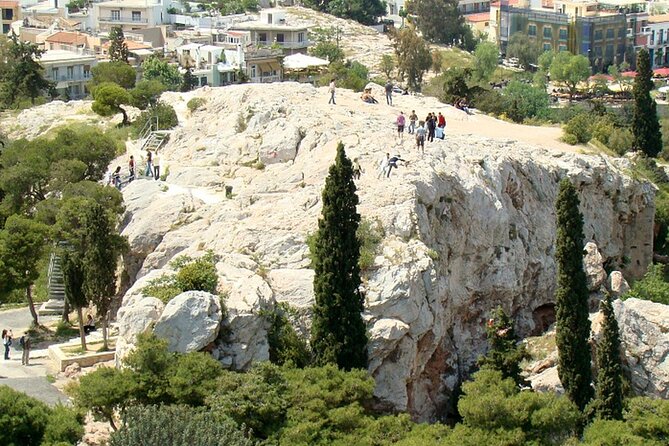
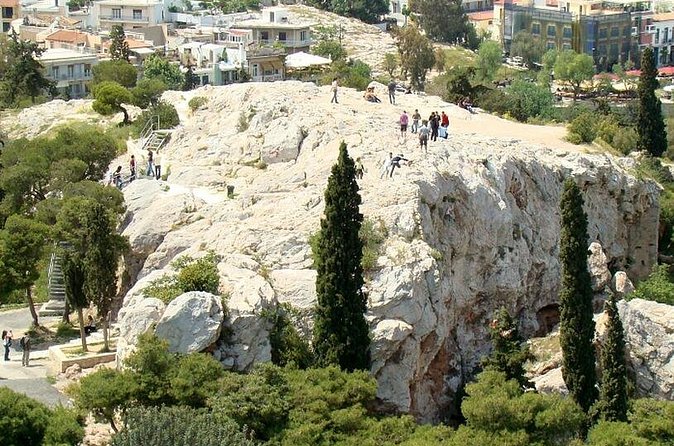
One of the most meaningful parts is the Areopagus stop, also called the Hill of Ares. This is the hill tied to public trials in classical times, but the Paul connection is what gives the stop its special charge.
In this plan, you do not just hear the idea. You are guided to the spot where Saint Paul is associated with his famous speech on an unknown god, and you can see a bronze plaque at the foot of the rock. That kind of tangible marker is what turns a Bible story into something you can orient yourself around on the ground.
Practical tip: plan to wear shoes you can trust on uneven stone and steps. Even short stops here involve climbing a bit, and Athens is not designed for delicate footwear.
Acropolis gate to Parthenon, built for meaning, not just photos
The tour builds the Acropolis story in the order you would want to understand it, starting with the top-of-hill sequence.
You will first hit the Propylaea area, the grand gate complex that links the outside world to the sacred precinct. From there, you move into the smaller but important sites on the hill, like the Temple of Athena Nike, which sits on the southwestern edge.
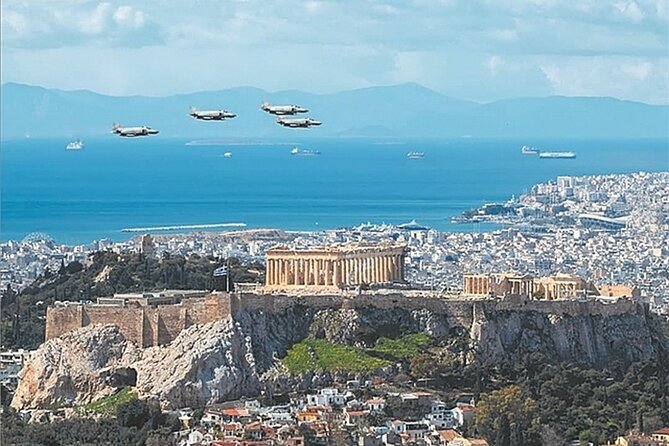
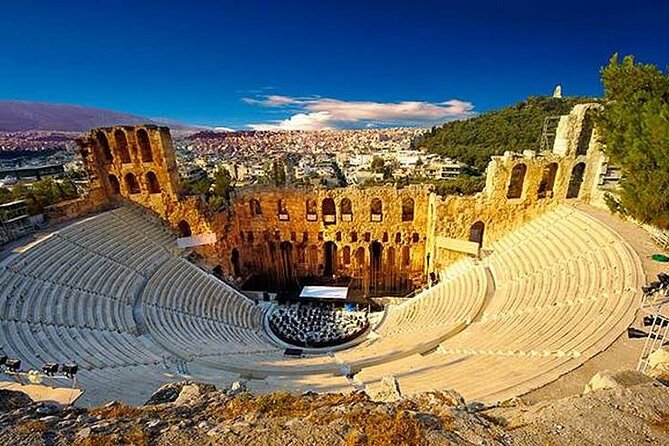
Then comes the main event: the Parthenon. You get enough time to actually see it as more than a postcard. The Parthenon is described as the culmination of Doric order development and part of Pericles’ rebuilding program after the Greco-Persian Wars. If you like religious history, this is where the politics and the theology overlap in stone. Athens used the temple to honor Athena Parthenos and also to function as a treasury of the Delian League.
Temple of Athena Nike and what the carvings try to tell you
Even with a short visit time, this stop is useful because it explains the idea of art as messaging. The temple includes carved relief friezes with different themes on different sides, including war scenes connected to Greek victories. The tour framing helps you notice that you are not just looking at ruins, you are looking at a strategy for celebrating identity.
Erechtheion and the Caryatids, including the controversy
The Erechtheion is one of those stops where you will understand why people argue about restoration and collecting. The porch includes famous caryatids, and the information shared on the tour explains that several figures were moved to the Acropolis Museum, replaced with replicas, and that at least one figure was taken by Lord Elgin in the early 1800s and later displayed in the British Museum.
You do not need to have a strong opinion before you visit. The key value here is that you come away aware the statues are part art history, part modern ethics debate. That makes the visit feel more real, less like you are staring at objects in a vacuum.
Same hours, spent a different way in Athens:
- Athens: Acropolis & up to 5 Archaeological Sites Combo Pass★ 4.2 · 13,904 reviews
- Athens: Acropolis, Parthenon & Acropolis Museum Guided Tour★ 4.8 · 9,316 reviews
- The Acropolis, Parthenon & Acropolis Museum Guided Tour★ 4.7 · 8,493 reviews
- Athens: Cape Sounion & Poseidon Temple Sunset Half-Day Trip★ 4.8 · 8,241 reviews
Ancient Agora: 5,000 years of the same idea, in the same space
After the Acropolis, you head to the Ancient Agora of Athens. This stop is not about a single monument. It is about the concept of a public gathering place. The agora served as an assembly area and later also as a marketplace and residential space over many eras.
The standout feature is the long timeline you feel when you walk through it. The site has gone through countless cycles of rebuilding and destruction, and excavations have exposed layers from Archaic to Greco-Roman and Byzantine periods.
If you are connecting Paul’s story to Athens, this is the moment where the city starts to feel less like temples and more like people. This area is the backdrop for how a message spreads in a real city, not just in scripture.
Drive to Peloponnese, then Corinth Canal for the geography of trade
After the Agora, you travel toward Corinth Canal. The drive includes a coastal road segment through the Saronic Gulf route and then into the Peloponnese region. The tour explains Peloponnese as a peninsula connected to central Greece by the Isthmus of Corinth, separated from the Gulf of Corinth by the Saronic Gulf.
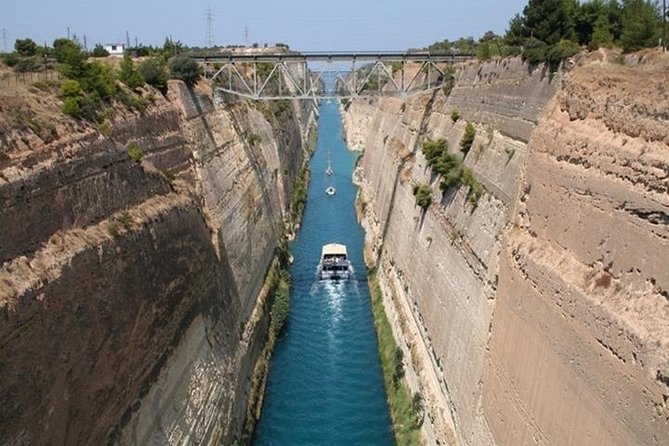
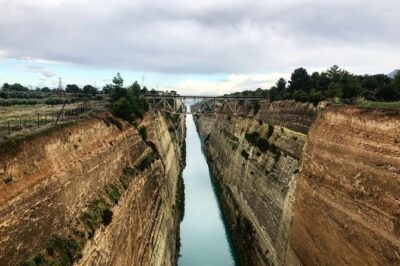
Then you get one of the best “quick science lesson” stops of the day: the Corinth Canal. You learn how it links the two gulfs, effectively turning the Peloponnese into an island. The canal is described as 6.4 kilometers long and about 25 meters wide, dug at sea level. And the big idea is that this canal was a 2000-year dream. Long before the actual canal was cut, ships had to travel around the Peloponnese, adding a long detour.
You might not linger long here, but it is the kind of stop that helps you understand why Corinth mattered. Geography was destiny.
Ancient Corinth visit: where commerce and early Christian-era conversations meet
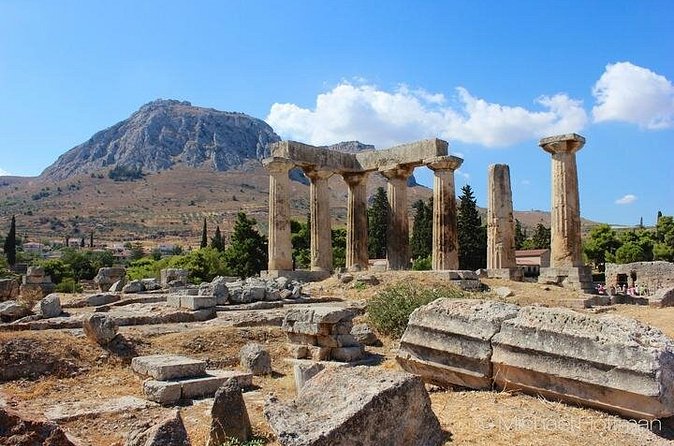
After the canal, you drive about 20 minutes to Ancient Corinth (Archaia Korinthos). This is where the tour turns from general Roman-Greek context into a more Paul-centered setting.
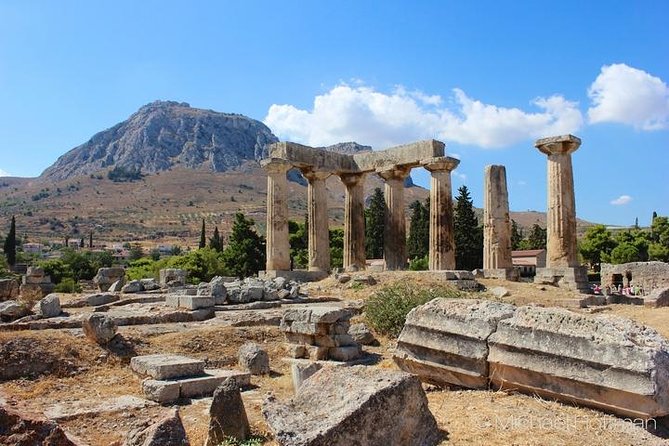
You get a time window of around 1 hour 20 minutes, and the background is clear: Corinth was settled early, with Neolithic origins mentioned, but its big advantage is strategic location. It sat at the crossroads of land routes and waterways connecting western Mediterranean travel toward Asia Minor and Syria-Palestine.
The explanation also covers Corinth’s growth and trade output, plus the founding of Corinthian colonies in the 8th century BC. Even if your main focus is Paul, this context helps you picture Corinth as a moving hub, not a sleepy town.
Lunch in Corinth, but keep expectations realistic
Lunch is part of the day in a practical way: there is time for a food break in a traditional restaurant in Ancient Corinth, but it is not included in the price. That is a good structure because it keeps the tour predictable on costs, while still giving you a local-feeling meal time.
If you are the type who loves to plan food, you will likely enjoy this moment. If you are the type who gets hangry quickly, this is one of the few spots where you will be glad you planned ahead.
Driver-led guidance vs licensed guides inside the sites
This tour is very clear about how guidance works. You get a professional English-speaking tour driver with good knowledge of history and culture, and they guide you until you enter archaeological sites and museums according to the program. But the driver is not licensed to accompany you inside the archaeological sites and museums.
So you will experience a mix:
- Explanations while traveling and at the approach to sites
- Time on your own inside some sites, based on how you explore
That is exactly where the reviews split. One set of experiences highlights guides like Danai, described as an archaeologist with impressive religious and Greek history knowledge, plus drivers like Spyros for attentive service like making sure water was available. Another experience mentions a guide named David who did an ok job, but wished for more guided storytelling while the group was dropped off.
My advice is simple: if you want constant narration at eye level inside each site, consider arranging an added licensed guide for the day. If you are fine with a strong set of orientation talks plus self-guided time, this format can work very well.
Price and value: what $445 per group really buys you
At $445.77 per group for up to 3 people, the tour is not trying to be the cheapest way into ruins. It is trying to be the least stressful way to do a large day.
You are buying:
- Private air-conditioned transportation
- Hotel or cruise pickup and drop-off
- An English-speaking professional driver
- A carefully timed visit set that links Athens and Corinth
The non-included costs are also worth understanding upfront. Entrance fees to archaeological sites and museum are not included, and the same goes for food and drinks. The tour also notes that a driver is not the same as a state-licensed guide inside sites.
When I think of value here, I see it as convenience plus context. If you already know the basics and you want someone to handle the logistics and point out what matters, this can be a great deal. If you want a fully narrated museum-level guide for every interior, you should plan for added guide costs.
Who this suits best (and who should consider a different style)
This fits well if you:
- Want a private vehicle and pickup with minimal hassle
- Prefer a day organized around story and location, especially Paul-related stops
- Like short, efficient visits that help you build a mental map quickly
It may feel less satisfying if you:
- Expect a licensed guide walking you through each archaeological site room by room
- Want deep commentary constantly while you are stopped at viewpoints and then left to explore
It also says dress code is formal. That is easy to handle with a light jacket and respectful outfits, but it is good to know before you go.
Booking call: should you book this Paul’s footsteps Athens and Corinth day?
I would book it if your goal is to connect Paul to place, with the big anchors handled for you: Acropolis highlights, the Areopagus plaque marker, and the Corinth Canal geography. The best versions of this day seem to come alive when the driver is strong and when you treat the self-guided portions as your chance to look closely.
I would pass or upgrade if you know you need a licensed guide inside sites to feel satisfied. In that case, the driver guidance plus drop-offs might leave you wanting more on-the-spot storytelling.
If you do book, arrive ready to move: bring your admission tickets plans, wear sturdy shoes, and treat lunch as your chance to recharge before Ancient Corinth. With that mindset, this day can feel like one coherent route, not a pile of disconnected stops.
FAQ
How many people are included in this private tour?
It is a private tour for your group, up to 3 people.
Is hotel pickup and drop-off included?
Yes. Hotel pickup and drop-off in Athens are included, plus pickup and drop-off at the cruise ship pier at Port of Piraeus.
What language is the tour offered in?
The tour is offered in English, with an English-speaking tour driver.
Are entrance fees included for the archaeological sites?
No. Entrance fees to archaeological sites and museum are not included.
Is lunch included in the price?
Lunch is not included. You get free time for lunch at a traditional restaurant in Ancient Corinth.
Do I need a separate licensed guide to go inside sites?
The driver is not licensed to accompany you inside archaeological sites and museums. The tour notes you can arrange an English-speaking licensed tour guide for an extra cost, subject to availability.
Are admission tickets required in advance?
The tour suggests pre-purchasing admission tickets because there may be limited availability. They can also buy tickets in advance for a small service fee.
What should I wear and how active is the day?
The dress code is formal, and travelers should have a moderate physical fitness level.
Latest from under the Acropolis


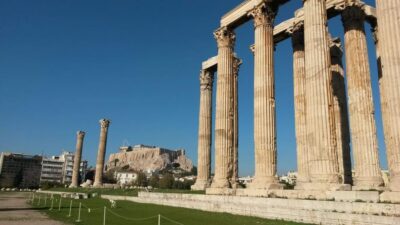




Ancient Corinth Tours, compared.
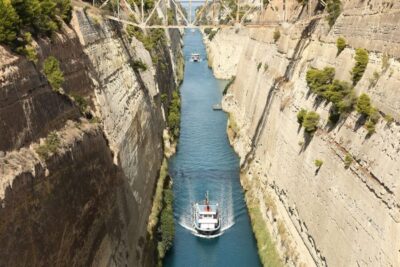
Ancient Corinth Day Trip with Canal & VR Guide
Read our review →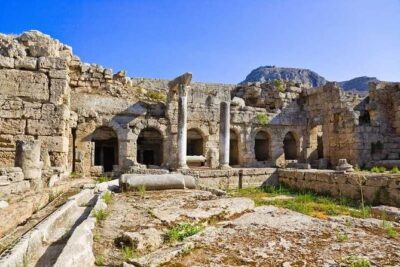
Biblical Tour Letters ToThe Corinthians St Paul’s Footsteps 6Hour
Read our review →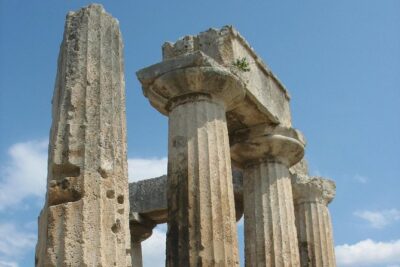
Private Biblical Tour Ancient Corinth & Isthmus Canal from Athens
Read our review →

Corinth Canal, Mycenae & Nafplio Premium Guided Tour
Read our review →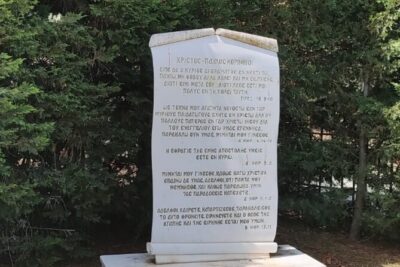
Private Tour of Apostle Paul’s Footsteps in Ancient Corinth
Read our review →
Corinth Half-Day Trip from Athens with Entrance Tickets
Read our review →Browse the lists this tour appears in