
Reviewed · VIP
Private Luxury Tour: Ancient Messene – Glory of the Peloponnese
Ancient Messene feels like a time machine. This private luxury tour from Athens strings together classic Greek landmarks, scenic river stops, and one of the best-preserved ancient cities in the Peloponnese. You get comfortable door-to-door pickup, an English-speaking driver, and a route that builds context as you go.
I love two things most. First, the early stops (Corinth and the Arcadian Gate area) help you get the story before the big ruins. Second, Ancient Messene’s scale does not feel like a quick look at broken stones, it feels like walking through an actual city plan.
One consideration: most archaeological sites are timed for short visits, and entrance fees are not included (plan on about €15 per person), with your driver focusing on guiding and context rather than escorting you inside.
In This Review
- Key Things You’ll Remember
- How This Private Tour Turns a Long Drive Into a Proper Day
- The Corinth Canal Start, Where the Peloponnese Story Begins
- Arcadian Gate: The Ceremonial Threshold You Can Actually Walk Through
- Ancient Messene: One of Greece’s Best-Preserved Urban Ruins
- Petros Themelis and the Theater Area: A Human Story Inside the Stones
- Asklepieion of Ancient Messene: When Healing Was Ritual, Not Medicine-Only
- Roman Messene, Byzantine Layers, and the City That Never Fully Disappeared
- Civic Life and Athletic Training, Stadium to Assembly
- Archaeological Museum: The Artifacts That Make the City Make Sense
- Zevgolatio Taverna Lunch Stop: A Real Taste of Messenia
- Price and Value: What Your $399.07 Really Covers
- Practical Tips So You Enjoy the Walks and Short Stops
- Should You Book the Ancient Messene Luxury Tour?
- FAQ
- What does the tour include for pickup and transport?
- Is this tour private or shared with strangers?
- How long is the tour, and does it include travel time?
- Are entrance fees included in the price?
- Is lunch included during the Zevgolatio stop?
- What is the language used during the tour?
- Are there any tips or gratuities included?
- What happens if the weather is bad?
Key Things You’ll Remember
- Luxury transport from Athens, either a sedan for 1 to 4 people or a mini van for 5 to 7
- Pre-visit storytelling from Pericles (often written as Periklis), so the ruins make sense faster
- Arcadian Gate as a major ceremonial threshold tied to the Mysteries of Andania
- Ancient Messene’s fortifications and intact city layout, not just scattered ruins
- A healing stop at the Asklepieion, including how incubation sleep worked in ancient practice
- Museum time plus Zevgolatio lunch, with time to buy local pasteli as a takeaway
How This Private Tour Turns a Long Drive Into a Proper Day
This is a full-day outing, about 9 to 10 hours including travel time, with hotel or cruise pickup and return to your original meeting point. The private format matters here because Ancient Messene is far enough from Athens that you want the day to feel planned, not stressful.
The transport is also part of the value. You travel in an air-conditioned vehicle, with bottled water and WiFi on board, and it stays comfortable even when you are crisscrossing the countryside. If you are traveling as a small group, the sedan option for 1 to 4 people can feel especially smooth and easy.
And unlike bus-style tours, you are not stuck waiting for the group to decide where to stand. Your driver can pace the day around what you can realistically see, then steer you to the most meaningful spots.
A handful more Athens outings to compare
- Best of Athens Half Day Private Tour
★ 5.0 · 3,714 reviews - Athens Full Day Private Tour
★ 5.0 · 2,903 reviews - Athens Airport Private Arrival Transfer with Meet & Greet
★ 4.5 · 1,495 reviews - Athens Airport to Athens Hotels Private Arrival Transfer
★ 5.0 · 947 reviews
The Corinth Canal Start, Where the Peloponnese Story Begins
Your first real “wow” comes at the Isthmus of Corinth, the narrow land bridge that connected the Peloponnese with mainland Greece for centuries. You’ll look at the logic of the geography first, then the engineering, because the Corinth Canal slices through rock and turned a long route into a faster maritime shortcut.
The time here is short, about 20 minutes, but it works as a warm-up. You get panoramic viewpoints plus an immediate sense of why people fought over this passage and why trade mattered. Admission for this stop is free, so it’s a low-risk, high-context start.
Then you’ll continue onward with a quick scenic pause at the Mavrozoumena Bridge area. This ancient stone bridge spans the Mavrozoumena River and is known for its traditional arched design. It’s not a museum stop, it’s a “look and reset” moment, with legends and folklore often tied to the bridge. Think of it like a breath before you step into Messene’s heavy history.
Arcadian Gate: The Ceremonial Threshold You Can Actually Walk Through
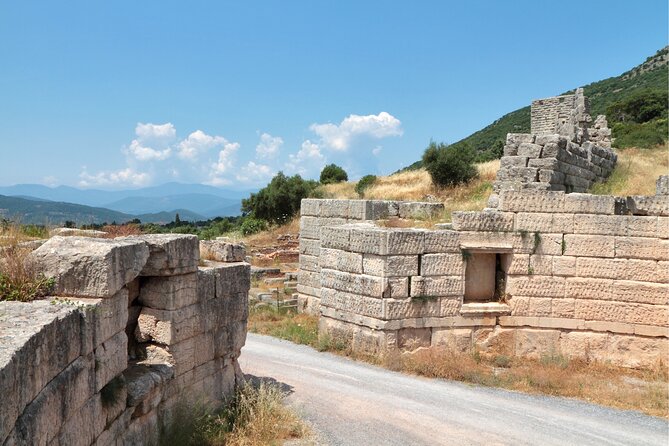
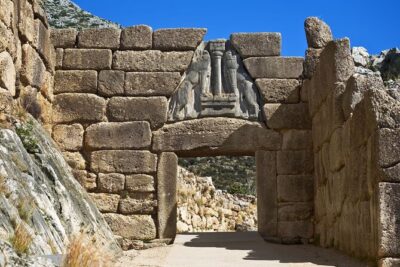
The Arcadian Gate is one of the clearest early “set the stage” moments on the route. It was the main northern entrance to Ancient Messene, built with enormous stone blocks in a massive circular gateway form. In practical terms, it tells you that Messene was built to control access, impress visitors, and mark meaning, not just move people in and out.
This is also where the tour’s storytelling pays off. The gate mattered in the Mysteries of Andania, where initiates and priests followed a ritual process that included purification at Divari Spring in Polichni before passing through this entrance as part of a sacred procession. Even if you are not planning for the ritual context, you’ll understand why this spot feels like a “threshold” rather than just a doorway.
You get about 15 minutes here, and admission is free. That timing is realistic because the gate is impressive, but it’s also a “walk your eyes around it” stop, so you do not lose the day to overly long standing around.
Ancient Messene: One of Greece’s Best-Preserved Urban Ruins
Now you get the big one: Ancient Messene, founded in 369 BCE by Epaminondas. Unlike many archaeological sites that sprawl with scattered remains, Messene’s strength is its preserved urban layout and monumental scale.
You’ll likely feel this most when you start moving from one civic and sacred space to another. The route includes the theater area, healing sanctuary, Roman imperial zone, early Christian remains, civic assembly space, athletic training grounds, and the stadium, all within the same city footprint. This is why it can feel less like “ruins tourism” and more like exploring a real place that used to function as a whole community.
Your time at the archaeological site is about 30 minutes for the main Ancient Messini portion, and admission is not included. That’s enough to connect the dots, especially with your driver providing context so you know what you are looking at before it becomes random.
What I appreciate is how much variety you get without switching locations constantly. Messene is not a single monument, it’s a whole system, fortifications included. And those fortifications matter because they frame how safe, powerful, and intentional this city was.
Petros Themelis and the Theater Area: A Human Story Inside the Stones
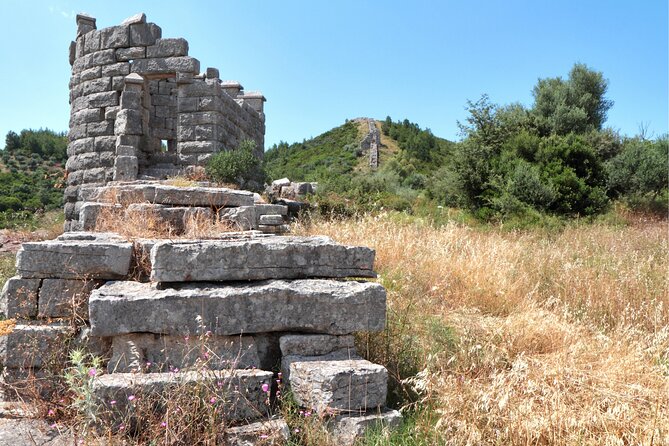
A meaningful stop in the complex is the theater area tied to Petros Themelis, the archaeologist credited with restoring this city. His tomb is integrated into the site and placed beneath an olive tree, which makes the memory of the restoration feel part of the landscape rather than stuck on the side.
You’ll spend about 10 minutes here focused on the theater resting area and that “present-day legacy” angle. The key takeaway is not just that the theater exists, it’s that someone worked hard to bring the city back into view for modern visitors.
The tour also points out why the theater is such a standout in antiquity. It was built in the 3rd century BCE and held around 10,000 spectators. It served as a center for political and cultural life, hosting theatrical performances, assemblies, and religious ceremonies.
If you like ruins that still have a sense of scale, this is the part that does it fastest. You are standing where ancient crowds gathered, and the location helps your brain picture the sound and movement, even with only a short time slot.
Same hours, spent a different way in Athens:
- Athens: Acropolis & up to 5 Archaeological Sites Combo Pass★ 4.2 · 13,904 reviews
- Athens: Acropolis, Parthenon & Acropolis Museum Guided Tour★ 4.8 · 9,316 reviews
- The Acropolis, Parthenon & Acropolis Museum Guided Tour★ 4.7 · 8,493 reviews
- Athens: Cape Sounion & Poseidon Temple Sunset Half-Day Trip★ 4.8 · 8,241 reviews
Asklepieion of Ancient Messene: When Healing Was Ritual, Not Medicine-Only
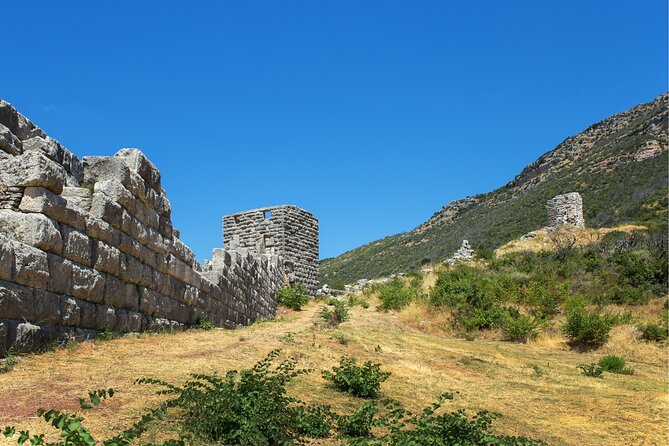
Next comes the Asklepieion, the city’s healing sanctuary and worship center for Asklepios, the god of medicine. The Asklepieion was built in the 3rd century BCE and functioned as both a sacred site and a place where the sick sought divine intervention plus treatment.
Your visit includes a quick walk through spaces associated with the healing process, including the idea of incubation sleep. In simple terms, patients came for ritual, herbal remedies, and rest meant to connect their hopes with divine healing.
It’s about 10 minutes here, and admission is not included. What makes it worthwhile is the mood. Compared to military or political spaces, the Asklepieion feels calmer, and the architecture is designed to slow your pace and focus your attention.
You’ll also learn that it was more than medicine. The sanctuary hosted festivals, theatrical performances, and philosophical gatherings, so it doubled as a cultural hub where people came not only to get cured but to participate in community life.
Roman Messene, Byzantine Layers, and the City That Never Fully Disappeared
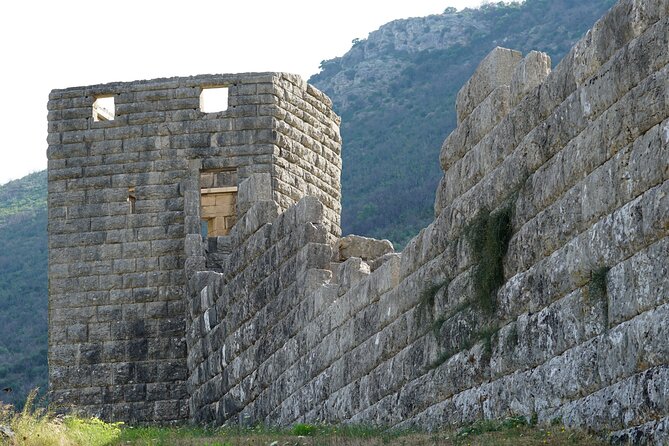
Messene did not stop after Greek antiquity. One stop in the route is the Sebasteion (Caesareion), the grand sanctuary dedicated to Roman emperors. It reflects Messene’s loyalty to Rome and served as an imperial worship space where emperors were honored as divine figures.
The ruins you see today include the basics that make it feel powerful: columns, altars, and statues associated with Roman authority. The site blended Greek and Roman architectural styles, showing how Messene adapted as political power shifted. This segment is short, about 10 minutes, with admission not included, but it gives you a key historical “transition” you can carry in your head.
Then you move into early Christianity with the Basilikḗ, built in the 5th century CE during the Byzantine period. It was a large church constructed over older classical structures, symbolizing the spread of Christianity in the region. You’ll see the three-aisled basilica layout concept and the remnants of marble columns, mosaic floors, and an elevated apse area.
This is another one of those short stops, about 10 minutes. But it hits emotionally because you realize you are not just looking at one era. Messene stayed important enough that new religious life grew over older civic and sacred spaces.
Civic Life and Athletic Training, Stadium to Assembly
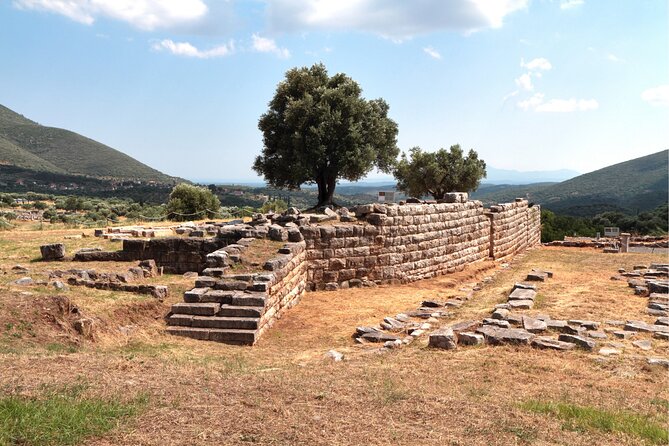
Ancient Messene included not just sanctuaries and theaters, but decision-making spaces and training grounds.
You’ll visit the Ekklesiasterion, the citizen assembly space. This was where political, social, and legal matters were discussed and decided. It was built in the Hellenistic period and worked like a smaller version of Athens’ Pnyx, with stone seating arranged in a semicircle.
This part is about 10 minutes, admission not included. What you should look for is how the shape supports gathering and speech. Even when you cannot “hear” the past, you can imagine the flow of arguments and votes, especially when a city’s identity depends on civic participation.
Next is the Palaistra, the athletic and educational training complex. Built in the Hellenistic period, it trained young men preparing for competitions and military service. The palaistra was surrounded by Doric colonnades, and its rectangular courtyard likely helped define a structured rhythm for wrestling, boxing, and other exercises.
This stop is also about 10 minutes. If you enjoy how the Greeks connected physical training with discipline and even philosophy, this is where that theme becomes tangible rather than abstract.
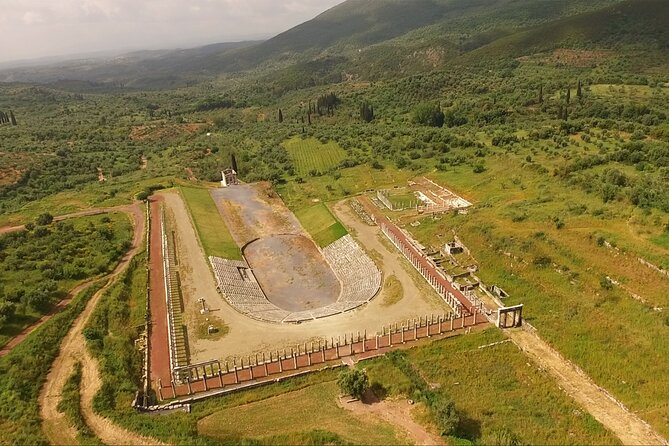
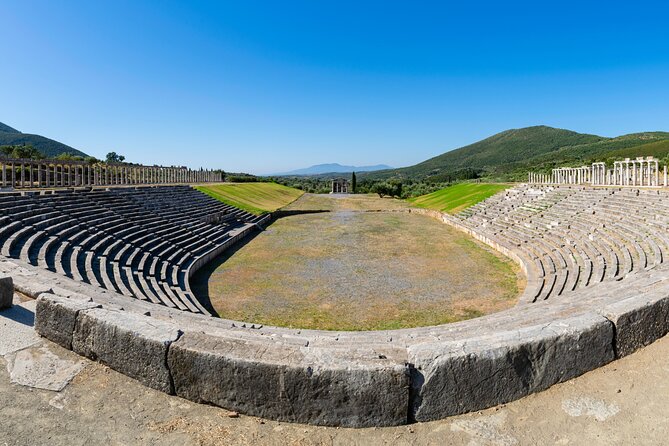
Then comes the Stadium of Ancient Messene, one of Greece’s best-preserved ancient stadiums. It was built in the 3rd century BCE and hosted sporting events, military training, and public ceremonies. The stadium’s colonnades and monumental entrances reinforce its civic role, not just entertainment.
You’ll walk along the track area during about a 10-minute visit, with admission not included. If you like engineering and scale, this is satisfying because you can see how the city designed spectatorship and movement.
Archaeological Museum: The Artifacts That Make the City Make Sense
After the ruins, you’ll get a chance to connect what you saw to objects in the Archaeological Museum of Ancient Messene. This is about 20 minutes and admission is not included.
The museum houses artifacts from the city, covering Classical through Byzantine periods. Highlights include statues of gods and emperors, inscriptions that relate to civic and religious life, and pottery and everyday objects tied to the Asklepieion, the Agora, and the Mysteries of Andania.
This museum stop is especially helpful if you find that walking ruins can still leave you with “I saw it, but I want names.” In a short time, the museum gives you vocabulary for what you already noticed in the city layout.
Zevgolatio Taverna Lunch Stop: A Real Taste of Messenia
At some point in the day you’ll reach Zevgolatio, a village known for its traditional dining stop. You’ll have about an hour for lunch at a taverna next to the historic old train station.
The food focus here is local and simple: fresh meats raised by the tavern owners, grilled over an open flame, plus seasonal vegetables and herbs from their own garden. Lunch itself is not included, but your schedule builds in time so you are not eating at some rushed, generic waypoint.
Before you leave, you can pick up Zevgolatio pasteli, a sesame and honey bar made from pure, high-quality ingredients. It makes sense as a souvenir because it’s easy to carry, and it tastes like the region rather than like a packaged tourist snack.
Price and Value: What Your $399.07 Really Covers
At about $399.07 per person, you are paying for more than the ruins. You are paying for private luxury transport from Athens, air-conditioned comfort, bottled water, onboard WiFi, and a professional English-speaking driver who provides the history and the “what you’re looking at” explanations during the day.
The tour is private, meaning only your group participates. That matters because it typically reduces waiting and improves flow through multiple sites, especially with a schedule packed with short but varied stops.
What is not included is also important for budgeting. Archaeological site and museum entrance fees are about €15 per person (so bring cash or plan for card use where available). Lunch in Zevgolatio is also not included, though you do get time to enjoy it.
On balance, this pricing can be fair if you care about comfort and interpretation, not just checking off ruins. If you are trying to do this on your own with a car and local transport, the day would likely cost more in time and stress, even if the transport line itself looks cheaper.
Practical Tips So You Enjoy the Walks and Short Stops
This tour works best if you come prepared for walking and heat. Wear comfortable footwear, and bring a hat and sunscreen since Greece can be sunny.
Also, keep expectations matched to time. Some stops are only 10 to 20 minutes, so the goal is to see, understand, and move on, not to linger for hours. If you want longer time at one monument, this format might feel tight, but it also keeps the day from dragging.
Finally, if you are serious about photos, think about your “must get” shots early. Start with the big entrances like the Arcadian Gate and the stadium areas, then shift into details like inscriptions and architectural features when you are closer.
Should You Book the Ancient Messene Luxury Tour?
Book it if you want a structured day trip where you do not need to be an archaeologist to enjoy what you see. The short stops still feel coherent because your driver provides context, and the combination of Greek, Roman, and early Christian layers gives Messene a fuller story than you get at many single-era sites.
I would skip it or at least rethink if you know you want long, slow visits inside museums or if you hate entrance fees. Also, if your travel dates are flexible, aim for good weather, because the experience depends on it.
If you do book, prioritize good shoes, sunscreen, and a calm pace. This is the kind of day that feels like a journey through phases of the same city, not just a pile of monuments.
FAQ
What does the tour include for pickup and transport?
Pickup is offered at designated locations for hotel or apartment stays, and the driver waits outside your location. For cruise ports, the driver meets you in the arrival area with a sign with your name. You also get private transportation in an air-conditioned sedan or mini van, plus bottled water and WiFi on board.
Is this tour private or shared with strangers?
This is a private tour. Only your group participates.
How long is the tour, and does it include travel time?
The duration is about 9 to 10 hours, and it includes the time spent traveling between locations.
Are entrance fees included in the price?
No. Entrance fees for archaeological sites and museums are not included, and the cost is listed as €15.00 per person.
Is lunch included during the Zevgolatio stop?
Lunch is not included. You have a scheduled lunch stop with time at a traditional taverna, but meal costs are paid separately.
What is the language used during the tour?
The tour is offered in English, with expert English-speaking tour drivers.
Are there any tips or gratuities included?
No. Gratuities and tips are not included in the price and are left to your discretion.
What happens if the weather is bad?
This experience requires good weather. If it is canceled due to poor weather, you will be offered a different date or a full refund.
Latest from under the Acropolis


VIP, compared.
Luxury Catamaran Cruise from Athens with Traditional Greek Meal and BBQ
Read our review →
Hydra, Poros and Egina Day Cruise from Athens with Optional VIP Upgrade
Read our review →
Athens Pub Crawl with 1hr Open Bar & VIP Nightclub Access
Read our review →Athens Pub Crawl with 1hr Open Bar & VIP Nightclub Access
Read our review →
Half Day Best Of Athens Highlights Luxury Private Tour 4Hou
Read our review →
Private Luxury Biblical Tour: Apostle Paul in Athens & Corinth
Read our review →
Athens AirPort To Athens Hotels Luxury Private Transfer Service
Read our review →
Private Luxury Biblical Tour: Apostle Paul’s Footsteps – Corinth
Read our review →Browse the lists this tour appears in