
Reviewed · ACROPOLIS HILL TOURS
Athens Highlights Walking Tour beyond Acropolis
Athens reveals itself past the Acropolis crowds. This tour strings together the city center with the kind of monuments and everyday streets you usually skip when you sprint for the big sites. I particularly love how Plaka feels like a hillside village, and how the Roman Agora, the Gate area, and the Tower of the Winds make ancient Athens feel real and practical.
You also get a guide with serious Athens energy, and you’ll likely hear the Athens nerd facts without getting drowned out. In one review, the guide Dimos stood out for how clearly he tied the sights together, and you’ll appreciate the included hearing devices when the group gets a bit chatty. With a max of 20 people, it stays manageable.
One thing to consider: this is still a walking tour through outdoor streets, so you’ll want decent shoes and a moderate fitness level. The timing also puts you in the open a lot, so plan for changing weather conditions and bring sun or rain gear.
In This Review
- Key highlights in plain sight
- Beyond the Acropolis: what this Athens Highlights walk does differently
- Price and what $46.30 really buys you
- Meeting point, timing, and walking pace (the stuff that affects your day)
- Stop 1: Plaka, the hillside neighborhood under the Acropolis
- Stop 2: Tomb of the Unknown Soldier and the Evzones in Syntagma Square
- Stop 3: Agora Romaine, the Roman market that covers more than you see
- Stop 4: The Tower of the Winds, built for weather and worship
- Stop 5: Metropolitan Cathedral of Athens, 20 minutes inside the Metropolis
- Stop 6: Syntagma Square again, but with sharper context
- Stop 7: Panathinaiko Stadium (Kallimarmaro), the marble stadium moment
- Stop 8: Arch of Hadrian, your Roman-era finish line
- What the best guides do here, and why hearing devices help
- Hidden gems you can find only on this kind of route
- Who should book this Athens Highlights walking tour
- Should you book it?
- FAQ
- How long is the Athens Highlights Walking Tour?
- Where do we meet, and where does the tour end?
- What is included in the tour price?
- Is there an admission ticket required for every stop?
- What time does the tour start?
- How large is the group?
- Is cancellation free, and what conditions apply?
Key highlights in plain sight

- Plaka first, with time to wander cobblestone lanes, shops, and late-night tavernas
- Syntagma Square memorial moment, at the Tomb of the Unknown Soldier with Evzones nearby
- Roman Agora Romaine access, plus the Gate of Athena Archegetis and nearby Ottoman-era pieces
- Tower of the Winds stop, short but packed with wind-related details you can actually spot
- Metropolis Cathedral visit, with admission included for a 20-minute interior break
- Kallimarmaro and Hadrian’s Gate, two famous landmarks that finish the route cleanly
Beyond the Acropolis: what this Athens Highlights walk does differently
Most Athens days get stuck in a loop: Acropolis, photos, and then a rushed lunch before you move on. This tour takes the opposite approach. It keeps you in the historic center and uses the Acropolis as a backdrop, then shows you what the city looks and feels like after the main crowd wave has passed.
The value is not just “more sites.” It’s the order. Starting in Plaka means you get atmosphere right away, with narrow streets, small storefronts, and that mix of locals and visitors that makes Athens feel lived-in. Then you shift from neighborhood charm to formal landmarks, and you end in the zone of stadium and monumental gateways. You get variety without bouncing around the city.
It’s also a good option if you want Athens monuments but don’t want another full day at the Acropolis complex. This route gives you ancient Greek and Roman Athens right next to modern civic life, so you’re not studying history in a vacuum.
Other routes up the hill and around the Parthenon:
- Athens: Acropolis & up to 5 Archaeological Sites Combo Pass
★ 4.2 · 13,904 reviews - Athens: Acropolis, Parthenon & Acropolis Museum Guided Tour
★ 4.8 · 9,316 reviews - The Acropolis, Parthenon & Acropolis Museum Guided Tour
★ 4.7 · 8,493 reviews - Acropolis: Premium Acropolis and Parthenon Guided Tour
★ 4.8 · 5,208 reviews
Price and what $46.30 really buys you
At $46.30 per person for about 3 hours, you’re paying for three practical things: a licensed guide, hearing devices, and a focused route through multiple free-entry stops plus one included paid admission.
Here’s why that matters. Athens has lots of sites that are technically free to enter, but most people miss what they’re looking at. A good guide makes the difference between seeing a gate and understanding what it was for. The included hearing devices help the guide stay audible even in busy areas and at slightly noisy corners.
Also, the group size cap of 20 people helps. You’re not wrestling for attention while everyone crowds the same photo point. You still get to ask questions, and the walking pace feels like you’re moving with the city instead of being dragged to the next landmark.
If you like structure, but you also want room for a quick look around, this price feels fair for what you get.
Meeting point, timing, and walking pace (the stuff that affects your day)
The tour starts at Porinou 5, Athina 117 42, Greece, with a 9:00 am start. It finishes near Arch of Hadrian, Leof. Vasilisis Amalias 50, Athina 105 58, Greece. There’s no pickup or drop-off, so you’ll want to plan how you’ll reach the meeting point on foot or by public transportation.
The duration is about 3 hours, and the route includes several short stops. Some are mostly exterior viewing, and one key stop includes cathedral time indoors. The overall physical demand is moderate, so you’re not in “marathon mode,” but you do need to be comfortable walking cobblestones and negotiating uneven surfaces.
One small tip based on a real schedule: the meeting happens before the official start time. One review noted meeting at the office around 8:30. Even if your day runs a bit differently, arriving early is smart. It reduces stress and gives you time to get oriented before you head out.
Stop 1: Plaka, the hillside neighborhood under the Acropolis
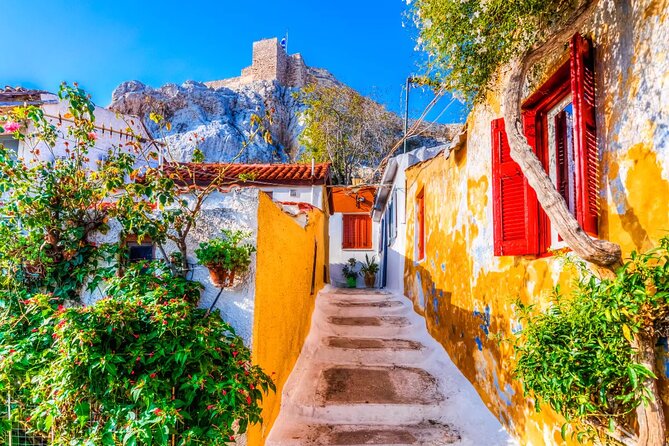
Plaka is where Athens starts to feel like a movie set, but still believable. You’re walking in the shadow of ancient temples, yet the vibe is distinctly neighborhood: narrow cobblestone streets, small shops with jewelry and clothes, and local ceramics that make decent gifts. Sidewalk cafes and family-run tavernas often stay open late, so you’re seeing a lively side of the city that’s easy to miss if you only do daytime monument tours.
You’ll also get a special section of Athens atmosphere in the nearby Anafiotika area. The whitewashed homes there can feel like you’ve stepped onto a Greek island, even though you’re still in the center of Athens. It’s a nice contrast to the large-scale ruins you’ll see later.
How long it lasts matters: you get about 45 minutes here. That’s long enough to do more than a quick stroll. You can slow down, take in street-level life, and make a few decisions about where you might return later.
Potential drawback: Plaka streets can be visually charming but also crowded and uneven. If you’re sensitive to lots of foot traffic or have mobility limits, give yourself extra care on the cobbles.
Stop 2: Tomb of the Unknown Soldier and the Evzones in Syntagma Square
From Plaka, you shift into Athens’ political heart at Syntagma Square. Between the old royal palace complex and the Constitution story, this area feels like where modern Greece declares itself.
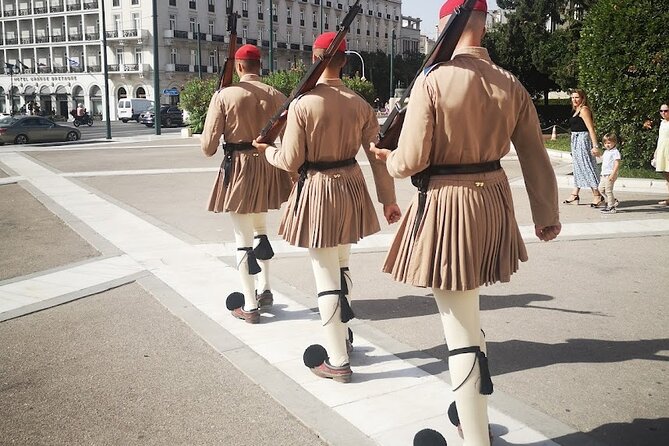
The highlight here is the Monument of the Unknown Soldier, a war memorial dedicated to Greek soldiers killed in war. It’s located in front of the Old Royal Palace and is guarded by the Evzones of the Presidential Guard. The monument was sculpted between 1930 and 1932 by sculptor Fokion Rok, so you get a concrete date range rather than vague “it’s old” energy.
You only have about 15 minutes at this stop. That’s enough time to understand what you’re seeing and watch the guard presence without turning it into a long detour.
Tip for your visit: stand in a place where you can see both the monument area and the surrounding square activity. This helps you grasp why it’s such a central civic stage.
More of Plaka and Monastiraki on foot:
- Acropolis and Parthenon Guided Walking Tour★ 5.0 · 4,755 reviews
- Greek Food Walking Tour in Athens★ 5.0 · 4,740 reviews
- Athens: Guided Greek Food Walking Tour with Tastings★ 4.9 · 2,859 reviews
- Acropolis monuments & Parthenon Walking Tour with Optional Acropolis Museum★ 5.0 · 2,678 reviews
Stop 3: Agora Romaine, the Roman market that covers more than you see
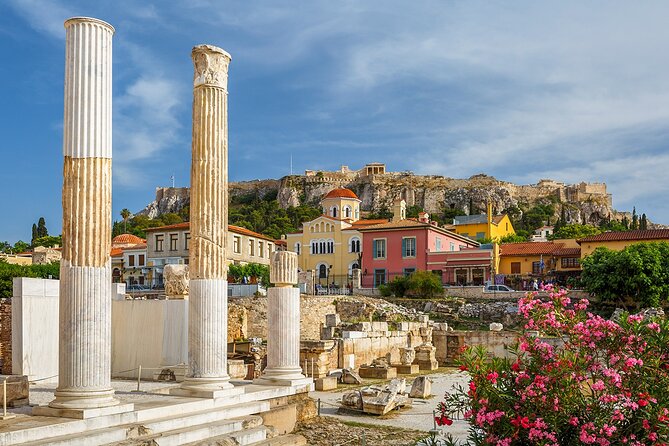
Roman Athens is one of those layers most people forget when they focus only on the Classical period. The Agora Romaine gives you that missing piece. It was the market area during Roman rule and it covered a much larger space than today’s visible site boundaries.
From outside the fence you can see quite a bit, but the time you spend inside is what makes it worth it. You’ll get a closer look at the Gate of Athena Archegetis and the propylaeum (the entrance gate) to the market. You’ll also spot a mix of eras, including an Ottoman mosque, plus the Tower of the Winds on the east side of the site.
This stop runs about 30 minutes, which feels just right. It gives you time to walk, pause, and connect details. If you’ve ever stared at ruins and thought, I have no idea what that part was for, this is the stop that answers that feeling.
Possible drawback: this is a “look carefully” area. If you expect every second to be a giant wow moment, you’ll need to stay a bit engaged. The payoff is in spotting how the parts relate: gate to market to structures to weather.
Stop 4: The Tower of the Winds, built for weather and worship
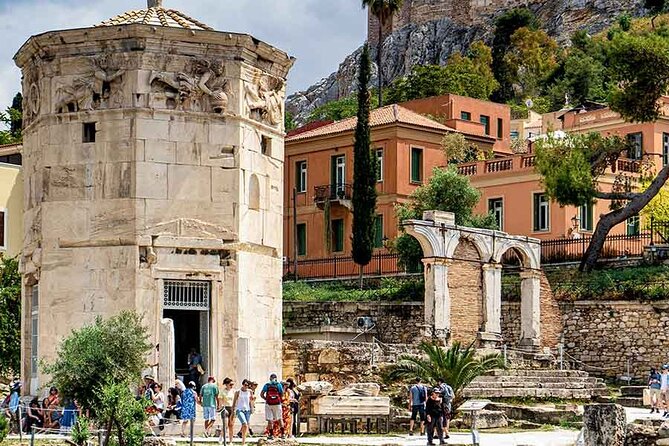
The Tower of the Winds is one of the most satisfying monuments for short-time attention. It’s an octagonal tower made from Pentelic marble, and it’s famous for its eight reliefs of wind gods around the top. The stop is about 10 minutes, so you’re not meant to drift. You’re meant to notice what the guide points out and leave with a mental picture.
The best part is that the name is not random. It comes directly from the wind reliefs. Even if you only catch a few details, it’s still easier to remember than monuments where the story is buried.
Practical tip: bring your eyes up. The wind reliefs are where the story lives. If you spend the whole time looking at the base, you’ll miss the key visual.
Stop 5: Metropolitan Cathedral of Athens, 20 minutes inside the Metropolis
Next you’ll visit the Metropolitan Cathedral of Athens, officially the Metropolitan Cathedral of the Annunciation. In day-to-day speech, people often call it the Metropolis or Mitropoli. This is the cathedral church of the Archbishopric of Athens and all of Greece.
This is the one stop where the time includes an interior experience, and it’s also the one with paid admission included. You get about 20 minutes here, so it works like a reset button in the middle of the walk.
What makes this valuable is the contrast. You’ve moved from Roman market and a weather tower to a living religious site in modern Athens. Even if you’re not focused on architecture, you’ll feel the difference in space, pace, and sound once you’re indoors.
Consideration: if churches are your weak spot, you might find it a bit short. But the 20 minutes is enough to appreciate the setting and then rejoin the route without losing the afternoon.
Stop 6: Syntagma Square again, but with sharper context
You’ll pass through Syntagma Square for about 15 minutes, and by this point you’ve learned enough context to make the square feel more than just a central stop on a map.
The square is named for the Constitution King Otto was required to grant after the popular and military uprising on 3 September 1843. It sits in front of the 19th-century Old Royal Palace, and the Greek Parliament has been housed here since 1934.
This second connection is important. When you understand why the square is named, it changes the feeling from generic “big square” to “political turning point made concrete.”
If you want a quick break here, this is also a good place to pause for water, then keep going.
Stop 7: Panathinaiko Stadium (Kallimarmaro), the marble stadium moment
Then comes Panathinaiko Stadio, also known as Kallimarmaro. It’s a historic stadium in Athens and is famous for one simple fact that’s easy to remember: it’s the only stadium in the world built entirely of marble.
You get about 30 minutes here, which is long enough to walk around, take in the shape, and get a feel for why the stadium matters culturally. The marble makes the space look almost too clean for a street-level city, which is exactly why it’s memorable.
Practical note: since it’s a stadium setting, it can feel more open and exposed to weather than some of the earlier stops. If it’s sunny, you’ll feel it here.
Stop 8: Arch of Hadrian, your Roman-era finish line
The last stop is the Arch of Hadrian, also known in Greek as Hadrian’s Gate. It resembles a Roman triumphal arch and marks an ancient road from central Athens toward eastern structures, including the Temple of Olympian Zeus.
You’ll spend about 10 minutes here. It’s not a long goodbye, but it’s a strong closing image. After everything else, it makes sense: Roman Athens was about connecting places by roads and monumental entrances, not just building standalone ruins.
Finish tip: once you’re done, you’re in a good position to keep exploring on foot. The central area around Hadrian’s Gate is convenient for moving onward.
What the best guides do here, and why hearing devices help
Two reviews point to the guide as a major strength, and one name came through clearly: Dimos. The common thread is clarity. A strong guide doesn’t just name sites. They explain how the city layers fit together, like how Roman market design changes what you notice at the Tower of the Winds, or how civic Athens frames Syntagma Square.
Hearing devices matter more than you might think. Athens streets can be noisy, and group tours naturally raise the volume when people start chatting. With hearing devices included, you can actually follow the story without constantly asking What did he say?
This combination, guide + audio support + short, focused segments, is why the route feels more satisfying than the typical “walk and read signs” day.
Hidden gems you can find only on this kind of route
This tour is designed to include spots you’re unlikely to string together on your own without knowing what to look for. Plaka’s streets and the Anafiotika atmosphere are the obvious wins, but the Roman Agora area is where the “only on a guided route” feeling becomes stronger.
The reasons are simple:
- many details are subtle, like what part of a gate you should notice
- you don’t always know that a particular structure like the Tower of the Winds is part of a larger wind-themed message
- you might not connect the Roman market boundaries to what you see inside the fence
You still have time to wander, shop, and take photos. The difference is you’ll wander with a map in your head, not just on your phone.
Who should book this Athens Highlights walking tour
This is a smart choice if you:
- want a 3-hour walking plan that covers multiple major Athens layers, Greek and Roman plus civic modern Greece
- like getting context, not just taking photos
- prefer small group tours, capped at 20 people
- don’t want the full Acropolis day, but still want those ancient connections in the background
It’s less ideal if you:
- want a lot of time inside major museums or long guided cathedral hours
- have very limited mobility and cannot comfortably handle cobblestones or uneven streets
- are hoping for a totally offbeat itinerary that skips all the famous anchors like Panathinaiko Stadium
Should you book it?
If your goal is to get your bearings fast and see a chunk of central Athens with real storytelling, I think this tour is an excellent fit. The price is reasonable because you’re not just paying for steps, you’re paying for a guide who can connect the sites, and for hearing devices that keep the experience coherent.
Book it if you want a balanced mix: village streets in Plaka, civic symbolism at Syntagma, Roman market structures in the Agora Romaine area, and a clean ending at Hadrian’s Arch with the marble stadium in between.
Skip it if you already have a tight plan that focuses only on the Acropolis complex, or if you need lots of long indoor time. For most people trying to understand Athens beyond the obvious, this is one of the better ways to spend a morning.
FAQ
How long is the Athens Highlights Walking Tour?
It’s about 3 hours.
Where do we meet, and where does the tour end?
You start at Porinou 5, Athina 117 42, Greece. The tour ends near Arch of Hadrian at Leof. Vasilisis Amalias 50, Athina 105 58, Greece.
What is included in the tour price?
You get a licensed tour guide, hearing devices, a walking tour through historic parts of Athens, and included entry for the Metropolitan Cathedral of Athens.
Is there an admission ticket required for every stop?
Most stops are free, and the Metropolitan Cathedral of Athens has admission included. The rest of the itinerary lists free admission tickets.
What time does the tour start?
The start time is 9:00 am.
How large is the group?
The tour has a maximum of 20 travelers.
Is cancellation free, and what conditions apply?
Free cancellation is available, and you can cancel up to 24 hours in advance for a full refund. If it’s canceled due to poor weather, you’ll be offered a different date or a full refund.
Latest from under the Acropolis


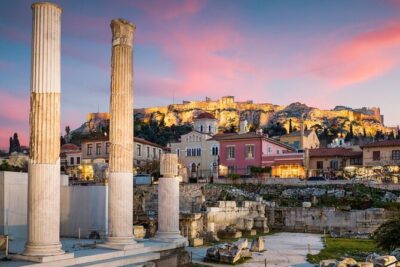

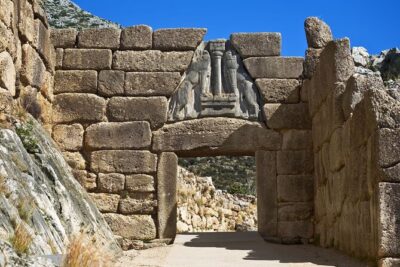

Acropolis Hill Tours, compared.
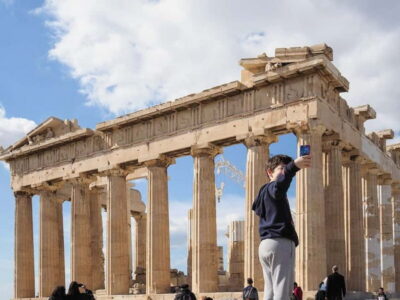
Acropolis & up to 5 Archaeological Sites Combo Pass
Read our review →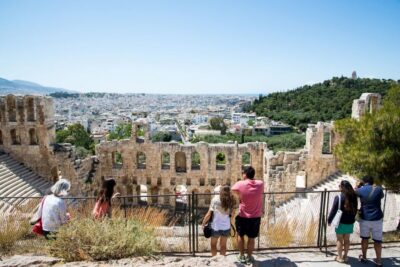
Acropolis, Parthenon & Acropolis Museum Guided Tour
Read our review →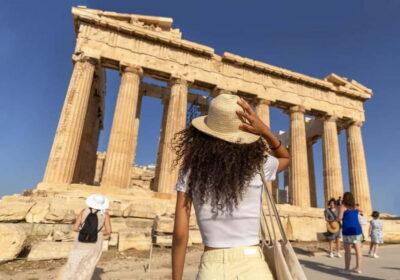
The Acropolis, Parthenon & Acropolis Museum Guided Tour
Read our review →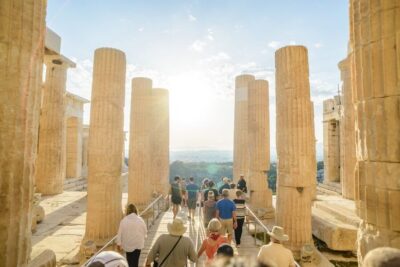
Acropolis: Premium Acropolis and Parthenon Guided Tour
Read our review →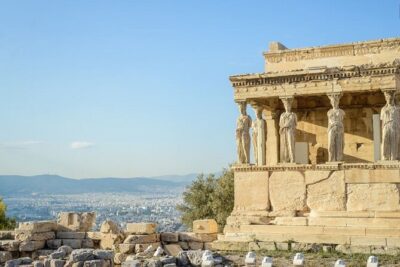
Acropolis and Parthenon Guided Walking Tour
Read our review →Acropolis, Parthenon & Acropolis Museum Guided Tour
Read our review →

Athens Scenic Electric Bike Tour with optional Acropolis visit
Read our review →Browse the lists this tour appears in