
Reviewed · MYTHS & LEGENDS TOURS
Athens Highlights: Myths & Philosophers Walking Tour
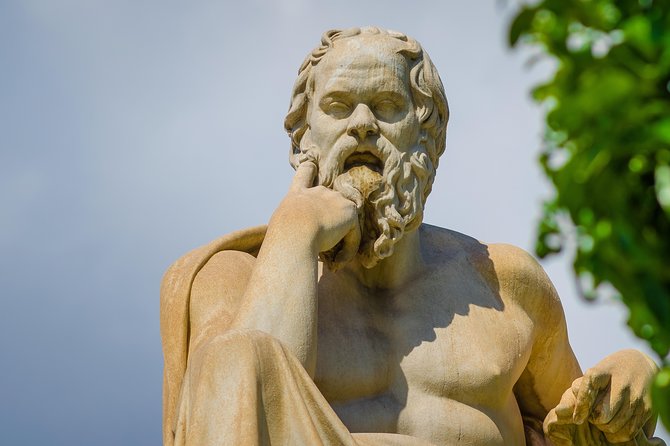
Socrates comes to street level. This private walking tour is built around ancient ideas, modern Athens sights, and a guide who encourages real questions as you walk, which makes the day feel personal. I also love the tight focus on the thinkers you actually name, with stops tied to Plato, Socrates, and Thales of Miletus right where their stories and themes echo through the city.
The only real thing to watch is time and added costs: it runs about 4 hours, and a few key sites along the route have entrance fees not included, plus the tour needs good weather to run as planned.
In This Review
- Key highlights you will feel on the walk
- Athens feels smarter when you walk it as a lesson
- Private tour energy: ask, react, and shape the pace
- Where the tour starts and how long it really takes
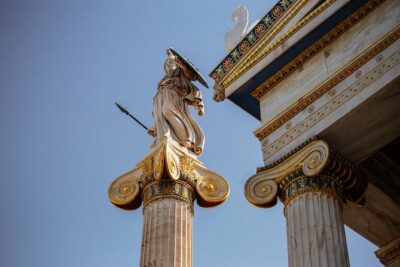
- Stop 1: The Academy of Athens and the idea of education
- Hellenic Parliament: Presidential Guard tradition as a living ritual
- National Garden: democracy and the science Greeks applied
- Ermou Street: Hermes, mischief, and the storytelling layer
- Plaka square and the Church of Panatanassa area
- Ancient Agora: where Stoic ideas formed in public space
- Tower of the Winds: Aiolos and the Greek map of nature
- Anafiotika: where Cynic energy meets the foot of the Acropolis
- Areopagus Hill: myths of the Olympian gods and Acropolis views
- Price and value: what you are paying for
- Comfort and practical tips for a smooth 4-hour walk
- Is this the right Athens tour for you?
- Should you book this Myths and Philosophers Athens walk?
- FAQ
- How long is the Athens Highlights: Myths & Philosophers Walking Tour?
- Is this tour private or shared?
- What is included in the price?
- Are entrance fees included for the stops?
- Where do we meet and where does the tour end?
- What happens if weather is bad?
- What is the cancellation policy?
Key highlights you will feel on the walk
- A private format with question time, so you are not stuck listening while the group moves on
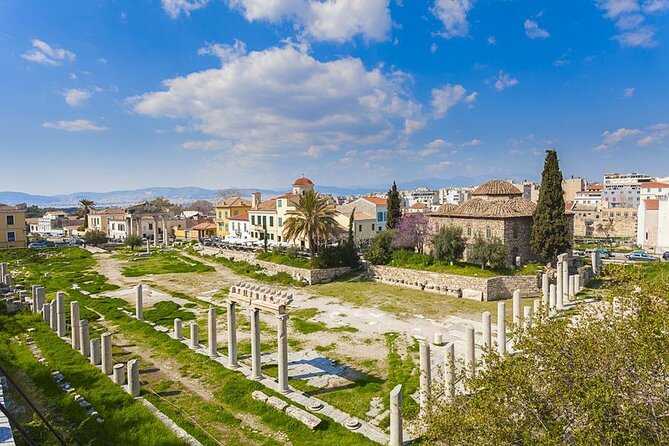
- Philosophers mapped to real places, from the Academy to the Ancient Agora and Areopagus views
- Myth plus philosophy in the same story, with gods like Hermes, plus wind mythology tied to the Tower of the Winds
- Practical breaks built in, including coffee/tea and shaded stops
- A modern Athens contrast, including the Hellenic Parliament and the Presidential Guard tradition
- An ending with Acropolis views, finishing on Areopagus Hill with myth talk and big sightlines
Athens feels smarter when you walk it as a lesson
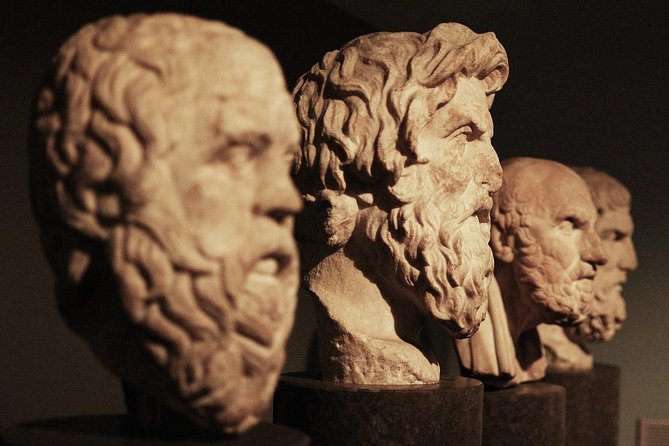
Athens is famous for monuments. This tour teaches you how to look at those monuments like someone from the ancient world might have. You move through myth and philosophy at sidewalk speed, so the city stops being a checklist and starts being a set of arguments you can follow.
What makes it work is the way it connects themes. You are not just hearing that philosophers mattered. You see where education, ethics, physics, politics, and even ideas about nature were discussed in Greek culture. Along the way, your guide ties modern landmark moments to older questions, so it feels like one long conversation across centuries.
Other retellings of the old stories on foot:
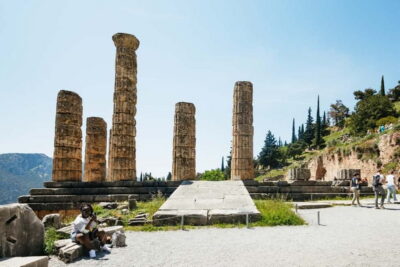
- Athens: Mythology of Delphi, Museum and Arachova Guided Tour
★ 4.7 · 5,102 reviews - Athens & Acropolis Highlights: Greek Mythology Small-Group Tour
★ 5.0 · 2,370 reviews - Athens: Acropolis and Mythology Highlights Small Group Tour
★ 4.8 · 2,275 reviews - Athens: Mythology Tour for Families
★ 4.8 · 173 reviews
Private tour energy: ask, react, and shape the pace
This is a private walking tour, meaning it is only your group. That matters more than you might think. When a guide can respond to your interests in real time, you get the best part of philosophy, the part where the idea meets your mind.
In particular, the guides linked to this experience are praised for turning the day into back-and-forth discussion. People describe a Socratic circle style, where questions are welcome and the guide adjusts how deep to go. If you have a teen who thinks history is boring, or a partner who wants the story behind the story, this format is designed for you.
If you prefer a tour that is mostly headsets and photos, this might feel more like a conversation than a slideshow. For the right group, that is the whole point.
Where the tour starts and how long it really takes
You meet at Panepistimio (PanepistimioAthens, 106 79) and end on Areopagus Hill (Theorias 21). The duration is listed as about 4 hours.
Because it is a walking tour through multiple stops, plan your day around a steady, city-level pace. You will get short visit windows at each location, not long museum marathons at every stop. That is a good thing for keeping the theme moving, but it also means you might want to add a follow-up visit later if one site really grabs you.
Stop 1: The Academy of Athens and the idea of education
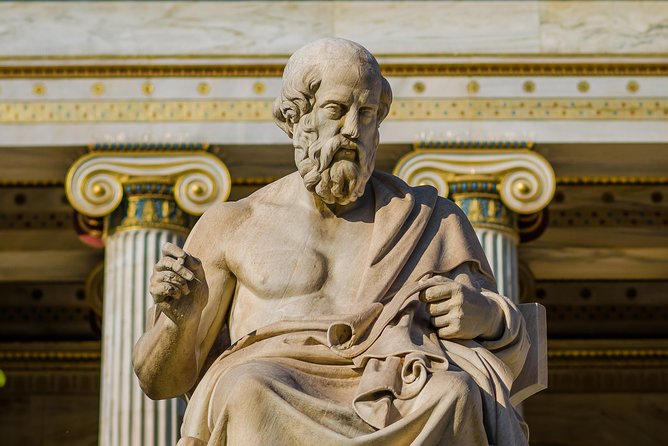
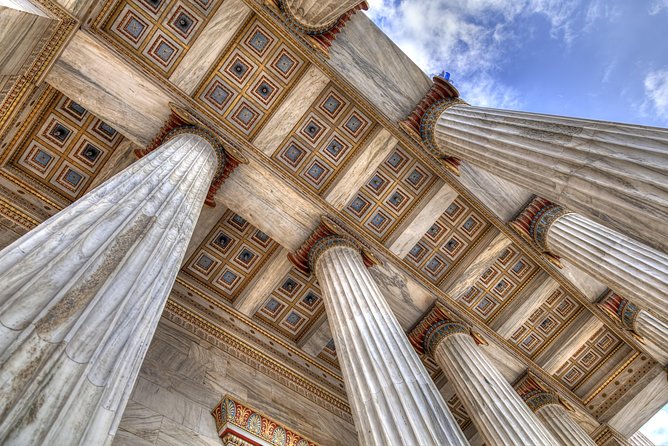
You begin with the Academy of Athens, where the experience focuses on the big sweep of Greek philosophical movements. Expect an outside introduction that frames the place as more than an architectural landmark. You are there to understand how education and schools of thought shaped the way Greeks argued about truth, ethics, and society.
There is also mention of a museum with an outstanding coin collection, stretching from ancient to modern. If you are into numismatics, economic history, or just the way everyday objects reveal big ideas, this part can add a surprising flavor to the day.
One practical note: admission for the Academy stop is not included, so if you want to go in, plan for that extra cost and time.
Hellenic Parliament: Presidential Guard tradition as a living ritual
Next you stand by the Hellenic Parliament, with a look at the Changing of the Presidential Guard tradition. This is one of those stops that gives your brain a reset. You go from abstract ideas about how society should work to a very visible modern ritual.
It is also a good contrast point. Philosophy talks about order, rules, and values. This is where you can see how Greece performs civic identity in public, right in the center of Athens.
Timing is tight at this stop (around 15 minutes), and admission is listed as free. That makes it an efficient scene-setting moment.
More of Plaka and Monastiraki on foot:
- Acropolis and Parthenon Guided Walking Tour★ 5.0 · 4,755 reviews
- Greek Food Walking Tour in Athens★ 5.0 · 4,740 reviews
- Athens: Guided Greek Food Walking Tour with Tastings★ 4.9 · 2,859 reviews
- Acropolis monuments & Parthenon Walking Tour with Optional Acropolis Museum★ 5.0 · 2,678 reviews
National Garden: democracy and the science Greeks applied
Then you head to the National Garden, using the setting to explore how Greek philosophy shows up as applied thinking. The themes called out include democracy, physics, astronomy, ethics, and more.
That mix is smart. It nudges you past the stereotype that philosophy is only debates in lecture halls. You start to see Greek thought as a tool kit: how to explain nature, how to reason about right action, and how to organize a society.
This stop is also free, with about 15 minutes to walk, look around, and absorb the ideas in a calmer environment.
Ermou Street: Hermes, mischief, and the storytelling layer

At Ermou Street, the focus shifts to the trickster side of myth: Hermes. You spend about 15 minutes here, and it works as a bridge between the earlier civic and scientific themes and the more philosophical locations ahead.
Myths can feel like side content if you treat them as separate. This tour treats them as meaning-making. When a guide ties a god like Hermes to the surrounding details, the stories stop being background wallpaper and start doing actual work in the argument.
Admission here is free, and the pay-off is mostly in your guide’s explanation and your ability to connect story logic to what you see.
Plaka square and the Church of Panatanassa area
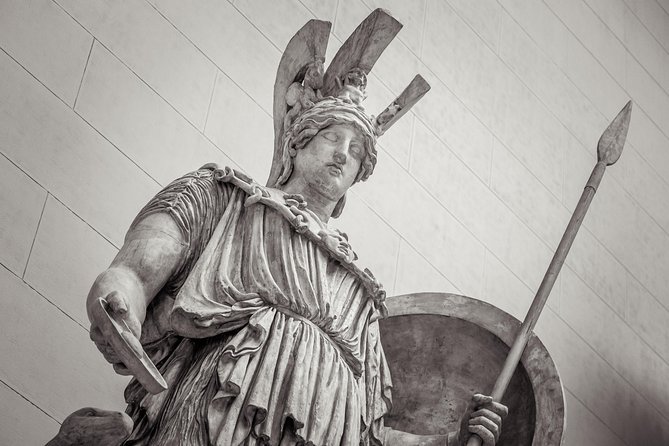
You then move into the Plaka area around the square named after the Church of the Pantanassa. Even though this part is shorter, it is valuable because it reinforces how Athens keeps folding older identity into modern street life.
This is a good pause to slow your thinking down, because Plaka streets can move fast when you are sightseeing. Here, it is about context, why the name exists, and how religious and cultural anchors shape the way neighborhoods remember themselves.
This stop is listed as free, with about 15 minutes.
Ancient Agora: where Stoic ideas formed in public space
The tour hits the Ancient Agora of Athens, with a specific focus on Stoic philosophy and the Poikile Stoa. The value of arriving here with a theme is huge. The Agora is where Athens held public life, and you can feel why philosophers would treat it as an ideal stage for ethics, logic, and civic behavior.
Admission is not included at this stop, so you may want to decide ahead of time whether you will pay to enter. If you are the type who likes to linger, this is one place where you might end up wishing you had more time.
Still, even outside the fees part, it is a key philosophical anchor. It gives you a tangible link between ideas and the physical spaces where people argued, taught, and lived.
Tower of the Winds: Aiolos and the Greek map of nature
Next comes the Tower of the Winds, where the theme is the wind mythology around Aiolos, the keeper of the winds. This stop mixes observation with myth. You look at a landmark connected to how Greeks imagined and understood the natural world.
The practical angle is good here. It is not just story time. The topic fits the Greek habit of using myth to explain patterns, predict conditions, and make the invisible feel legible.
Admission for the Tower of the Winds is listed as not included, so again, expect possible extra cost if you want to go inside.
Anafiotika: where Cynic energy meets the foot of the Acropolis
In Anafiotika, at the foot of the Acropolis in the Plaka area, you get a shift toward the Cynic philosophers. This is a strong pairing. Anafiotika’s vibe is different from the heavy landmark zones. It feels more like a lived-in patch of Athens, which makes it easier to imagine philosopher types who challenged norms and mocked comfort.
This stop is listed as free and lasts about 20 minutes. That extra time compared to some earlier stops helps you absorb the neighborhood feel, not just the lecture.
If you like off-the-main-path moments, this is one of the places you will probably remember, because it is where philosophy meets street atmosphere.
Areopagus Hill: myths of the Olympian gods and Acropolis views
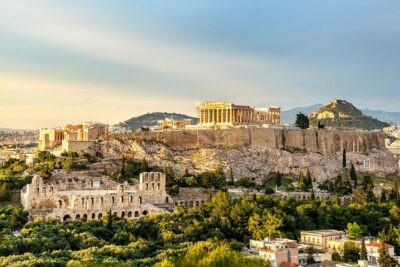
You end on Areopagus Hill, with breathtaking views of the Acropolis. The tour pairs the sightline with myth talk about the Olympian gods and it is a fitting conclusion. You finish with a big visual, not a closed building or a scripted photo spot.
This is also where the theme tends to land. After hours of thinkers, ideas, and stories, the myths and gods start to feel less like entertainment and more like an old language people used to explain what mattered.
This stop is listed as free, and the walking section ends on a high note, literally.
Price and value: what you are paying for
The price is $102.80 per person, for about 4 hours. Entrance fees are not included for some sites, including the Academy of Athens, the Ancient Agora, and the Tower of the Winds.
So what is the value? For me, it comes down to three things you cannot get from a self-guided stroll:
- A guide who can answer your questions on the spot, not just recite facts.
- A theme-driven route that keeps you focused on philosophy and myth, not just landmarks.
- The pacing choice of a private group, where your guide can slow down when you want more detail and move on when you do not.
You also get coffee and/or tea plus bottled water. Those small comforts matter during a city walk and help keep the energy up for the final hill.
If you already planned to pay for entrance tickets at several sites anyway, the cost becomes easier to justify. If you plan to stay mostly outside, the price still makes sense because the talking and discussion are the main product.
Finally, it is booked about 53 days in advance on average, which suggests it is not a last-minute thing you should ignore if you want a specific time window. Early booking usually gives you more control.
Comfort and practical tips for a smooth 4-hour walk
Since this is mostly outside, good weather is important. The experience says it requires good weather, and if it is canceled because of weather, you are offered another date or a full refund.
A few more practical thoughts based on the way this experience is described:
- Bring comfortable walking shoes. Even with short stops, you are covering multiple areas.
- Expect sun and wind exposure at elevated or open sites like Areopagus. Shade is helpful where available, and the route includes calmer garden moments.
- Wear layers if you are traveling shoulder season. Athens can shift through the day.
- Have a question ready. Philosophy tours work best when you treat it like a conversation, not a lecture.
Also, you get a mobile ticket, and the tour is near public transportation, which makes it easier to slot into a bigger Athens day without stress.
Is this the right Athens tour for you?
This is best for you if you want Athens with ideas, not only photos.
Book it if:
- You are a philosophy and mythology fan, whether you know the names well or you are starting fresh.
- You want a tour that feels like a discussion, with time to ask questions.
- Your group includes teens or young adults who need a more active style, not just standing and listening.
- You like Athens landmarks but also crave the story behind why they mattered.
You might reconsider if:
- You want a shorter outing. One suggestion that pops up clearly is that some groups may find four hours long, and a 2 to 3 hour version would suit more people.
- You hate walking or you are trying to minimize time on your feet.
- You are very fee-sensitive. A few notable stops have entrance fees not included.
Should you book this Myths and Philosophers Athens walk?
I think this is a strong choice if your goal is to leave Athens thinking differently. The route is built to connect myth, science, ethics, and politics to physical places, and the private format turns that connection into a back-and-forth learning experience.
If you are choosing just one guided activity in Athens, and you care about philosophy more than pure sightseeing, this is the kind of tour that changes how you see the city afterward.
If you are on the fence, my advice is simple: check your comfort with a 4-hour walking day, and decide whether you want to budget for a couple of entrance tickets at the stops marked as not included.
FAQ
How long is the Athens Highlights: Myths & Philosophers Walking Tour?
It is listed as approximately 4 hours.
Is this tour private or shared?
It is a private tour/activity, so only your group participates.
What is included in the price?
The tour includes coffee and/or tea and bottled water.
Are entrance fees included for the stops?
No. Entrance fees are not included for certain stops, including the Academy of Athens, the Ancient Agora of Athens, and the Tower of the Winds.
Where do we meet and where does the tour end?
The meeting point is PanepistimioAthens 106 79, Greece, and the tour ends at Areopagus HillTheorias 21, Athina 105 55, Greece.
What happens if weather is bad?
The experience requires good weather. If it is canceled due to poor weather, you will be offered a different date or a full refund.
What is the cancellation policy?
You can cancel for a full refund up to 24 hours in advance of the experience start time.
Latest from under the Acropolis




Myths & Legends Tours, compared.
Mythology of Delphi, Museum and Arachova Guided Tour
Read our review →
Athens & Acropolis Highlights: Greek Mythology Small-Group Tour
Read our review →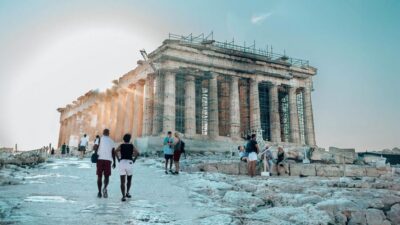
Acropolis and Mythology Highlights Small Group Tour
Read our review →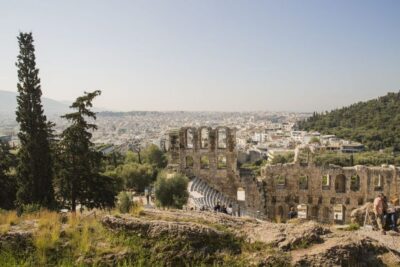
The History of Athens: Greek Mythology Private Tour
Read our review →

Greek Mythology Treasure Hunt for Kids – Athens Private Tour
Read our review →
Horror Mythology Evening Experience – Myths Come to Life
Read our review →Browse the lists this tour appears in