Reviewed · ATHENS
Sparta – Bred for Battle! The legendary period!
Sparta is a long, glorious haul. This private day trip turns Athens and the Peloponnese into a moving classroom, from Attica’s ancient landmarks to Sparta’s battle-era echoes and the hillside ruins of Mystras.
I like two things most about how this tour is built. First, the round-trip air-conditioned transportation means you spend less time navigating and more time looking. Second, you reach each stop and then get to explore independently at your own pace, which is great when one person wants ruins and another wants photos.
One drawback to plan for: it is a long day. Even if the stops are thoughtfully chosen, the timing at places like Mystras and the Sparta sites can feel tight if you love slow wandering or want to do everything super methodically.
In This Review
- Key points before you go
- Getting out of Athens: pickup, the drive, and that first Acropolis moment
- Attica on the road: why the scenic drive matters
- Corinth Canal: the fast wow factor in 15 minutes
- Sparta is the point: how the warrior story turns into walkable stops
- The Sparta sites included during the day
- Leonidas and the Sparta monuments: short stops with big meaning
- Mystras: Byzantine layers on the slopes of Mt. Taygetos
- Price and what $602.19 per group really buys
- Pacing, comfort, and practical tips for a day like this
- Who this tour suits best
- Should you book Sparta and Mystras on this schedule?
- FAQ
- How long is the Sparta tour?
- Is pickup included, and where does the tour meet?
- Is this tour private?
- How many people can be in a group?
- Are entrance fees included?
- What about food and drinks?
- Do you get an English-speaking guide?
- Is transportation provided?
- What dress code is required?
Key points before you go
- Private group of up to 3 keeps the schedule flexible and the drive more comfortable.
- Attica to Peloponnese routing gives you a sense of how the region connects, not just a list of sites.
- Corinth Canal in 15 minutes is a quick look, not a deep visit.
- Sparta’s lineup of sites includes multiple stops in the Sparta area, not just one photo point.
- Mystras is a hilltop time check: you will cover a lot in about an hour.
- Driver history until entrances is useful, but you enter sites on your own since drivers are not licensed inside.
Getting out of Athens: pickup, the drive, and that first Acropolis moment
You start with pickup from your hotel in Athens or from the cruise port area at Piraeus. The Piraeus port is a major entry point for cruise ships, and since Athens sits roughly 12 km, you are not doing some epic transfer. It is more like a long scenic start than a logistics headache.
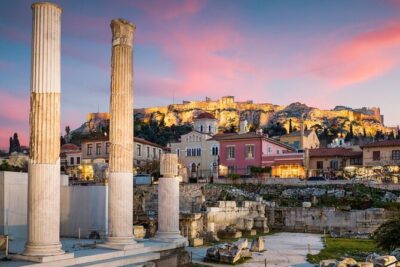
From there, you head toward Athens for a first big visual hit at the Acropolis area, described as the Temple of Democracy. Even if you have seen the Acropolis before, this sets the tone. It says: today we are not just visiting one town, we are moving through layers of Greek story.
Practical note: you are traveling with a professional English-speaking driver, but you will not be paired with a licensed guide inside archaeological sites. The driver can give context and point you toward what matters, then you go in and explore yourself.
Before you book, here is what else runs from Athens:
- Athens: Acropolis & up to 5 Archaeological Sites Combo Pass
★ 4.2 · 13,904 reviews - Athens: Acropolis, Parthenon & Acropolis Museum Guided Tour
★ 4.8 · 9,316 reviews - The Acropolis, Parthenon & Acropolis Museum Guided Tour
★ 4.7 · 8,493 reviews - Athens: Cape Sounion & Poseidon Temple Sunset Half-Day Trip
★ 4.8 · 8,241 reviews
Attica on the road: why the scenic drive matters
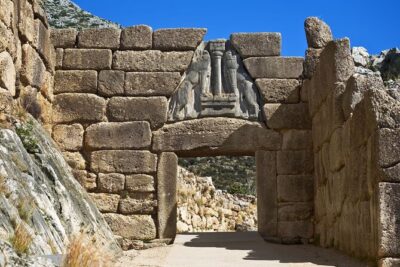
After that opening Acropolis stop, you travel through Attica, the region tied to 6,000 years of human activity and the birth of ideas we still recognize. The point of this leg is not just to get you from A to B. It is to give you a framework for what you are seeing later in the Peloponnese.
If you like history explained in plain language, this part helps. You get a sense of how Attica connects to arts, architecture, and major archaeological sites, plus how Greek festivals and cultural life still echo ancient patterns.
Also, because Attica is where many visitors start their Greek trip, it is a nice change to view it as a corridor of influence rather than a single museum sprint. You will spend time looking, then you shift gears to the south.
Corinth Canal: the fast wow factor in 15 minutes
At the Corinth Canal stop, you get one of Greece’s most striking engineering interruptions. It links the Gulf of Corinth to the Saronic Gulf and cuts through the narrow isthmus. The canal is 6.4 km long and only 25 meters wide, dug at sea level, turning the Peloponnese into something like an island from the mainland perspective.
The key is how this stop is sized. It is only about 15 minutes, so this is for quick views and orientation, not for a long photographic session. If you want to linger, be strategic: pick one spot for a few strong angles instead of trying to walk the whole area.
Value-for-time thought: this is the kind of stop that works best when you treat it as a visual pause. Then you keep going, because the day’s real focus is Sparta and Mystras.
Sparta is the point: how the warrior story turns into walkable stops
Once you reach the Sparta area (through the Laconia region), the day shifts from scenic travel to specific battle-era themes. Sparta is presented as a warrior society that grew powerful after conflicts involving Athens, with loyalty and military service at the center of daily life. The tour also ties Sparta to Greek myth, including the Menelaus, Helen, and Trojan story that feeds into the bigger war narrative.
What I find useful here is that you are not only hearing about Sparta as a concept. You are given a sequence of physical stops that match the story.
The Sparta stop time is generous enough that you can choose your pace. You can spend longer on the things that click for you, then move on before you get drained. That is especially important on a day trip like this, where the schedule is full and the drive takes time.
The Sparta sites included during the day
Depending on how your day flows, you should expect Sparta-area highlights such as:
- The Archaeological Museum of Sparta
- The Acropolis of Sparta
- The ancient theater of Sparta
- Temple of Artemis Orthia
- The Tomb of Leonidas (often described as the Cenotaph of Leonidas)
Even if you are not an expert on Greek archaeology, this lineup is a smart way to read Sparta as more than one ruin.
Same hours, spent a different way in Athens:
- Acropolis: Premium Acropolis and Parthenon Guided Tour★ 4.8 · 5,208 reviews
- Athens: Mythology of Delphi, Museum and Arachova Guided Tour★ 4.7 · 5,102 reviews
- All Day Cruise -3 Islands to Agistri,Moni, Aegina with lunch and drinks included★ 5.0 · 4,958 reviews
- Athens, Piraeus, and Coastline: Blue Hop-On Hop-Off Bus★ 3.9 · 4,849 reviews
Leonidas and the Sparta monuments: short stops with big meaning
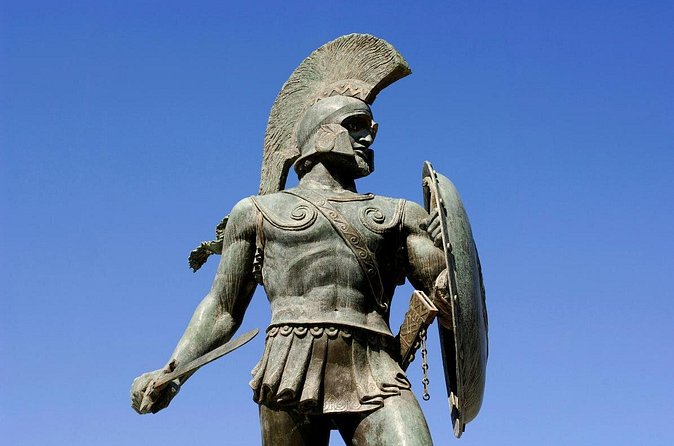
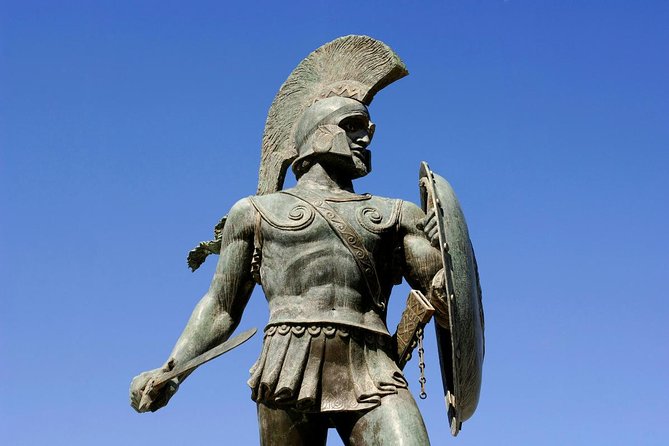
The Cenotaph of Leonidas stop is positioned north of modern Sparta. It is described as a limestone construction from the 5th century B.C., linked to the story of Leonidas, and associated with traditions about where remains were transferred and buried after Thermopylae. Excavations in the 1890s uncovered the structure, and a name that comes up is Waldstein, credited with the work.
This stop is short, about 10 minutes, and that matters. You will not have time for a long, slow study. So use it like a checkpoint: look at the scale, take in the temple-like shape, and then move on while the story is still fresh in your head.
If you want to get the most out of Leonidas without rushing, I suggest this: spend your energy on one or two details you can remember later. The review feedback you have probably heard elsewhere about Sparta sites being more useful when you pair them with museum context fits this pattern well. A quick exterior stop plus a stronger museum moment can click for a lot of people.
Mystras: Byzantine layers on the slopes of Mt. Taygetos
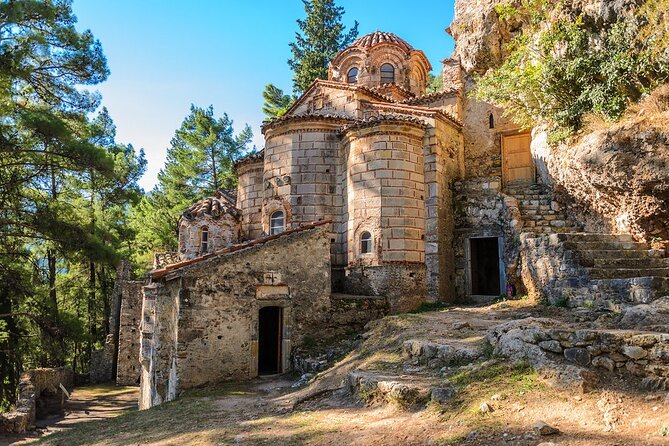
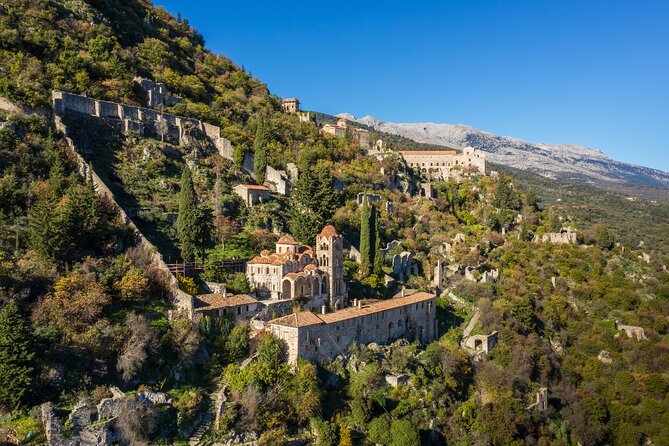
Mystras is where the day turns from ancient Sparta into later power and belief systems. You visit a steep foothill area on the northern slopes of Mt. Taygetos, about 6 km northwest of Sparta. The top castle was founded by the Frankish leader William II de Villeharduin in 1249, then came under Byzantine control in 1262.
Later you get more political shifts, including the seat of the Despotate of Moreas, and the crowning of Constantine XI Palaeologos in 1448. After Ottoman capture in 1460, the site changed hands again, and it eventually became part of the Greek liberation era in 1821. The tour also notes the end of the old town’s life when modern Sparta was founded in 1834.
This is a place where your expectations should be honest. You only have about an hour at the archaeological site. That is enough for orientation and for seeing key parts, but it is not enough for museum-level reading or for checking every single corner if you get pulled into every side path.
So if you enjoy ruins best when you can pace freely, you might want to focus on high-level structure and view lines first, then circles back if time allows. And if you were hoping for specific types of interiors, keep in mind the visit window may not match that kind of deep, slow browsing.
Price and what $602.19 per group really buys
This private tour costs $602.19 per group, up to 3 people, for about 9 hours. That means your value depends on how many of you are splitting the cost.
If you travel as a duo or a small family, private transport and pickup from hotel or cruise port can start to make sense quickly. You are paying for someone to handle the driving and the history explanations en route, then for a route that includes major stops instead of leaving you to plan and connect everything yourself.
Entrance fees are not included, and food and drinks are also not included. That is important because it affects your total spend. The good news is you can control it: eat before you go, bring a snack if permitted where you are, and plan for entrance tickets once you arrive.
Bottom line on value: you are paying to reduce friction and squeeze a lot of meaningful places into one day without doing the bus-and-line dance.
Pacing, comfort, and practical tips for a day like this

This is built for efficient movement, not marathon wandering. You have a long transfer day with multiple stops, including a driving-heavy segment through Attica and then down into the Peloponnese.
Here is how I’d prepare if you want the day to feel satisfying rather than frantic:
- Wear comfortable shoes you can walk in on uneven ground, especially around Mystras.
- Bring sun protection. Greece does not care about your itinerary.
- Plan for a snack and water. Food is not included.
- Keep your camera ready for the canal and the hilltop ruins, but do not burn time trying to capture everything.
Also, the tour lists a formal dress code. That may sound odd for a ruins day, but at minimum it means avoid very casual beachwear. Comfortable layers still win.
Fitness matters too. The tour asks for a moderate physical fitness level, which aligns with the hilltop terrain at Mystras and the reality that you are moving through archaeological areas on a schedule.
Who this tour suits best

This trip is ideal for you if:
- You want one day that links multiple historic zones instead of one town only.
- You like hearing context from a driver and then exploring at your own pace.
- You travel in a small group and prefer private comfort over public transport.
It may not be the best fit if:
- You dislike long days with tight stop windows.
- You want deep time in Mystras specifically, or you need lots of museum reading time to feel satisfied.
- You prefer a licensed guide walking inside every site, because the driver cannot accompany you inside archaeological sites and museums as part of the standard format.
Should you book Sparta and Mystras on this schedule?
If you like structure and you want a meaningful sweep of places without the stress of arranging transport, I would book it. The private group size, pickup from your exact starting point, and the Sparta-to-Mystras pairing are a strong use of time.
Just go in with the right mindset. Treat Corinth Canal and Leonidas as quick, high-impact stops. Treat Mystras as a hilltop orientation visit. If you do, this tour will feel like a smart day of contrasts: ancient Spartan identity, then later Byzantine layers, all tied together by the drive that connects the landscape.
FAQ
How long is the Sparta tour?
The duration is listed as about 9 hours.
Is pickup included, and where does the tour meet?
Yes. Pickup is offered from your hotel in Athens, or from the Port of Piraeus for cruise guests. You meet at the main entrance of your hotel, or outside the cruise terminal exit where the driver holds a sign with your name.
Is this tour private?
Yes. It is a private tour, and only your group participates.
How many people can be in a group?
The price is per group up to 3 people.
Are entrance fees included?
No. Entrance fees to archaeological sites and museums are not included.
What about food and drinks?
Food and drinks are not included.
Do you get an English-speaking guide?
You get a professional English-speaking tour driver who provides history and cultural context until you enter the archaeological sites and museums.
Is transportation provided?
Yes. You travel by air-conditioned vehicle appropriate for the group, with round trip transportation and return drop-off at the same place you were picked up.
What dress code is required?
The tour lists a formal dress code. Comfortable, presentable clothing is the safest way to follow that.