Reviewed · ATHENS
Sightseeing of Athens
Acropolis views are the quick hit you came for. This private Athens sightseeing route connects the Acropolis Museum with classic old streets in Plaka, plus practical photo stops around the city sights. I like the small-group setup (up to 3) with pickup and air-conditioned comfort, and I also like how the route keeps you moving without feeling rushed. One catch to plan for: entrance tickets are not included, so you’ll want to budget about 30 euro for the Acropolis and Acropolis Museum stops.
In about five hours, you get the big monuments and the Athens “in-between,” like the Panathenaic Stadium marble, the Changing of the Guard, and time in Syntagma Square and the Metropolis area. It’s booked fairly often (around 13 days ahead on average), so if your dates are fixed, I’d lock it in early.
Because parts of the day sit on foot, you should expect some walking on uneven historic surfaces, especially around the Acropolis and Plaka. Also, since the itinerary is built around travel time inside a half-day window, don’t expect long stays at every single stop on the list.
In This Review
- Key points to know before you go
- Your half-day Athens circuit, from Acropolis heights to Plaka streets
- Entering the Acropolis the smart way, plus what to expect on-site
- Acropolis Museum: the hour that turns statues into a story
- Panathenaic Stadium photo stop, and why that marble is a big deal
- The Presidential Mansion area, then the Changing of the Guard moment
- Syntagma Square and the Metropolis area: where politics and religion meet
- Plaka: the walk-and-lunch part that makes the day feel real
- Mount Lycabettus: quick panorama time without a full outing
- The “modern Athens” stops in between, and why they matter
- Price and value: what $325.21 per group really buys you
- Getting the most out of the 5-hour schedule
- Who this Athens sightseeing tour fits best
- Should you book Sightseeing of Athens with Hermes transfer?
- FAQ
- Is pickup included on this Athens sightseeing tour?
- How long is the tour?
- How many people are in a group?
- What does the price include?
- Are entrance tickets included for the Acropolis and the Acropolis Museum?
- Is there a mobile ticket?
- Are service animals allowed?
- What is the cancellation policy?
Key points to know before you go

- Private group of up to 3 with pickup and air-conditioned vehicle, so you can set a comfortable pace.
- Acropolis Museum gets its own hour, meaning you’re not forced to skim sculptures and artifacts.
- Changing of the Guard is scheduled for a short 15 minutes, so you can see the ceremony without burning your whole day.
- Plaka includes a walk and lunch break, which is where Athens starts to feel lived-in.
- Mount Lycabettus is a quick 20-minute stop for city views, ideal if you want panorama time without hiking all day.
Your half-day Athens circuit, from Acropolis heights to Plaka streets
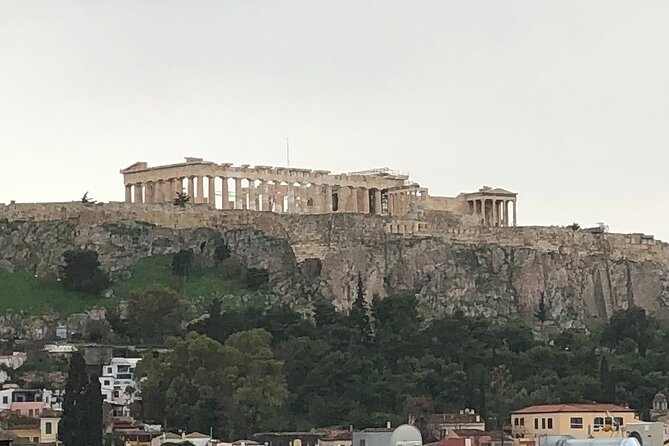
This is the kind of Athens tour that makes sense if you want the highlights, but you also want to feel the city behind the headlines. The route starts with the Acropolis, then moves into the Acropolis Museum for context, and finishes with classic Athens neighborhoods and landmarks. It’s built around a 5-hour window, and the operator notes that the remaining time is for travel, so you should think of it as a focused highlights sampler.
I like that your group stays small. A party of up to three makes a difference when you’re dealing with stairs, security lines, and timing the best photo angles. You also get onboard WiFi, bottled water, and a map plus booklet of town highlights, which helps you follow along even if it’s your first trip.
Before you book, here is what else runs from Athens:
- Athens: Acropolis & up to 5 Archaeological Sites Combo Pass
★ 4.2 · 13,904 reviews - Athens: Acropolis, Parthenon & Acropolis Museum Guided Tour
★ 4.8 · 9,316 reviews - The Acropolis, Parthenon & Acropolis Museum Guided Tour
★ 4.7 · 8,493 reviews - Athens: Cape Sounion & Poseidon Temple Sunset Half-Day Trip
★ 4.8 · 8,241 reviews
Entering the Acropolis the smart way, plus what to expect on-site
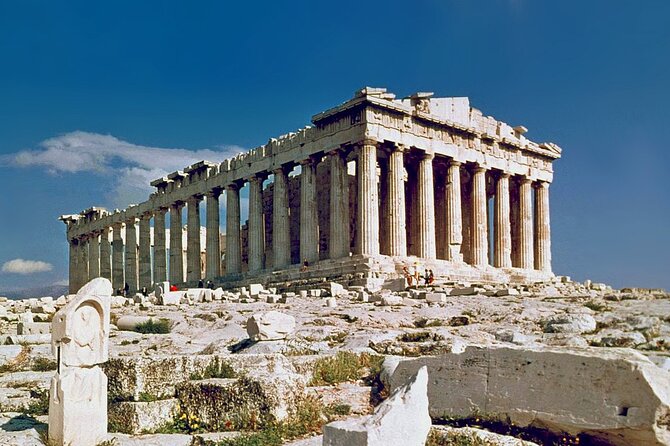
The tour begins at the Acropolis, the rocky citadel above Athens. It’s the ancient religious and civic center, and the famous centerpiece is the Parthenon. The word Acropolis itself is Greek, roughly meaning highest point or extremity, which is a handy way to remember why this place always feels dramatic.
You’re given about an hour on-site. That’s just enough time to see the big essentials if you move with purpose. You’ll want to prioritize the areas with the best views over Athens and the main temple ruins, then use the remaining minutes to connect dots: where the buildings were, what the sight lines were like, and why the city grew around this hill.
Two practical tips:
- Start with the skyline views first, then circle toward the most iconic structures. Light changes quickly on the hill.
- Wear shoes you can trust on rocky, uneven ground. Even if you’re not trying to “tour hard,” the Acropolis adds up physically.
Note: the Acropolis entrance ticket is not included, so plan to buy or arrange that portion separately.
Acropolis Museum: the hour that turns statues into a story
After the hill, you head to the Acropolis Museum, which is built to house the artifacts found on the Acropolis itself and nearby slopes. This is one of those stops where it pays to slow down for just an hour, because you’ll see how the museum pieces connect to the buildings you just looked at above.
You get about one hour here. That is a sweet spot for understanding the big idea without spending your entire day in galleries. The museum focuses on works spanning from the Greek Bronze Age through Roman and Byzantine Greece, and it also sits over ruins of parts of Roman and early Byzantine Athens. So you’re not only looking at objects, you’re also seeing layers of the city’s past beneath your feet.
If you only do one museum in Athens, doing this one right after the Acropolis is a strong move. It helps you identify what you’re looking at when you return your gaze to the hill.
And one more practical win: the tour includes a mobile ticket, which can make entry smoother when it’s time to go in. Just make sure your phone is charged.
Again, museum entrance isn’t included in the package, so that extra budget item matters.
Panathenaic Stadium photo stop, and why that marble is a big deal
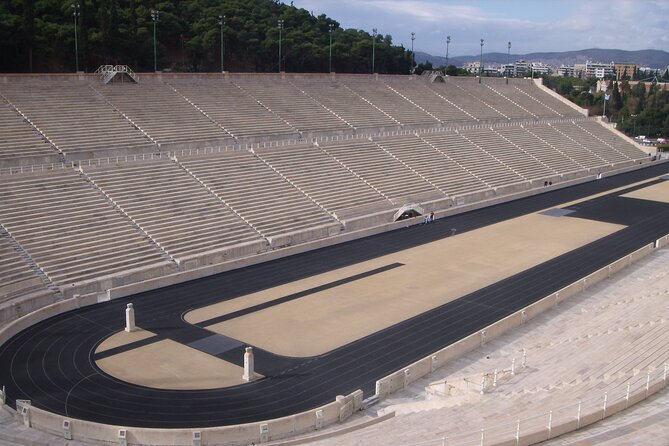
Next up is the Panathenaic Stadium, also called Kallimarmaro. The big standout here is that it’s the only stadium in the world built entirely of marble. That makes it one of the most visually distinct places in Athens, even if your time is short.
You’ll have a quick stop for photos, about 10 minutes. Use that time for two things:
- Look at the shape and seating bowl from a few angles.
- Snap at least one shot that shows you’re actually inside the stadium setting.
This stop is not about long explanations. It’s a chance to add a memorable Athens photo to your day and connect modern sports history to the ancient setting the city is known for.
The Presidential Mansion area, then the Changing of the Guard moment

Athens is full of “official” buildings, and this tour threads through that side of the city too. You’ll see the Presidential Mansion, the official residence of the president of the Hellenic Republic, which used to be the Royal Palace before the monarchy ended by referendum in 1973.
Then comes the highlight for many people: the Changing of the Guard Ceremony at the Presidential Guard site. The unit guards the Tomb of the Unknown Soldier and the Presidential Mansion, and they’re known as the last unit of Evzones in the Hellenic Army. Their uniform has deep roots in the clothing worn by klephts during the Greek War of Independence, and the signature piece is the fustanella, the kilt-like garment.
You’ll have around 15 minutes for this. That short time window is perfect because you’ll likely catch the ceremony without losing too much momentum in a half-day plan. If you want good photos, pick a spot early and keep an eye on where the crowd flow is tightest.
This is also a good contrast stop: after ancient stone and museum artifacts, you get a very modern, ritual-driven Athens moment.
Same hours, spent a different way in Athens:
- Acropolis: Premium Acropolis and Parthenon Guided Tour★ 4.8 · 5,208 reviews
- Athens: Mythology of Delphi, Museum and Arachova Guided Tour★ 4.7 · 5,102 reviews
- All Day Cruise -3 Islands to Agistri,Moni, Aegina with lunch and drinks included★ 5.0 · 4,958 reviews
- Athens, Piraeus, and Coastline: Blue Hop-On Hop-Off Bus★ 3.9 · 4,849 reviews
Syntagma Square and the Metropolis area: where politics and religion meet

From the guard ceremony area, you move into central Athens where everyday life, politics, and landmarks are close together. Syntagma Square, also called Constitution Square, is the city’s heart for modern public life. It’s named after the 1843 constitution demand, and it sits in front of the 19th-century Old Royal Palace, now housing the Greek Parliament since 1934.
You’ll have time to see this area as part of the route. I like this moment because it’s not just “look at a building.” Syntagma Square gives you a sense of where Athens actually moves in real time, where locals pass through, and where big national energy shows up.
Near there is the Metropolitan Cathedral, often called Metropolis or Mitropoli. It’s the cathedral church of the Archbishopric of Athens and all Greece. Even if you’re not planning a long interior visit, the exterior and setting help you understand the city’s spiritual center.
Plaka: the walk-and-lunch part that makes the day feel real
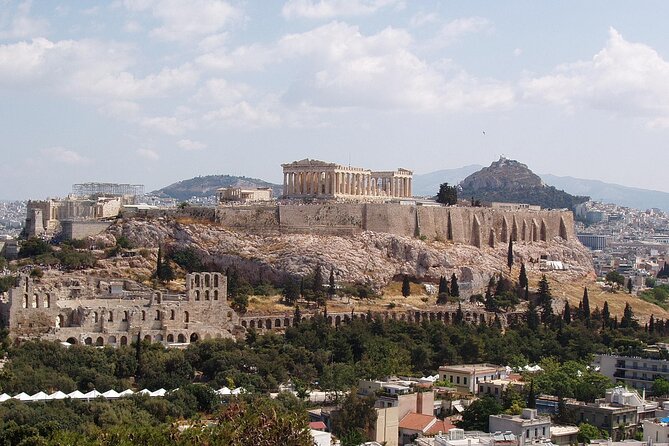
Now you get to the part that most people remember after the photo-heavy stops: Plaka. This old neighborhood spreads around the northern and eastern slopes of the Acropolis. It’s known as the Neighborhood of the Gods, largely because it sits so close to the ancient sites and includes lots of archaeological areas.
You’ll get about an hour for a walk around and a lunch break. This is where I’d slow down and do two things:
- Wander a bit away from the most obvious main lanes, so the streets feel more lived-in.
- Use your lunch break to pick something simple. The goal is not a gourmet marathon, it’s a break that lets you experience neighborhood Athens.
Plaka is also built on top of earlier residential areas, so even when you’re just walking, you’re in a place that layers the past into the present. That combination is why the area is so popular, but you still have enough room in an hour to find your rhythm.
Mount Lycabettus: quick panorama time without a full outing
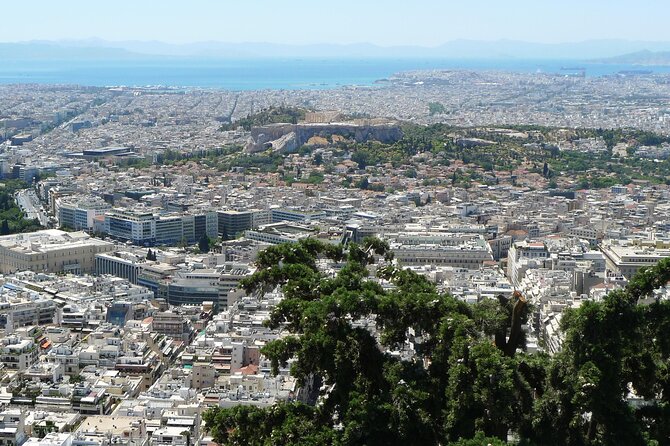
If you want views over Athens without turning the day into a long hike mission, Mount Lycabettus is a good choice. It’s a limestone hill rising to 277 meters, with pine trees at the base. The summit is the highest point in central Athens, and from there you can see the city.
You’ll have around 20 minutes at the top, which is short but workable if your goal is photos and a quick reset. The summit area includes the Chapel of St. George, a theatre, and a restaurant. Even if you don’t plan to linger for food, the view payoff is the point here.
Practical advice: in hotter months, bring water and take breaks. You have bottled water included, which helps. Also, don’t plan to do this stop and then immediately sprint back down if you’re feeling tired. Give yourself a few minutes to adjust your pace.
The “modern Athens” stops in between, and why they matter
The route doesn’t only stick to tourist icons. It also includes several major academic and civic landmarks that give you a more complete sense of Athens.
You’ll see the Academy of Athens, founded in 1926 with roots tracing back to the historical academy associated with Plato. The main building is one of the city’s landmarks. Nearby, you’ll also see the National and Kapodistrian University of Athens, which has been in continuous operation since 1837 and is described as the oldest higher education institution of the modern Greek state.
The National Library of Greece is another stop, founded in 1832, with a mission to collect and preserve evidence of Greek culture and human intellectual production. Then there’s the Old Parliament House, which held the Greek Parliament between 1875 and 1935 and now houses the National Historical Museum.
You’ll also pass by or stop at the areas around the modern center, including the Parliament zone and the cathedral district mentioned earlier. I like these moments because they keep the day from becoming only “ruins and museums.” They show you Athens as an active capital city with ongoing research, teaching, and public life.
Even if your time at each individual location is short, the variety is what keeps the tour from feeling repetitive.
Price and value: what $325.21 per group really buys you
The price is $325.21 per group, up to 3 people. That matters because it’s not a per-person ticket. If you’re traveling as a small family or a trio, the math can make the tour feel like a strong value compared with paying for separate transport and spending extra time figuring things out on your own.
What’s included is practical, not fancy:
- Private transportation in an air-conditioned vehicle
- Pickup offered
- WiFi on board
- Bottled water
- A map and booklet for Athens highlights
- All fees and taxes for the tour service itself
What’s not included:
- Entrance tickets for the Acropolis site and Acropolis Museum, listed as 30 euro
So the real “all-in” cost is your tour fee plus your entrance tickets. Even then, you’re paying for a structured half-day with a professional driver. One review specifically praises the chauffeur from Hermes transfer as professional and helpful, and that matches what you want on a tight schedule, especially in a city where parking and traffic can be a headache.
If you prefer flexibility over structure, you might feel limited by the timed stops. But if you want a clean, efficient route, the value is clear.
Getting the most out of the 5-hour schedule
This tour is built to pack a lot into a short window, so your habits matter. Here’s how you can squeeze the most from it:
- Pick your priorities for photos in advance. Acropolis, museum views, Plaka streets, and panoramic time from Lycabettus are the likely winners.
- Eat lunch in Plaka, not at the end of the day. The route includes that lunch break, and it’s the part that benefits from not being rushed.
- Dress for walking. Comfortable shoes matter for the Acropolis and Plaka.
- Keep your phone ready for the mobile ticket entry flow.
Also, because it’s a private tour, you won’t be competing with a large crowd in your group. That small-group advantage can make the whole experience feel calmer.
Who this Athens sightseeing tour fits best
This works best for:
- Couples and small families who want a high-effort highlights day without the stress of planning transport and timing.
- First-timers who want the Acropolis and museum connection, plus classic Athens city landmarks.
- Anyone who appreciates a mix of ancient sites and modern Athens atmosphere in one half day.
It might not be ideal if you want to linger for long periods at each stop. With about five hours total and some stops naturally shorter, this is a “see it, enjoy it, move on” type of tour.
Should you book Sightseeing of Athens with Hermes transfer?
I’d book it if you want a smooth, small-group highlights route that starts with the Acropolis, gives you real time at the Acropolis Museum, and then rounds out the day with Plaka and city landmarks. The included private transport, air-conditioned comfort, bottled water, and onboard WiFi are the kinds of practical details that make a short itinerary actually work.
I’d hesitate only if you hate fixed time windows or you’re hoping the Acropolis stops will turn into a long personal exploration. In that case, you may prefer a more open, self-guided plan.
If your goal is to come away with great photos and a better understanding of what you saw, this one is a solid bet.
FAQ
Is pickup included on this Athens sightseeing tour?
Yes. Pickup is offered, and you travel in a private, air-conditioned vehicle.
How long is the tour?
The experience runs about 5 hours.
How many people are in a group?
It’s a private tour/activity, with up to 3 people per group.
What does the price include?
The price includes bottled water, private transportation, WiFi on board, all fees and taxes for the tour service, and a map and booklet of Athens highlights.
Are entrance tickets included for the Acropolis and the Acropolis Museum?
No. Entrance tickets are not included. The information provided lists 30 euro for the Acropolis archaeological site and the Acropolis Museum.
Is there a mobile ticket?
Yes, the tour includes a mobile ticket.
Are service animals allowed?
Yes, service animals are allowed.
What is the cancellation policy?
You can cancel for a full refund if you cancel up to 24 hours in advance. If you cancel less than 24 hours before the start time, no refund is offered.