
Reviewed · ACROPOLIS HILL TOURS
Philosophical and historical tour of Acropolis of Athens
Ancient Athens, taught like a story. This Acropolis of Athens tour frames the monuments with how people lived, argued, worshiped, and built democracy. You’re not just walking from stone to stone, you’re learning how the ideas behind the site still echo today.
I love the way the guide starts with a big-picture lesson about the creation of human civilization, then lands that story on Athens. I also like the very practical setup, earset receivers for clear audio, and that the guide is a licensed historian or archaeologist, such as Harry, who keeps things thorough and interactive.
One possible drawback: if you want quick photo stops and lots of free time, this is more of a thinking tour than a sightseeing sprint. Also, it runs in all weather, including rain, so bring a real rain layer, not just hope.
In This Review
- Key highlights you will actually feel during the tour
- South Entrance meeting point, express security, and getting your bearings fast
- The tour’s big idea: from human origins to Athenian civic values
- Theatre of Dionysus, where drama took its first breath
- Stoa of Eumenes, sanctuary of Asclepius, and the Odeon rhythm of public life
- The Gateway view: hills, the Agora, and a different take on democracy
- Erechtheion and the power of myth as social memory
- Parthenon: technical achievement plus civic messaging
- The real value question: is $47 worth it?
- Weather, recording rules, and how to prepare like a pro
- Who this philosophical Acropolis tour suits best
- Should you book this Acropolis of Athens tour?
- FAQ
- Where is the meeting point for the Acropolis of Athens philosophical tour?
- How long is the tour?
- Is skip the line included?
- Are Acropolis admission tickets included in the price?
- If I book without entrance fee, what do I need to do?
- Do you provide audio equipment?
- What language are the tours offered in?
- Does the tour run in rain?
- Can I record the tour guide?
- What is the cancellation policy?
Key highlights you will actually feel during the tour
- Licensed historian or archaeologist guides, not generic narrators, with a focus on Athens through evidence and interpretation
- Earset receivers so you can hear every word even in crowds and windy viewpoints
- Theatre of Dionysus connection to the earliest tragedies and comedies, explained in plain language
- Myths tied to Athens, with discussion of the stories and what might sit behind them
- Panoramic viewpoints over Athens and the Agora, with commentary that challenges the usual talking points
- Parthenon analysis as both a technical achievement and a political statement about civic values
South Entrance meeting point, express security, and getting your bearings fast
The tour meets right by the South Entrance of the Acropolis, on Dionysiou Areopagitou Street. It’s directly across from the main entrance of the Acropolis Museum, and you’ll spot the group by a white flag with an orange crown.
The early win here is that you enter the archaeological site from the South Entrance, then get settled quickly. You also get a skip the line through an express security check. That matters because the Acropolis area can be slow-moving, and 3 hours can vanish if you start late or get stuck in queues.
Once inside, the tour begins with a seated orientation. The guide gives you context before you start climbing. I like this approach because it prevents the classic problem: you see impressive ruins, but they don’t stick together in your mind.
One more practical point: the tour provides personal earset receivers for each guest. That’s a small thing that makes a big difference on a windy hilltop. You won’t have to guess what the guide said over other people’s conversations.
Other routes up the hill and around the Parthenon:
- Athens: Acropolis & up to 5 Archaeological Sites Combo Pass
★ 4.2 · 13,904 reviews - Athens: Acropolis, Parthenon & Acropolis Museum Guided Tour
★ 4.8 · 9,316 reviews - The Acropolis, Parthenon & Acropolis Museum Guided Tour
★ 4.7 · 8,493 reviews - Acropolis: Premium Acropolis and Parthenon Guided Tour
★ 4.8 · 5,208 reviews
The tour’s big idea: from human origins to Athenian civic values
This is not a tour that just describes what’s carved into walls. It’s built like a short course. At the start, the guide offers a concise lesson on the creation of human civilization, then places ancient Greek civilization, especially Athens, into that bigger framework.
From there, the guide moves monument by monument, but the key is the “why.” Instead of sounding like a museum label, the tour treats the monuments as material expressions of human practices, innovations, and long-term cultural habits. You’ll hear how the ancient Greek world’s competitive environment shaped major developments, and you’ll get guided connections to modern life as citizens and actors in your own societies.
You also end with an epilogue. The guide ties together what you saw, analyzed, and admired into a final lesson. If you like tours where you leave with a clear takeaway, that structure helps.
Theatre of Dionysus, where drama took its first breath
The first major stop is the Theatre of Dionysus. This matters because the tour frames it as the first theatre in human history. Whether you take that as a strict claim or a careful historical milestone, the real point is what it represented: theatre and drama as a practice, born in front of the Athenian public.
You’ll also connect theatre to religion. The guide links the tradition to religious tolerance and innovation in Athens. That changes how you look at the site. It’s not just seating and stone architecture, it’s a civic space where ideas were staged, argued, and performed.
What you should watch for as you stand there: the theatre’s relationship to the public. This tour keeps steering you back to the idea that Athens was a place where citizens interacted through civic culture, not just laws and elections.
Stoa of Eumenes, sanctuary of Asclepius, and the Odeon rhythm of public life
After the theatre, the tour passes by the Stoa of Eumenes and includes a brief visit to the sanctuary of Asclepius, the god of medicine. Even if you only get a short look, this stop is useful because it shows Athens wasn’t one-dimensional. Religion, healing, public gathering, and performance all sat in the same cultural ecosystem.
Next comes the Odeon of Herodes Atticus. You’ll have a moment to reflect on public infrastructure and how it shapes human activity and culture. That theme continues with what comes next.
Then the tour reaches the Temple of Athena Nike, devoted to Victory. The guide encourages you to see it as more than a pretty landmark. In the tour’s framing, these structures are not neutral. They influence the way people move, gather, celebrate, and imagine their place in society.
A practical note: these stops keep your eyes moving, which is good for attention. The downside is that you are still on a walking circuit with uneven ground, so comfortable shoes help.
The Gateway view: hills, the Agora, and a different take on democracy
One of the best payoffs in this tour happens from the monumental gateway of the Acropolis. You get to admire the view of the surrounding historically important hills and the Agora, the democratic marketplace below.
What makes this more than a standard viewpoint moment is the analysis. The guide talks about the Agora’s true value and counters mainstream narratives. That means you’re encouraged to think beyond the simplified story that democracy just happened because of famous speeches or clever leaders.
In practice, you’ll come away with a clearer mental map: the Acropolis is not isolated. It sits above Athens’ civic center, and the city’s daily life, debates, and economic activity connected up to the monumental symbols you’re studying.
If you like tours that give you a coherent way to picture the ancient city while you’re looking at the modern one, this viewpoint stop does that job well.
A handful more Athens outings to compare
- Historical Delphi One Day Tour with Arachova Stop & Expert Guide★ 4.5 · 1,247 reviews
- Historic Athens: Small Group Electric Bike Tour★ 4.9 · 966 reviews
- Acropolis, Parthenon & Athens Old City Heritage Walking Tour★ 4.5 · 876 reviews
- Athens: Small Group E-Bike Tour of Historic Highlights★ 4.9 · 154 reviews
Erechtheion and the power of myth as social memory
Entering the sanctuary, the tour’s penultimate stop is the Erechtheion, described as the temple of myths and legends, the social memory of Athenian society.
This is where the tour leans hardest into story. You’ll explore how narratives shape social subconscious and identity, not just individual beliefs. In other words, myths are treated as tools that societies use to explain themselves, teach behavior, and reinforce who belongs where.
You may find this part especially useful if you’ve read Greek myths before and wondered why they keep showing up in art, politics, and public life. Here, the guide connects myths to social function.
The Erechtheion also gives you a breather from the Parthenon shadow that everyone rushes toward. It slows your thinking at the exact moment when many people hit peak tiredness. Even if your legs are complaining, your brain gets a fresh angle.
Parthenon: technical achievement plus civic messaging
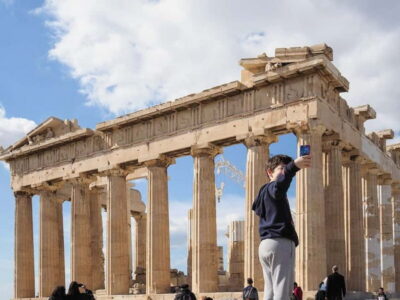
Finally, you reach the Parthenon. The guide presents it as a masterpiece of the Classical period and possibly the greatest technical achievement of the Athenian democratic state.
That phrase might sound heavy, but the way the tour frames it keeps it grounded: the Parthenon honors humanity, and it has been used as a symbol of Western civilization. You’ll also hear analysis of why it became so influential as a visual and ideological reference point long after Athens stopped being the dominant political power in the region.
Here’s what you should do with your eyes at this stop. Don’t just look at the iconic columns. Look for the civic idea behind the building, the sense that a state can express values through architecture. This tour presses you to see the Parthenon as an outcome of competitive innovation and shared public goals.
You also get those memorable panoramic views of Athens from the Acropolis. That’s part of why the last stop feels like a payoff. You’re not only looking at ancient engineering, you’re seeing the city that the monuments still oversee.
The real value question: is $47 worth it?
At $47 per person for a 3-hour tour, the value mostly comes from what you get bundled in.
Here’s what stands out for cost to experience:
- A local licensed English-speaking guide, always a historian or archaeologist
- Personal earset receivers so you can actually hear what you paid for
- Express security check, which saves time and stress
- A structured approach that goes beyond photo commentary, including a concluding epilogue and themed interpretation
Admission fees depend on your selected option. If you choose the package with entrance fee, entry fees are included. If you choose without entrance fee, you must book your own tickets. The tour also mentions that admission fees are automatically removed on days when entry to the Acropolis is free.
What that means for value: if you’re the type who would otherwise skip tickets or forget the right time slot, the with entrance fee option can be less stressful. If you already know your ticket plans, the without entrance fee option can still work, but you must match the same date and time slot as your tour.
Also, food and drinks are not included, and there’s no hotel pickup and drop-off. So you’ll want to plan your own meals around your schedule.
Weather, recording rules, and how to prepare like a pro
The tour takes place in all weather conditions, including rain. That’s normal for the Acropolis, but it’s worth treating seriously. Bring a real rain jacket and something to protect your phone or camera.
Guests are not allowed to record the tour guide. That means you can take your own photos and enjoy the moment, but don’t expect to film the narration.
The tour is in English, and it lasts 3 hours. If you’re visiting Athens in a tight schedule, that length is about right. Long enough to connect ideas across several monuments, not so long that you can’t recover afterward.
Who this philosophical Acropolis tour suits best
This tour fits you best if you want more than architecture photos. You’re likely to enjoy it if you like:
- history connected to human behavior and civic life
- myths explained with a focus on meaning, not just names
- a guide who talks like a historian or archaeologist, not a script-reader
- time spent forming a mental picture of ancient Athens, including the Agora and surrounding hills
It may be less ideal if you only want a basic circuit, minimal discussion, and maximum free roam time. The tour’s reflective, analysis-heavy style takes its time on purpose.
If you like interactive learning, that can be a bonus. In one example of a guide experience connected to this tour, Harry was described as thorough and interactive, which suggests the group style can work well for questions and engagement.
Should you book this Acropolis of Athens tour?
Book it if you want the Parthenon, the Theatre of Dionysus, and the Erechtheion to mean something beyond their shapes. This is a 3-hour guided path that links monuments to Athens’ democratic influence, civic culture, and the myths that helped shape identity.
Skip it if you’re chasing a mostly silent, fast photo run. Also consider skipping if the idea of all-weather walking and a lecture-like pace stresses you out.
If you’re on the fence, choose the option that includes entrance fees if you want the simplest planning. If you choose without entrance fees, make sure your tickets match the same date and time slot as your tour, or you won’t be able to join.
FAQ
Where is the meeting point for the Acropolis of Athens philosophical tour?
You meet next to the South Entrance of the Acropolis, on Dionysiou Areopagitou Street, directly across from the main entrance of the Acropolis Museum. You’ll recognize the group by a white flag with an orange crown.
How long is the tour?
The duration is 3 hours.
Is skip the line included?
Yes, the tour includes skip the line through an express security check.
Are Acropolis admission tickets included in the price?
It depends on the option you choose. Admission or entry fees are included only if you select the option that includes them.
If I book without entrance fee, what do I need to do?
If you choose the option without entrance fee, you are responsible for booking your own tickets at least one day before the tour. Your tickets must match the same date and time slot you selected for the tour.
Do you provide audio equipment?
Yes. The tour provides personal earset receivers for each guest so you can listen to the guide throughout the tour.
What language are the tours offered in?
The tour guide provides the tour in English.
Does the tour run in rain?
Yes. The tour takes place in all weather conditions, including rain.
Can I record the tour guide?
No. Guests are not allowed to record the tour guide.
What is the cancellation policy?
Free cancellation is available if you cancel up to 24 hours in advance for a full refund.
Latest from under the Acropolis





Acropolis Hill Tours, compared.
Acropolis & up to 5 Archaeological Sites Combo Pass
Read our review →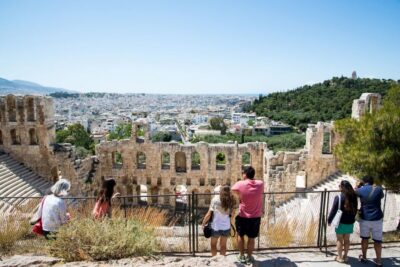
Acropolis, Parthenon & Acropolis Museum Guided Tour
Read our review →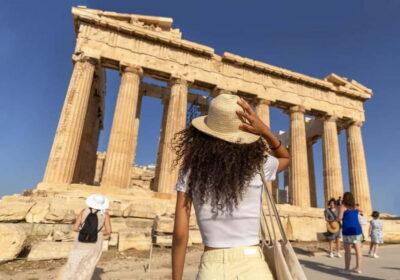
The Acropolis, Parthenon & Acropolis Museum Guided Tour
Read our review →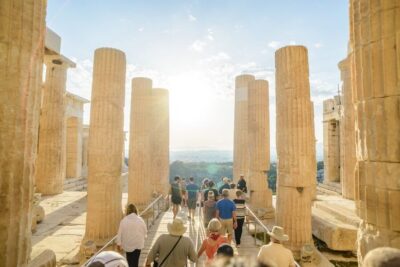
Acropolis: Premium Acropolis and Parthenon Guided Tour
Read our review →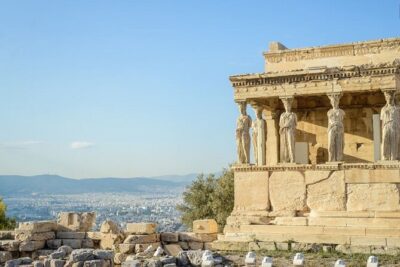
Acropolis and Parthenon Guided Walking Tour
Read our review →Acropolis, Parthenon & Acropolis Museum Guided Tour
Read our review →

Athens Scenic Electric Bike Tour with optional Acropolis visit
Read our review →Browse the lists this tour appears in