
Reviewed · ACROPOLIS HILL TOURS
Best of Athens & Acropolis Full Day Private Guided City Tour
Athens is loud, but this tour stays focused. You get a private, English-speaking guide and a full-day route that threads the Acropolis classics with Athens’ everyday neighborhoods.
I love the Acropolis climb when the city falls away and the marble details start making sense. I also like the way the day balances big monuments with time to wander in Plaka and Monastiraki at an easy pace.
One consideration: the schedule moves through a lot in about 5 to 7 hours, so if you want long, slow museum time, you may feel a bit rushed.
In This Review
- Quick hits
- The real appeal: a private Athens day that doesn’t feel random
- Pickup and communication: where this tour keeps life easy
- What to wear and how to not slip on the Acropolis
- Acropolis approach: quarry marks, drainage channels, and the big idea
- Parthenon stop: the symmetry that isn’t accidental
- Propylaea: the entrance built like a stage
- Temple of Athena Nike: tiny temple, big meaning
- Erechtheion: myths mapped onto an irregular plan
- Ancient Agora: where democracy, philosophy, and commerce all rubbed elbows
- A Doric temple viewpoint: Hephaistos and the craft story
- Syntagma and the Unknown Soldier: civic Athens in modern form
- Neoclassical Athens: the Academy, University, and National Library facades
- Panathenaic Stadium: where Olympic history restarts
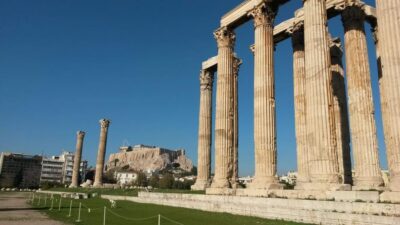
- Olympeion ruins and the imperial scale trick
- Plaka and Monastiraki: the day ends where Athens smells like food and stone
- Price and value: what $600.12 per person really covers
- Is the packed schedule right for you?
- Should you book this Best of Athens and Acropolis private tour?
- FAQ
- How long is the Best of Athens and Acropolis tour?
- Is pickup included, and how do I coordinate the meeting point?
- Is the tour guided in English?
- Are admission tickets included for the main archaeological sites?
- Is this a private tour?
- What parts of Athens does the route include?
Quick hits
- Private guide time so you can ask questions and get straight answers on what you’re seeing
- Smooth-marble route tips to keep your footing steady on the Acropolis
- Optical tricks at the Parthenon explained in plain language, including why it looks perfectly symmetrical
- Agora to craft-and-trade temples that connect democracy and daily work instead of only politics and gods
- Neoclassical Athens stops at Syntagma and the university buildings for a different Athens view
- Photo-friendly windows at Propylaea and the Acropolis colonnade, plus city-photo moments at the stadium and Plaka
The real appeal: a private Athens day that doesn’t feel random
This is the kind of full-day Athens tour that helps you see the city in the right order. You start on the Acropolis, then move into the Ancient Agora area, and only later swing into modern Athens and the classic streets.
Because it’s private, it’s just your group. That matters on the Acropolis, where you’ll constantly be deciding where to stand, when to move, and how long to linger on details.
If you’re the type who likes to get your bearings fast and then enjoy the day, this format fits. If you prefer total freedom with no structure, you might still enjoy parts, but you’ll likely miss the guidance that turns ruins into a story you can follow.
Other routes up the hill and around the Parthenon:
- Athens: Acropolis & up to 5 Archaeological Sites Combo Pass
★ 4.2 · 13,904 reviews - Athens: Acropolis, Parthenon & Acropolis Museum Guided Tour
★ 4.8 · 9,316 reviews - The Acropolis, Parthenon & Acropolis Museum Guided Tour
★ 4.7 · 8,493 reviews - Acropolis: Premium Acropolis and Parthenon Guided Tour
★ 4.8 · 5,208 reviews
Pickup and communication: where this tour keeps life easy

Pickup is offered, and coordination uses WhatsApp or Apple iMessage so you can line up the exact place to meet. I like that you’re not guessing with a bunch of people at a busy street corner.
In the wider company service experience, their communication has been consistently prompt, with examples like Nikos replying quickly to requests and Stefanos meeting in the airport arrivals hall with an electronic sign. For you, that usually translates into less waiting and fewer stress loops before the real sightseeing begins.
Bring the basics you’d bring anywhere in Athens: water, sun protection, and a phone charged enough for tickets and photos. If you wear sneakers, great, but make sure they have grip, because the next part is all smooth stone.
What to wear and how to not slip on the Acropolis
The Acropolis route includes smooth marble surfaces, and it’s easy to overestimate how grippy they are. Good footwear is not a small detail here, it’s the difference between enjoying the climb and worrying about every step.
Keep your pace steady. If you rush, you’ll get out of rhythm on the ascent and you’ll have less energy for the architectural details you paid to see.
Also, follow the barrier rules. These sites are protected archaeology, so you’ll get the best experience by staying where you’re allowed and using guided viewpoints for photos.
Acropolis approach: quarry marks, drainage channels, and the big idea

The day starts with the Acropolis climb along a pedestrian route that gives you a gradual reveal. As the city stretches away, you see why this limestone outcrop became a symbol for Athens at its zenith.
This is where a guide really earns their keep. You’ll hear the big themes, like the Periclean ambition behind the building program, the sacred meaning of the site, and the long chain of events that brought Classical Greece into later Western thinking.
Then the guide helps you spot the practical clues in the stone. Look for ancient quarry marks in the bedrock, carved drainage channels, and reused marble blocks that quietly show centuries of restorations.
Photo tip: if you pause about midway up, you can get a dramatic frame with the Parthenon set against the Saronic Gulf. Just be ready to stand still and shoot, because the line of sight is short-lived when groups are moving.
Admission ticket is included for the Acropolis portion, so you’re not stuck negotiating separate tickets before you even reach the main monuments.
Parthenon stop: the symmetry that isn’t accidental

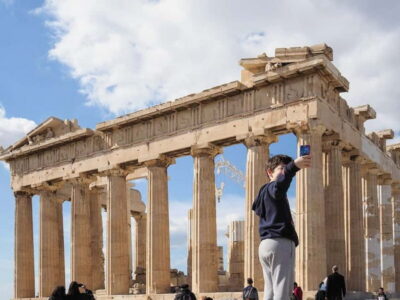
You’ll reach the Parthenon and take in its scale and proportions without needing to be an architecture nerd. The key is understanding that the perfection you see was designed, not guessed.
The guide points out how optical refinements create the illusion of absolute symmetry. That includes subtle curvature and tilted columns that look straight to the eye even when your brain expects something flatter.
You also learn that the friezes weren’t originally the muted stone look you see today. They once carried vivid color, and that civic storytelling element matters, because the Parthenon was as much about public identity as sacred space.
Look for small tells. Corner columns are slightly thicker to counter optical thinning, and you might see traces of ancient pigments on sheltered stones.
Photo tip: shoot along the colonnade for rhythmic lines and real sense of scale. And please respect the barriers. This is not the place for close calls with protected stone.
Admission ticket is included for this stop too, so your focus stays on seeing rather than managing logistics.
A handful more Athens outings to compare
- Best of Athens Half Day Private Tour★ 5.0 · 3,714 reviews
- Athens Full Day Private Tour★ 5.0 · 2,903 reviews
- Athens Airport Private Arrival Transfer with Meet & Greet★ 4.5 · 1,495 reviews
- Athens Airport to Athens Hotels Private Arrival Transfer★ 5.0 · 947 reviews
Propylaea: the entrance built like a stage

The Propylaea is your gateway into the sacred precinct, and it’s designed to manage your arrival. Think of it as architecture that choreographs movement, a fortress and a flourish at the same time.
You’ll get details on the Doric columns and the use of Pentelic marble, and you’ll see why the gateway feels both strong and elegant. You’ll also learn how the design adapts to the terrain, which shows up in its asymmetry.
Photo tip: step just inside, then turn back. Framing the city through the columns makes a classic Athens shot that feels personal, not generic.
This stop stays short, which works well because it keeps the day moving while you still get the payoff moment of entry.
Admission ticket is included here as well.
Temple of Athena Nike: tiny temple, big meaning

Above the gate, the Temple of Athena Nike looks like a jewel box. It’s Ionic elegance in a compact footprint, perched on a bastion, and it’s all about victory, both military and civic.
You’ll hear how the friezes once depicted dynamic battle scenes and winged Nikes. There’s a special detail you’ll likely be pointed toward: the motif of Nike adjusting her sandal.
Good to know: when you see that motif during your visit, you’ll be seeing a replica. Originals are preserved in the Acropolis Museum, so the guide helps you understand what you’re looking at without making you feel like you’re missing something.
Photo tip: capture both the bastion and the temple together. That cliff-edge drama is part of why this spot matters.
This stop is also brief, but the symbolism is dense enough that you’ll feel the payoff.
Admission ticket is included.
Erechtheion: myths mapped onto an irregular plan
The Erechtheion can feel mysterious in the best way. It’s built around layered myths, and the design reflects that, with an asymmetrical plan that wraps around holy spots.
You’ll be reminded of Athena’s olive tree and Poseidon’s salt spring, plus the memory of legendary kings tied to the site. The guide connects myth to physical geography so it feels like you’re walking a story, not a museum label hunt.
The south porch’s Caryatids are the signature. Those maiden statues carry the roof like living columns, and you’ll see why artists and architects keep referencing them.
Look for the olive tree to the west as a founding-myth clue. Even if you’re not sure what you’re seeing at first, the guide’s orientation helps.
Photo tip: frame two Caryatids with the Parthenon blurred behind for depth. It’s an easy composition once you know where to stand.
Good to know: the figures you’ll see are faithful casts, with originals preserved in museums. Knowing that up front helps you appreciate both the craftsmanship and the preservation choices.
Admission ticket is included.
Ancient Agora: where democracy, philosophy, and commerce all rubbed elbows
After the Acropolis, the Ancient Agora gives you a different scale. Instead of towering temples, you’re walking through the civic heart where daily life and big ideas overlapped.
This is where Athens gets human. You’ll hear about democracy, philosophy, commerce, and gossip happening together in colonnades and public spaces.
The Stoa of Attalos (museum) is a highlight because it anchors grand ideas to everyday objects. Coins, weights, and inscriptions make the civic story feel grounded in real people and real transactions.
Look for boundary stones marking sacred versus civic zones, and for ruts from ancient cart wheels. Those marks are the kind of detail you’d miss on a casual pass.
Photo tip: wide shots from the north looking south can frame the Acropolis crown in the distance. It’s a nice way to visually connect what you saw upstairs with what you’re seeing below.
This stop is about an hour, and the shady porticoes can be a relief if the sun hits hard midday.
Admission ticket is included.
A Doric temple viewpoint: Hephaistos and the craft story
Next comes a best-preserved Doric temple, dedicated to Hephaistos (craft) and Athena Ergane (handiwork). This temple overlooks the workshops of ancient metalworkers, which adds a working-person angle to a day that started with rulers and rituals.
You’ll get a look at intact metopes with Heracles and Theseus myths. And you may spot original roofing elements, depending on how the area is set for access.
Photo tip: catch the temple three-quarters from the southeast corner. That angle helps the rhythm of the columns read clearly.
Good to know: the elevated position gives you panoramic views back across the Agora area. It’s one of those “catch your breath while you still get something” moments.
Admission ticket is included.
Syntagma and the Unknown Soldier: civic Athens in modern form
After classical Athens, the tour moves into modern city rhythm around Syntagma. This is Athens’ civic living room, with boulevards fanning out and people gathering near fountains and flowerbeds.
Under your feet is literally layered Athens. Metro construction has revealed classical remains, and you can often spot archaeological finds visible from the station concourse area.
Photo tip: a fountain foreground with Parliament in the background is an easy classic composition.
Then the day takes a formal turn at the Monument to the Unknown Soldier. You’ll see the Evzones, Greece’s elite ceremonial guards, with their distinct uniform, including the fustanella pleats and pom-pom tsarouhia.
The changing of the guard becomes a timed reset point in the capital. It feels solemn, controlled, and surprisingly moving in a country where history is often close to daily life.
Look for the relief carving of a fallen hoplite, a simple detail that lands emotionally.
Photo tip: stand side-on to capture synchronized steps without blocking other people. And stay behind the line. Don’t touch the guards, and don’t obstruct their path.
Admission is free for this stop.
Neoclassical Athens: the Academy, University, and National Library facades
The Academy of Athens is a temple-like façade with statues of Athena and Apollo. The frontage also includes Socrates and Plato seated at the fore, making it an intellectual emblem that deliberately dialogues with the ancient past.
You’ll notice the guide pointing out color hints. Polychrome details, like soft reds and blues, can be part of what restoration work has tried to recover visually.
Photo tip: take a low angle from the steps to dramatize the statuary and pediment. It makes the building feel more monumental than a quick street glance.
Then you’ll see the National and Kapodistrian University of Athens as part of an Athenian Trilogy grouping. The building is a textbook of 19th-century classicism, with a frescoed portico and symmetrical plan.
Look for allegorical figures and ironwork along the forecourt. The guide helps connect those details to the idea of a state rebuilding its learning and identity.
Admission is free.
After that, the National Library of Greece keeps the theme of knowledge as public good. Expect a neoclassical façade with twin curving staircases, Doric columns, and a temple-like poise.
Good to know: the modern library facilities operate at the Stavros Niarchos Foundation Cultural Center. You don’t need to go there to appreciate the original façade’s intent.
Photo tip: symmetry is everything here. Center yourself and use the façade framing for a balanced shot.
Admission is free again.
Panathenaic Stadium: where Olympic history restarts
You’ll finish part of the day at Panathenaic Stadium, the Kallimarmaro. It’s carved entirely from white marble and hosted the first modern Olympic Games in 1896.
This stadium sits on the footprint of an ancient stadium used for the Panathenaic festival. That overlap between ancient ritual and modern reinvention is exactly the kind of Athens continuity that makes the day feel more than a checklist.
Look for the steep horseshoe stands and the finish line marking. Plaques to 1896 champions may be part of what you can see depending on timing and access.
Photo tip: from upper tiers, shooting down the lanes gives a sweeping amphitheater effect.
Good to know: optional paid entry lets you climb higher and see a small exhibit, but it’s not included. If you only have energy for one extra ticket in the day, this is the most logical place.
Admission is not included for this stop.
Olympeion ruins and the imperial scale trick
The Olympeion, once the largest temple in Greece, is one of the most Roman-feeling stops on the route. Even in ruins, the towering Corinthian columns communicate imperial ambition under Hadrian.
A standout photo moment can be the solitary fallen column. The fluted drum segments show how the temple was built, which gives the ruins more structure than you might expect.
Photo tip: you might get a quick capture through the coach window with Hadrian’s Arch if traffic allows. This stop can be quick in practice, so be ready.
Because this part is not described with a ticket in the provided details, plan on seeing it as an exterior ruins and viewpoint stop as part of the circuit.
Plaka and Monastiraki: the day ends where Athens smells like food and stone
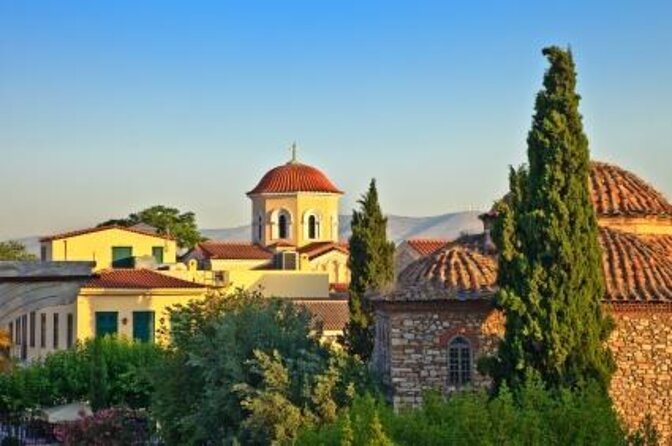
Plaka is Athens’ village under the rock. You’ll wander through a maze of neoclassical houses, flower-draped balconies, and tiny chapels that feel timeless rather than staged.
This is a good time to stop for ice cream, browse an artisan shop, or simply slow your brain down. The cobblestones and stairs can be a slow-down tool, not a punishment.
Look for Anafiotika, the whitewashed Cycladic-style houses clinging to the Acropolis slope, built by island craftsmen. Even if you’re not sure where you are, the walls and bright surfaces give it away.
Photo tip: early afternoon light can make pale walls look almost luminous. It’s a simple lighting advantage.
Admission is free, and the stop is about an hour.
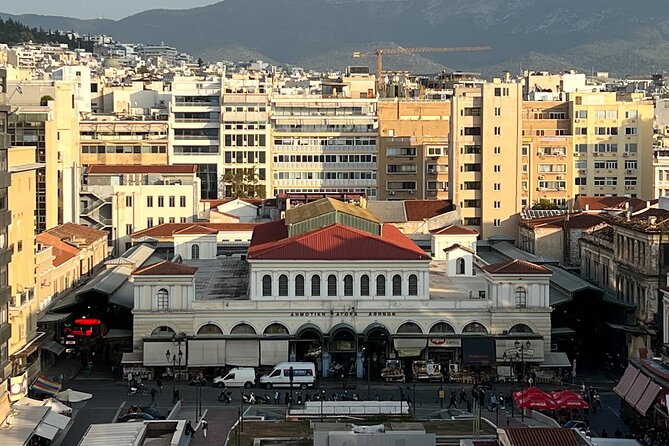
Then Monastiraki brings the market overlap. You’ll see layers of Athens in one area: a mosque, a church, Roman Agora ruins, plus flea-market stalls selling everything from leather sandals to antiques.
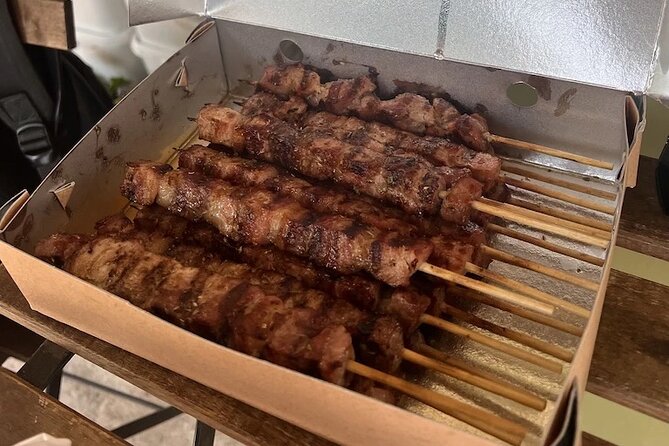
Street food and bargaining chatter are part of the scene, so come with patience for crowd density. Keep small valuables zipped, because busy squares are exactly where opportunistic pickpockets work.
Photo tip: golden hour from the square can light up the Acropolis skyline with the Parthenon appearing especially dramatic.
Admission is free here too, with about an hour allocated.
Price and value: what $600.12 per person really covers
Let’s talk money honestly. At $600.12 per person, this is not a budget outing. It’s paying for private time, an English-speaking guide, and a route that prioritizes the Acropolis complex and multiple major sites in one go.
The value angle is that many of the key archaeological admission tickets are included for the core Acropolis and Agora sequence. That reduces the chance of wasting precious vacation time on ticket lines and decision-making.
Pickup offered also matters. If you’re carrying luggage, traveling with kids, or arriving mid-day, being met and moved efficiently can save you from the Athens “where do I stand” problem.
When would this feel worth it? If you’re traveling as a couple, a small group, or you strongly prefer guided interpretation over self-guided wandering, the premium can feel easier to justify.
When might you skip it? If you’re comfortable planning your own route, want to linger at museums longer than 15 minutes at a time, or you’re trying to stretch a tight travel budget, you may prefer a cheaper mix of tickets and public transport.
Is the packed schedule right for you?
This tour fits best if you like a clear plan and strong guidance at the places where interpretation makes the biggest difference. The Acropolis and Parthenon stops are built for short, high-impact learning moments, and the later neighborhoods give you room to breathe.
It’s also a good match if you want a mix of Classical Greece and modern Athens without switching days or coordinating separate guide services. You’ll cover viewpoints, ceremonial moments, and classic streets all in one outing.
If you’re the type who wants to spend half a day inside one museum, ask yourself if you’ll still enjoy the quick-turn pace. The upside is momentum and perspective. The downside is fewer long sit-down moments.
Also, the experience requires good weather, so if Athens is giving you rain that day, you’ll need flexibility in your plans.
Should you book this Best of Athens and Acropolis private tour?
I’d book it if you want one guided day that hits the top Athens targets, explains what you’re seeing, and includes a lot of key admissions without you juggling logistics. The combination of Acropolis architecture details and later time in Plaka and Monastiraki is the sweet spot.
I’d pause if you want slower pacing, more museum time, or a mostly self-guided trip. Also, because it’s priced per person, ask yourself whether your group size makes the math feel comfortable.
If you can work with the schedule and you value a knowledgeable guide narrative, this is a strong way to see Athens without turning your day into a scattered scavenger hunt.
FAQ
How long is the Best of Athens and Acropolis tour?
The tour lasts about 5 to 7 hours.
Is pickup included, and how do I coordinate the meeting point?
Pickup is offered. You need WhatsApp or Apple iMessage to coordinate the exact pick up spot.
Is the tour guided in English?
Yes, it’s offered in English.
Are admission tickets included for the main archaeological sites?
Admission tickets are included for the Acropolis section and several Acropolis and Agora stops. The Panathenaic Stadium has optional paid entry, which is not included. Stops like Syntagma, the Unknown Soldier, and the neoclassical university and library buildings are free in the provided details.
Is this a private tour?
Yes. It’s a private tour/activity, and only your group participates.
What parts of Athens does the route include?
The route includes the Acropolis and its major monuments, the Ancient Agora, Syntagma, the Monument to the Unknown Soldier, the Academy of Athens, Athens university buildings, the National Library of Greece, Panathenaic Stadium, Plaka, and Monastiraki.
Latest from under the Acropolis





Acropolis Hill Tours, compared.
Acropolis & up to 5 Archaeological Sites Combo Pass
Read our review →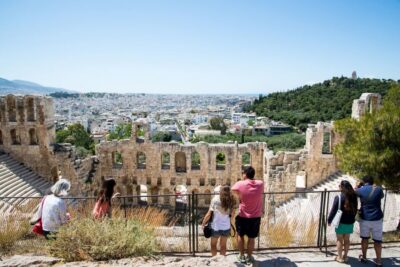
Acropolis, Parthenon & Acropolis Museum Guided Tour
Read our review →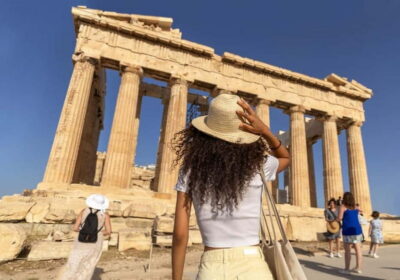
The Acropolis, Parthenon & Acropolis Museum Guided Tour
Read our review →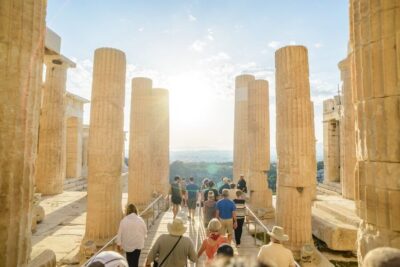
Acropolis: Premium Acropolis and Parthenon Guided Tour
Read our review →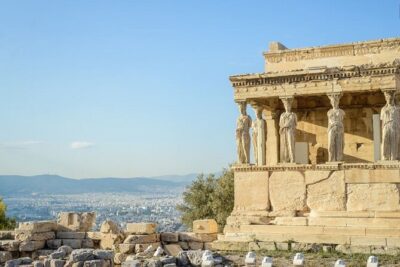
Acropolis and Parthenon Guided Walking Tour
Read our review →Acropolis, Parthenon & Acropolis Museum Guided Tour
Read our review →

Athens Scenic Electric Bike Tour with optional Acropolis visit
Read our review →Browse the lists this tour appears in