Reviewed · FULL-DAY
Argolis Private Full Day tour
Corinth to Epidaurus in one day is a great Greek memory. This private Argolis tour strings together big-ticket ancient sites with real coastal breaks, in a comfy vehicle with pickup included. You also get to shape the day around what you care about most, which is a rare luxury in Greece. One thing to watch, though, is that the driver can explain history but is not allowed into the sites with you.
What I like most is the private setup. No random crowding, no strangers dropping in, and you can move at a pace that fits your group. I also love the practical extras, like WiFi on board and bottled water, which makes the long drive feel much easier.
The main consideration is cost creep. Entrance tickets are not included, and if you want a licensed English guide inside the sites, that is an optional add-on payable in cash.
In This Review
- Key things that make this day work so well
- Private Argolis in a single day: what you are really paying for
- Getting started: pickup, timing, and how the day stays sane
- Stop 1, Corinth Canal: the quick engineering stop that frames the whole region
- Stop 2, Ancient Corinth: ruins, Roman streets, and the city that kept changing sides
- The Aphrodite connection and why Corinth mattered
- The Temple of Apollo and what you can actually see
- Agora, rostrum, and Lechaion Street: the walk that feels like a time machine
- Stoa, Peirene, and the healing theme nearby
- A realistic drawback at this stop
- Stop 3, Mycenae: the fortress behind the word Mycenaean
- Stop 4, Nafplio: a real break with a big historical resume
- Stop 5, Tolon and lunch by the sea: keep the day human
- Stop 6, Epidaurus Theater: the reason people talk about acoustics
- Your driver, your guide, and what changes if you add the licensed guide
- Who this private Argolis tour is best for
- Should you book the Argolis Private Full Day tour?
- FAQ
- Is this tour private, and how many people can be in the group?
- What pickup and drop-off options are included?
- How long is the tour?
- Are entrance fees included?
- Is lunch included?
- Do we need a tour guide for the sites?
Key things that make this day work so well
- True private pacing for up to 3 people, so you can customize without compromise
- Driver-led commentary on the way, with the helpful note that the driver cannot enter sites
- Corinth Canal stop for a quick reality check on engineering, with no locks and narrow passages
- Ancient Corinth and its Roman streets give you variety, not just one ruin
- Epidaurus Theater visit for one of the best-known acoustics and a rare preserved circular orchestra
- Coastal rhythm at Nafplio and Tolon before you head back toward Athens
Private Argolis in a single day: what you are really paying for
This is not a cheapest-days-out kind of tour. It is priced per group at $533.95 for up to 3 people. That price makes sense if you are splitting the ride with a couple of friends or family and you value a door-to-door day without the stress of organizing trains, buses, and timed tickets. If you book for fewer than 3, it will feel pricey, because you are still paying for a full private vehicle.
A smart way to think about value here is simple. Your money buys three things: time, comfort, and reduced friction. You get hotel or port pickup and drop-off included, plus an air-conditioned vehicle. You also get WiFi on board and bottled water, which sounds small until you are sitting in traffic with a big day ahead.
And the private angle matters more than people expect. When you can customize the day, you can spend extra minutes where you care, and skip what does not interest you. That flexibility is especially useful in Argolis, where the driving legs can feel long if you are trying to hit everything on a strict timetable.
A handful more Athens outings to compare
- Best of Athens Half Day Private Tour
★ 5.0 · 3,714 reviews - Athens Full Day Private Tour
★ 5.0 · 2,903 reviews - Athens Airport Private Arrival Transfer with Meet & Greet
★ 4.5 · 1,495 reviews - Athens Airport to Athens Hotels Private Arrival Transfer
★ 5.0 · 947 reviews
Getting started: pickup, timing, and how the day stays sane
The tour runs about 9 to 10 hours, with pickup offered from your Athens hotel or the Piraeus cruise terminal area. You will also get a mobile ticket, which helps if you are moving through pickup points and want fewer printed pieces.
One detail that can genuinely help: the tour says the driver will meet you with an H.P. Tours sign at the airport customs exit, or at the correct Piraeus terminal exit. Piraeus can be a maze. Having the meeting point clearly tied to the terminal name reduces the risk of standing around guessing where your ride is.
Also note the driver setup. You get a professional driver, and they will explain monuments and history en route. But by law they are not allowed to accompany you inside the sites. If you want a lot of on-the-ground interpretation while you walk among ruins, you should consider the optional licensed English guide add-on.
Stop 1, Corinth Canal: the quick engineering stop that frames the whole region
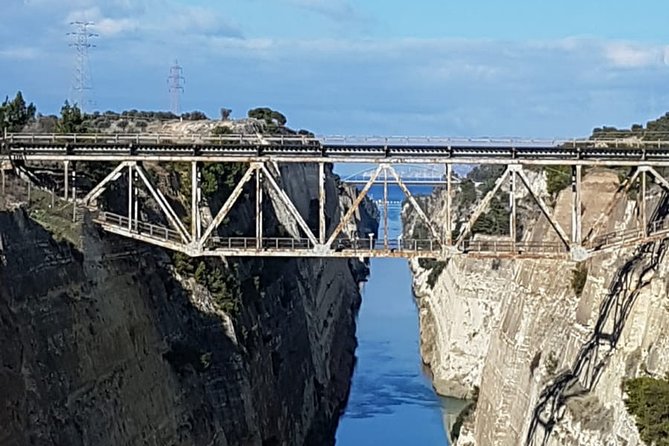
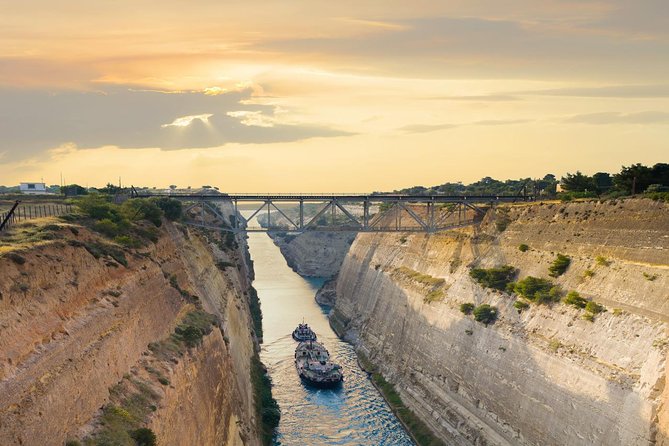
The Corinth Canal is the kind of sight that makes you stop talking and just look. It cuts through the narrow strip of land (the Isthmus of Corinth) and separates the Peloponnese from Greece’s mainland, so it is basically a man-made statement about geography.
A few technical points make the visit more interesting than a quick photo stop:
- It is 6.4 kilometers long
- It has no locks
- The base width is about 21.4 meters, which makes it impassable for most modern ships
- It is not just abandoned history. It has periodic closures for repairs from landslides
Historically, the canal was proposed in classical times, then construction began in 1881 and finished in 1893. The original effort got bankrupted due to geological and financial troubles. In other words, this is not a clean success story, it is a real-world lesson in how hard ambitious projects can be.
Practical tip: treat this stop as your mental warm-up. Once you see the canal, the geography of the day clicks. You are traveling through places that were shaped by sea routes and narrow passages for thousands of years.
Stop 2, Ancient Corinth: ruins, Roman streets, and the city that kept changing sides
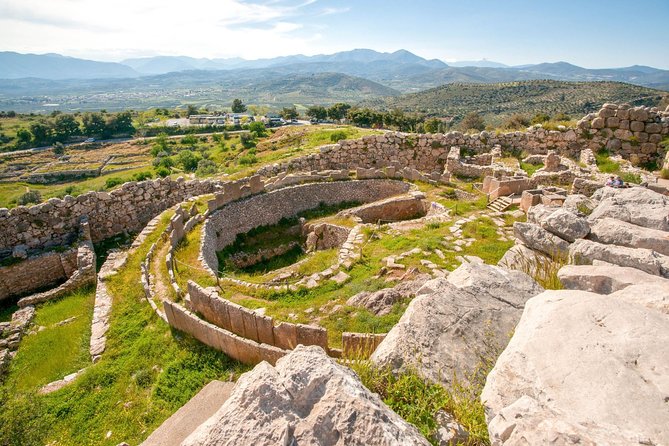
Ancient Corinth is one of those places where you can feel layers. Myth, trade, wars, empires, earthquakes, and rebuilding all show up in the story. And on the ground, the ruins are strong enough to let you imagine the scale even if only part of the site has been excavated.
The Aphrodite connection and why Corinth mattered
Corinth sat at a crossroads. In its early heyday, it competed with major Greek cities thanks to traffic and trade over the Isthmus. In the mythic version, the first kings traced lineage back to Sisyphus, which sets a tone of stubborn fate and repeated effort.
Religiously, Corinth is tied to Aphrodite. The great temple on the Acropolis (the Acrocorinth) was dedicated to her, and Corinth became known as a major cult center. The description you get here includes the idea of more than a thousand temple attendants, which helps explain why the city had such a long cultural footprint.
Same hours, spent a different way in Athens:
- Athens: Acropolis & up to 5 Archaeological Sites Combo Pass★ 4.2 · 13,904 reviews
- Athens: Acropolis, Parthenon & Acropolis Museum Guided Tour★ 4.8 · 9,316 reviews
- The Acropolis, Parthenon & Acropolis Museum Guided Tour★ 4.7 · 8,493 reviews
- Athens: Cape Sounion & Poseidon Temple Sunset Half-Day Trip★ 4.8 · 8,241 reviews
The Temple of Apollo and what you can actually see
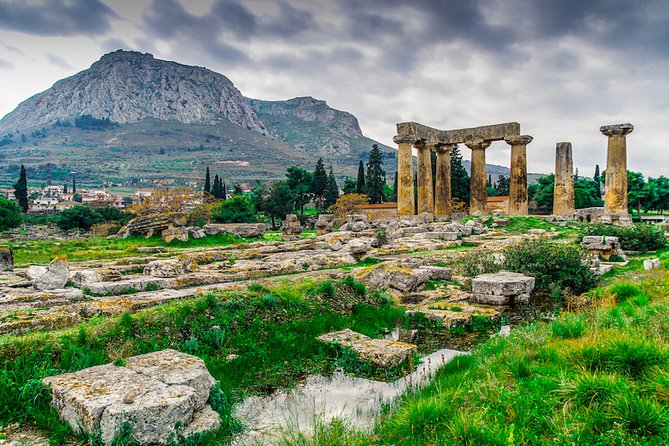
At the archaeological site, the Temple of Apollon (built in the middle of the 6th century BCE) is the standout structure. One specific feature makes it worth paying attention: the remaining columns are monolithic, instead of being built from column drums. Today you can still see seven columns standing.
The temple alone helps you understand Corinth’s level of ambition. Even with invasions and destruction over the centuries, these stones still give you a sense of what a major city looked like when it was wealthy.
Agora, rostrum, and Lechaion Street: the walk that feels like a time machine
This is where Ancient Corinth does more than just hand you ruins. The agora area includes a bèma or rostrum platform. The popular story is tied to Paul being questioned by Gallio, but this tour information points out that archaeological and historical research does not support that claim strongly.
Even if you treat that part as a debate rather than a hard fact, the value stays: you are looking at where major public decisions would have been announced. It turns the site into something civic, not just religious.
Then there is Lechaion Street, an arched gateway leading into a preserved Roman “shopping mile.” It was originally preserved in a form that lasted well into later centuries, and walking it makes you understand public life. Shops lined the galleries, and the street acted like a hub for commerce and everyday movement across the Roman empire.
If you like details, you can also spot the elaborately decorated gateway, the preserved paved street feel, and even a well-preserved latrine. That kind of thing often makes ruins feel more real than big monuments alone.
Stoa, Peirene, and the healing theme nearby
In the south of the agora area, there is a long Stoa associated with Philip II of Macedon. Nearby, you can connect the dots to Peirene, the spring with clear water, decorated with arcades and once set with statues. Poets came for inspiration, and the water link to Pegasos adds a mythic flavor.
All of this is a reminder that ancient cities were built for more than power. They were built for daily movement, politics, commerce, and belief.
A realistic drawback at this stop
Ancient Corinth is big, and the information you get depends on your guide setup. Since the driver cannot enter sites with you, your experience can lean more self-guided unless you add a licensed English guide. If you want deep explanations while you stand in front of specific structures, plan for that.
Stop 3, Mycenae: the fortress behind the word Mycenaean
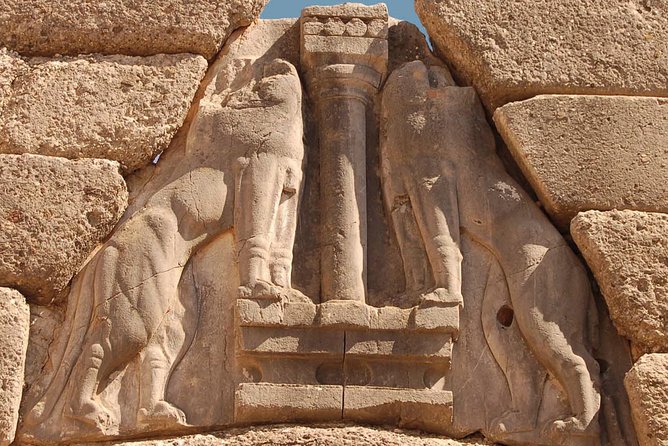
Mycenae is where the day shifts from “city ruins” to “stronghold thinking.” This site is near Mykines in Argolis, and it sits on a hill about 900 feet above sea level, roughly 120 kilometers from Athens.
This stop matters because Mycenae defines an era. The period of Greek history from around 1600 BC to about 1100 BC is called the Mycenaean period. At its peak around 1350 BC, the citadel and lower town had an estimated population of 30,000 and covered about 32 hectares.
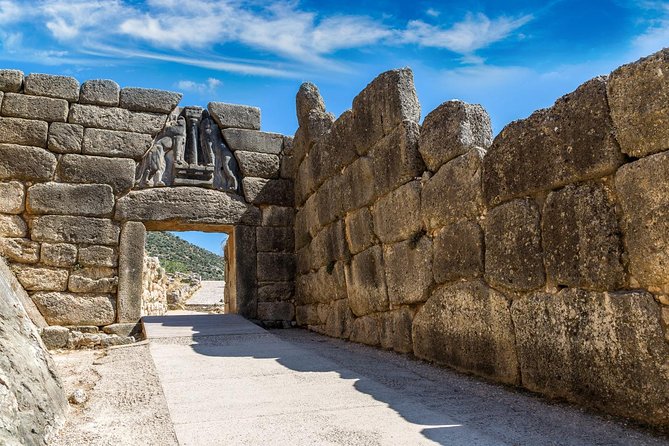
The tour information also includes a smart context point about modern identification. In the early 1700s, Francesco Grimani used classical descriptions, like Pausanias’s account of the Lion Gate, to identify these ruins as Mycenae. That is a neat reminder that archaeology often starts with reading the landscape through texts.
What you can expect on the ground is a strong, compact feel. You are on a site that was built to be defended, not just admired. If you like seeing how geography supports power, you will probably enjoy the view points from the hill.
Stop 4, Nafplio: a real break with a big historical resume
Nafplio is not an ancient ruin stop. It is a living seaport town that climbs the hills near the Argolic Gulf. You get about 40 minutes here, which is short, but it is enough to reset your brain after the long archaeological segments.
This town has an unusually important modern history. It served as:
- Capital of the First Hellenic Republic
- Capital of the Kingdom of Greece
from the start of the Greek Revolution in 1821 until 1834.
Today, it is still the capital of the Argolis regional unit. That means you will feel a town vibe, not just tourist scenery.
Practical mindset: treat your Nafplio time as a walking reset. You want a quick coastal atmosphere, good light for photos, and a chance to breathe before the next site.
Stop 5, Tolon and lunch by the sea: keep the day human
Tolon sits about 7 kilometers east of Nafplion. The tour includes a lunch stop idea here, at a traditional family-run restaurant with a view of the Saronic Gulf.
Even with only about 45 minutes, this part is valuable because it turns the day from “stop, walk, sit, repeat” into a proper meal break. In a packed historical day, a real lunch matters more than people think. It is often when you process what you saw earlier and actually enjoy the rest of the route.
A small note: lunch is not included in the price. You will be paying for it directly at the restaurant. The value is that you get a good setting without needing to hunt around.
Stop 6, Epidaurus Theater: the reason people talk about acoustics
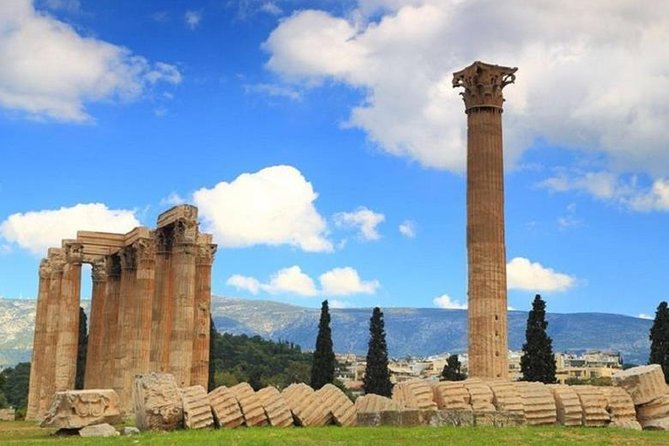
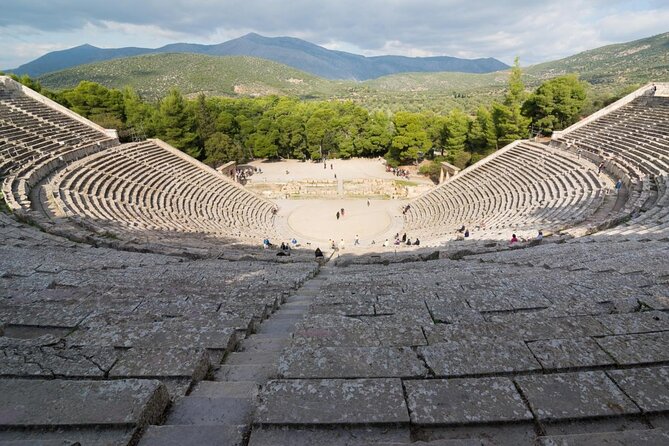
Epidaurus is one of Greece’s most famous spiritual and cultural sites, tied to the Sanctuary of Aesculapius, the ancient healing figure. The theatre is dated to the 3rd century BC, and the key draw is its unique acoustics.
What I like about this stop is that it is not just about one building. You get context through the sanctuary theme, where healing and culture were connected. Then the theatre gives you the visual payoff.
The theatre is famous because it retains its original circular orchestra, which is rare. The circular layout is part of why the acoustics are so distinctive, and it also makes the space feel intact compared to many other ruins.
You get about 45 minutes here. It is not enough time to be a deep scholar, but it is enough to enjoy the structure, find your viewing spot, and understand why Epidaurus became a landmark.
Your driver, your guide, and what changes if you add the licensed guide
One of the biggest strengths of this tour is how it uses its driver. The driver provides explanations about monuments and history as you travel between stops. That helps you arrive at each site with a mental map, not just a list of names.
But the law detail matters: the driver is not allowed to accompany you inside the sites. If you want guided interpretation while walking through Ancient Corinth, Mycenae, and Epidaurus, the tour offers an optional licensed English guide add-on for 400 Euros payable in cash, subject to availability.
So here is the practical decision rule:
- If you mostly want comfortable logistics, a bit of history in transit, and time to wander on your own, you may be fine without a licensed site guide.
- If you want the full narrative while you stand among the ruins, add the licensed guide, because the driver cannot cover that part inside.
Who this private Argolis tour is best for
This tour fits best if you are traveling with up to 3 people and you want a day that feels organized, not scrambled. It is especially good for:
- Couples or small families who prefer private driving over public transit
- People who like a mix of ancient sites plus towns with a coastal break
- Travelers who want flexibility, because the itinerary can be customized
It may be less ideal if you are traveling solo on a tight budget, because the per-group price does not drop unless you fill the seats. It may also be less ideal if you want heavy commentary in every single site and you do not want to pay extra for a licensed guide.
One more practical note: this tour is booked on average about 71 days in advance, which is a hint that your dates can sell out, especially if you care about availability for licensed guides.
Should you book the Argolis Private Full Day tour?
I think it is a strong book if you value privacy, smooth transportation, and a day plan that hits major regional highlights without you doing the route math yourself. The combination of Corinth Canal for geography, Ancient Corinth for layered city life, Mycenae for fortress-era context, Nafplio and Tolon for a real meal and sea air, and Epidaurus for the theatre experience is a clean way to see Argolis beyond Athens.
Book it if:
- You are traveling as a group of up to 3 and want the comfort of end-to-end pickup and drop-off
- You are okay with partly self-guided ruins, with history delivered mostly by the driver
- You want to customize the day to your interests
Consider not booking, or at least plan your expectations, if:
- You want a licensed guide inside every site but do not want to add the optional cost
- You are trying to minimize total expenses, since entrance fees and lunch are not included
FAQ
Is this tour private, and how many people can be in the group?
Yes. It is totally private, meaning only your group participates. The price is per group for up to 3 people.
What pickup and drop-off options are included?
Private transportation includes Athens hotel or Piraeus port pickup and drop-off. Airport pickup can also be arranged on request for an additional fee that varies by vehicle type.
How long is the tour?
The duration is about 9 to 10 hours.
Are entrance fees included?
No. Entrance Fees to Ancient Corinth, Mycenae, and Epidaurus are not included. The listed amount is 55.00 Euros per adult.
Is lunch included?
No. Lunch is not included. The day includes a lunch stop suggestion in Tolon at a traditional family-owned restaurant with a view of the Saronic Gulf.
Do we need a tour guide for the sites?
An English-speaking licensed tour guide is optional and costs 400 Euros payable in cash, subject to availability. The English-speaking driver can explain monuments and history, but they are not allowed by law to accompany you inside the sites.
Latest from under the Acropolis




Full-Day, compared.
All Day Cruise -3 Islands to Agistri,Moni, Aegina with lunch and drinks included
Read our review →


Full-Day Meteora Tour with Local Guide & Greek Lunch
Read our review →