

Reviewed · CYCLING TOURS
Ancient Athens E-Bike Tour
Hills in Athens, minus the suffering. In this Ancient Athens e-bike loop, you zip between the big names like the Acropolis and ancient Agora without burning your day on foot. You get a standing, motorized trike-style ride that keeps you moving and makes the route feel tight and efficient.
Two things I like a lot. First, it’s a fast way to hit major sites in about two hours, so you still have time to wander Plaka on your own afterward. Second, the tour is built around a small group and a real-time guide, with names like Dimitris and Kevin popping up in past tours, plus route tweaks when you already saw certain spots.
One consideration: the really important admissions are not included, so you should budget for archaeological-site tickets even though the ride itself is covered. Also, the tour requires good weather, so plan for a backup date if conditions are rough.
In This Review
- Key highlights worth caring about
- Why a standing e-bike works so well for ancient Athens
- Price and value: what $72.09 includes, and what it doesn’t
- Getting there: meeting point and how the timing feels in real life
- The route in motion: what you see at each stop
- Theatre of Dionysus area, tied to the Acropolis ticket
- Odeon of Herodes Atticus: the Roman theatre still used today
- Acropolis: a close-side view of the Parthenon hill
- Pnyx: the democracy hill, in an archaeological park
- National Observatory of Athens: the hill of Nymphs area
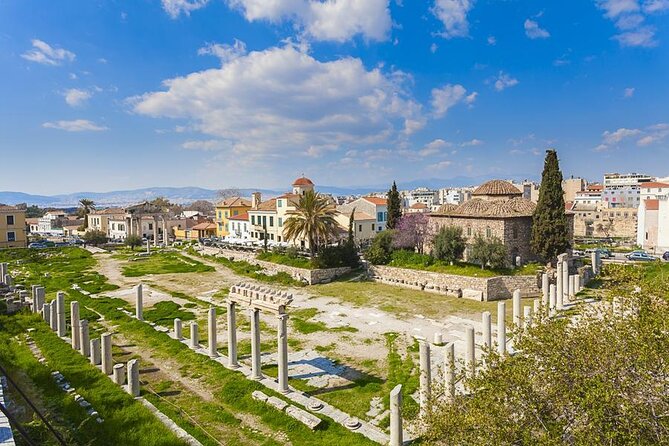
- Ancient Agora: the main market of ancient society
- Keramikos: where ceramics made the neighborhood name
- Monastiraki: heart of Athens for food and street energy
- Roman Agora and the Tower of the Winds
- Comfort, safety, and how the guide can change the experience
- Stop choices in one tour: what this means for your Athens plans
- Who should book this e-bike tour, and who should skip it
- Should you book the Ancient Athens E-Bike Tour?
- FAQ
- How long is the Ancient Athens E-Bike Tour?
- How much does the tour cost?
- What is included in the tour price?
- Are archaeological site tickets included?
- What sites have specific ticket prices?
- How many people are in the group?
- Where does the tour start and end?
- What happens if weather is poor, or if I need to cancel?
Key highlights worth caring about
- Standing e-bike comfort means no pedaling, so you keep your energy for viewpoints and photos
- Small group size (max 12) makes it easier to hear your guide and stay together
- Time-saver route strings together Odeon, Acropolis area, Pnyx, Agora, Kerameikos, and Plaka
- Helmet and costumer insurance included keeps the ride feeling more relaxed
- Guides adapt on the fly if you already covered part of the route
- Heat-friendly option for seeing multiple hills and ruins without the full uphill grind
Why a standing e-bike works so well for ancient Athens
Athens is famous for its ruins, and also famous for its hills. If you’re trying to cover the Acropolis area plus the Agora in one day, walking can turn into a slow, sweaty puzzle: stairs, long distances, and sudden “why is this uphill?” moments.
This tour solves that with a motorized standing setup. You stand comfortably on the trike, glide between stops, and only slow down when you need a close look. That matters because Athens’ best “wow” moments are often the ones you want to see from a proper angle, not from the back of a crowd while you’re trying to conserve energy.
And because you’re not pedaling, it’s easier to keep your pace consistent. You can focus on listening to the story and looking at the details instead of managing your breathing.
More of Athens covered between the bike lanes:
- Athens Scenic Electric Bike Tour with optional Acropolis visit
★ 5.0 · 3,350 reviews - Athens: City Electric Bike Tour with Acropolis Visit Option
★ 4.9 · 1,017 reviews - Athens Small Group E-Bike Tour
★ 5.0 · 1,013 reviews - Historic Athens: Small Group Electric Bike Tour
★ 4.9 · 966 reviews
Price and value: what $72.09 includes, and what it doesn’t
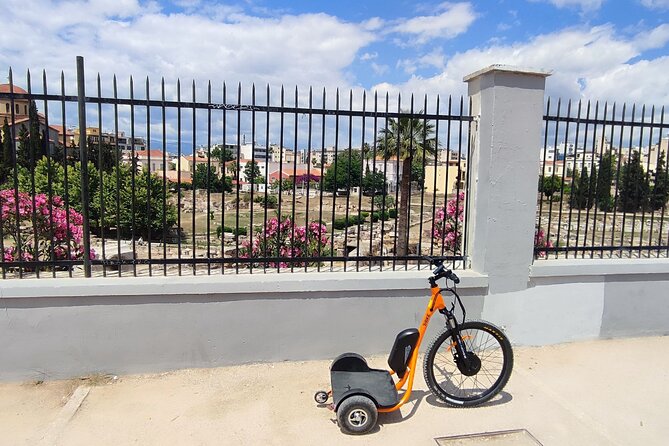
At $72.09 per person, you’re paying mainly for the ride experience and guiding, not for site admissions. The included items are clear: use of Trikke, a helmet, and costumer insurance. You also get a mobile ticket.
What’s extra is archaeological-site access. The tour lists specific costs for key places, including:
- Acropolis Hill admission: 20€
- Odeon of Herodes Atticus admission: 20€ (listed separately on the stop details)
- Ancient Agora admission: 4€
Other stops are listed as free or included. For example:
- Pnyx is listed as free
- Keramikos is listed as free
- Plaka is listed as free
- Some “admission ticket included” notes show up for stops like the National Observatory of Athens and Monastiraki
Because there are a couple overlaps and a few mixed notes (especially around Odeon and Acropolis Hill ticketing), the smart move is simple: plan cashless payment for the paid sites the itinerary names clearly, mainly the Acropolis Hill and Ancient Agora tickets.
Still, the value is strong if you want breadth. Two hours is short enough that a walking-only plan would feel rushed. Here, the ride does the heavy lifting.
Getting there: meeting point and how the timing feels in real life
The tour meets at Leof. Andrea Siggrou 22, Athina 117 42. It ends back at that same meeting point, so you don’t need to worry about where you’ll end up after you finish.
The operating window is Monday through Saturday, 10:00 AM to 4:00 PM, and the experience runs year-round through the listed date range. If you’re thinking about booking, an interesting detail is that this is commonly booked about 42 days in advance. That’s a clue to treat it like a popular “see a lot quickly” activity, especially during peak season.
The group size is capped at 12 travelers, which helps the whole experience feel organized. You’re not crammed into a long conga line, and it’s easier for your guide to adjust if someone needs a breather or if traffic forces a route shift.
The route in motion: what you see at each stop

This tour is designed as a guided loop of Athens’ core ancient zones, with a mix of major ticketed monuments and free open-air sites. Here’s what to expect, and why each stop is worth the brief pause.
Theatre of Dionysus area, tied to the Acropolis ticket
The itinerary starts at the most important theatre in Ancient Greece, the place where theatre began, tied to the Theatre of Dionysus. It also notes that the Acropolis Hill ticket includes Theatre of Dionysus access.
This matters because it sets the tone: you’re not just sightseeing ruins, you’re walking through the origin story of performance in the Greek world. If you’re the type who likes context (how systems started, not just what they looked like), this early stop gives you that mental framework for the rest of the loop.
Ticket note: the listed price is 20€ for the relevant access.
Other Athens hills taken with a motor:
- Athens Electric Bike Tour★ 5.0 · 836 reviews
- Athens: Discover the City Electric Bike Tour★ 4.9 · 544 reviews
- Athens: 2-Hour Highlights Tour by E-Bike After Sunset★ 4.9 · 532 reviews
- Athens Acropolis Official E-Scooter Guided Tour Fat E-Bike★ 5.0 · 504 reviews
Odeon of Herodes Atticus: the Roman theatre still used today
Next is the Odeon of Herodes Atticus, a Roman theatre built in the second century A.D. It’s described as still in use for shows, created as a memorial gift for the wife of Herod Atticus.
Even if you’ve seen photos, seeing it in person changes the feel. The structure reads as both ancient and “alive,” because the design is built for voices and staging, not just to be admired from a distance.
Time on site is about 10 minutes, and the admission note indicates this can be ticketed via the Acropolis-area ticketing setup as well as listed separately. Either way, expect this to be one of the main paid entries.
Acropolis: a close-side view of the Parthenon hill
Then you’re at the Acropolis itself, with a plan to watch the hill from a very close side. The Parthenon temple crowns the top, and this is the big visual anchor for the whole area.
What I like about including Acropolis here is pacing. You’re not trying to do the entire archaeological complex on your own. Instead, you get an efficient look that helps you decide what to return to later, when you have more time and less pressure.
Acropolis admission is listed at 20€.
Pnyx: the democracy hill, in an archaeological park
Pnyx is described as the place where democracy started. It’s also located within an archaeological area and park, which makes the stop feel less like a single monument and more like a setting.
You’ll get around 15 minutes here. That’s enough time to grasp why people connect Pnyx to civic life, not just mythology. If you enjoy understanding how ideas shaped architecture, you’ll probably leave with a better mental map than you’d get from pictures alone.
Admission for Pnyx is listed as free.
National Observatory of Athens: the hill of Nymphs area
Next is the National Observatory of Athens, described as the first observatory of Athens. The stop notes that the hill of Nymphs sits inside an archaeological area and park.
This is a nice change of pace, because it keeps the tour from becoming only “temples and theatres.” Observatories are a reminder that ancient Athens wasn’t only about politics and performance. People studied the sky, and science moved through daily life too.
Time on site is about 15 minutes, and the admission note is listed as included.
Ancient Agora: the main market of ancient society
The Ancient Agora is where you shift from monuments to daily life. It’s described as the most important side of Ancient Greece, with a main market role in ancient society.
You get about 20 minutes. That’s long enough to notice that an Agora is not just a background. It’s where social life, trade, and public conversation all met. If your brain likes “how people actually lived,” this is one of the strongest stops.
Ancient Agora admission is listed as 4€.
Keramikos: where ceramics made the neighborhood name
Keramikos is close to the Ancient Agora and is described as the ceramics-production area, which is the root of the neighborhood’s name.
The key benefit here is breathing space. Keramikos is open and spreads out, so it feels less like you’re standing behind barriers and more like you can take in the setting of the area.
Time is around 10 minutes, and the admission is listed as free.
Monastiraki: heart of Athens for food and street energy
Monastiraki is described as one of Athens’ most crowded squares and considered the heart of Athens, with bars, restaurants, and lots of choices nearby.
You’ll only have about 10 minutes. That means you’re not turning this into a full meal stop. Instead, it’s a practical way to set yourself up for later browsing. If you want to finish the day with a drink or snack, this is where you’ll naturally drift afterward.
The admission note for Monastiraki is listed as included.
Roman Agora and the Tower of the Winds
Finally, you reach the Roman Agora, described as a Roman version of the Greek Agora from the second century A.D. Inside, you can see the Tower of the Winds.
Time is about 10 minutes. This stop is good for closing the loop because it shows how later Rome layered its own identity over older Greek spaces.
Admission details for Roman Agora are inconsistent in the stop notes: the price is listed as 4€, but the same stop notes admission as free. The safest way to handle it is to treat Roman Agora as potentially ticketed, and check on the day for what you need to pay (if anything).
Comfort, safety, and how the guide can change the experience
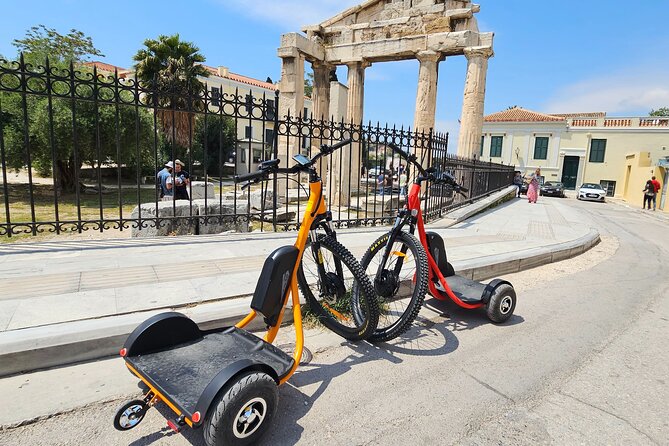
The ride setup helps here more than you might think. A standing e-bike keeps you stable and reduces the friction of long walks. Add the helmet and the costumer insurance, and the whole activity feels more like a controlled city cruise than a risky stunt.
The guide makes a real difference. In past runs, Dimitris has been praised for being fun and for making sure you get views and context that match what you already saw. That matters because Athens can be overwhelming. If you come in having already done a few sites, a guide who adjusts the order keeps the tour from feeling like a repeat of what you did yesterday.
One more small thing that helps: the group is small, so your guide can keep you together and give clearer direction at intersections. That’s not just comfort. It’s how you avoid losing time and end up with a smoother overall experience.
Stop choices in one tour: what this means for your Athens plans
A two-hour ancient Athens loop is not trying to replace a full-day deep ticket plan. It’s designed to help you do something practical:
- Get the big sites under your belt fast
- Learn the story behind them so your photos make more sense
- Decide what to revisit later without guessing
If you’re staying in central Athens, this style of tour also makes your day feel less like a checklist. You get a guided framework, then you can roam afterward with better instincts.
It also helps in warm weather. The ride itself reduces fatigue, and you still get access to viewpoints around the Acropolis area without turning the day into a march.
Who should book this e-bike tour, and who should skip it
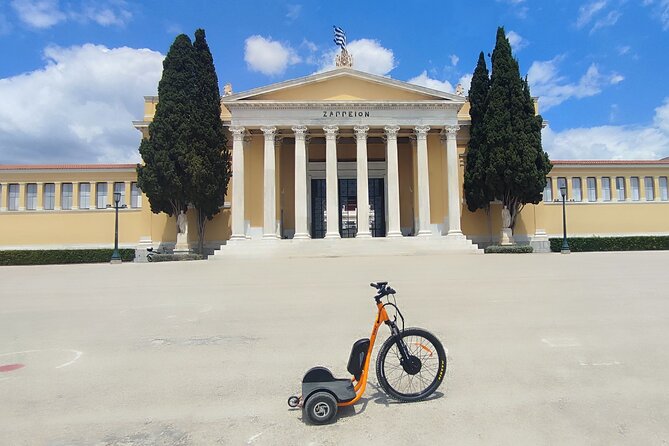
This tour is a good match if you want to see a lot in a short time and keep walking to a minimum. It also suits families, since kids in the 9 to 15 range have enjoyed the experience.
You might also like it if:
- You’re traveling solo or as a couple and want a small-group feel
- You prefer guided context over wandering aimlessly
- You’re visiting in warmer months and want to reduce physical strain
You may want a different plan if:
- You hate motorized vehicles or prefer slow walking
- You want to spend a long time inside museums rather than moving between outdoor sites
- You expect every single stop to be free, because key admissions like the Acropolis Hill and Ancient Agora are ticketed
Should you book the Ancient Athens E-Bike Tour?
I’d book it if your priority is smart coverage. For $72.09, you’re getting a short guided route with included helmet, insurance, and the ride. Then you pay for major admissions you’d likely want anyway, like the Acropolis Hill and Ancient Agora.
I’d also book it if you like the idea of a small group and a guide who can adjust your route so it doesn’t feel generic. Athens rewards planning, but it also rewards spontaneity, and this tour hits that sweet spot: guided structure plus time for your own wandering afterward.
FAQ
How long is the Ancient Athens E-Bike Tour?
It runs for about 2 hours.
How much does the tour cost?
The price is $72.09 per person.
What is included in the tour price?
Included are use of the Trikke (standing e-bike), a helmet, and costumer insurance. You also get a mobile ticket.
Are archaeological site tickets included?
No. Tickets to the archaeological areas are not included. Some specific stops are listed as admission ticket included or free, but the main archaeological admissions have separate prices listed.
What sites have specific ticket prices?
The tour details list Acropolis Hill at 20€, Odeon of Herodes Atticus at 20€, and Ancient Agora at 4€. Other stops are listed as free or as having admission included.
How many people are in the group?
The tour has a maximum of 12 travelers.
Where does the tour start and end?
It starts at Leof. Andrea Siggrou 22, Athina 117 42, Greece, and ends back at the same meeting point.
What happens if weather is poor, or if I need to cancel?
This experience requires good weather. If it’s canceled due to poor weather, you’ll be offered a different date or a full refund. You can cancel up to 24 hours in advance for a full refund.
Latest from under the Acropolis






Cycling Tours, compared.

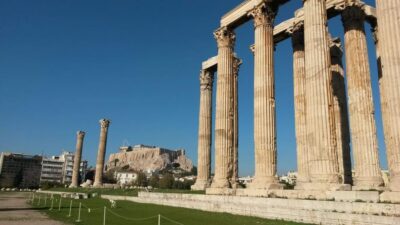
Athens Scenic Electric Bike Tour with optional Acropolis visit
Read our review →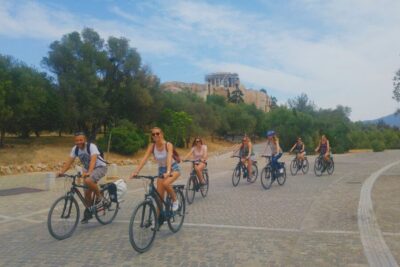
City Electric Bike Tour with Acropolis Visit Option
Read our review →
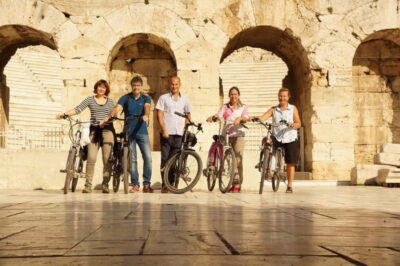
Historic Athens: Small Group Electric Bike Tour
Read our review →



Browse the lists this tour appears in